
Only 24% of Ugandans have access to basic sanitation, officials warn
Recent outbreaks of Mpox and Ebola have disproportionately affected urban informal settlements in Kampala, where overcrowding and limited sanitation infrastructure increase the risk of disease transmission.
Hajjat Sharifah Buzeki, the Executive Director of KCCA. (Credit: John Musenze)
________________
Only about a quarter of Ugandans have access to basic sanitation services, raising concern among health officials and development partners about the country’s ability to prevent disease outbreaks and improve public health.
The warning was highlighted during the launch of National Sanitation Week 2026 in Kamwokya, Kampala, on Monday (March 16). The event was organised by the Environmental Health Department under the Ministry of Health in partnership with the Kampala Capital City Authority (KCCA) and other stakeholders. The week-long campaign is being held under the theme "Accelerating Safely Managed Sanitation for a Healthy Uganda."
According to Dr Robin Nandy, the UNICEF country representative in Uganda, the country still faces major sanitation challenges despite years of public health campaigns and investments.
“As per the WHO and UNICEF Joint Monitoring Programme 2024, access to basic water supply stands at 63% in Uganda, while access to basic sanitation stands at only 24%,” Nandy said.
He added that access to safely managed water and sanitation services is even lower, standing at about 18% and 20% respectively, particularly affecting rural communities and urban informal settlements.
Public health experts say the sanitation gap continues to expose millions of Ugandans to preventable diseases. Poor sanitation and hygiene are closely linked to outbreaks of diseases such as cholera, dysentery and diarrhoea.
Nandy said diarrhoea alone remains one of the leading causes of child deaths in Uganda.
“Diarrhoea, one of the three major childhood killers, claims the lives of 33 children every day in the country,” he said.
He noted that poor sanitation also contributes to chronic malnutrition and affects children’s growth and development. In some parts of the country, the situation is particularly severe. In the Karamoja sub-region, more than 60% of the population still practises open defecation, the highest rate in Uganda.
The region also has some of the highest levels of child malnutrition, with an estimated 41% of children affected by chronic undernutrition. Health experts say improving sanitation could significantly reduce disease burden and improve child health outcomes.
Sanitation also plays a key role in preventing disease outbreaks. According to Nandy, infectious diseases such as cholera, Ebola, COVID-19 and Mpox spread more easily in communities where sanitation and hygiene services are inadequate.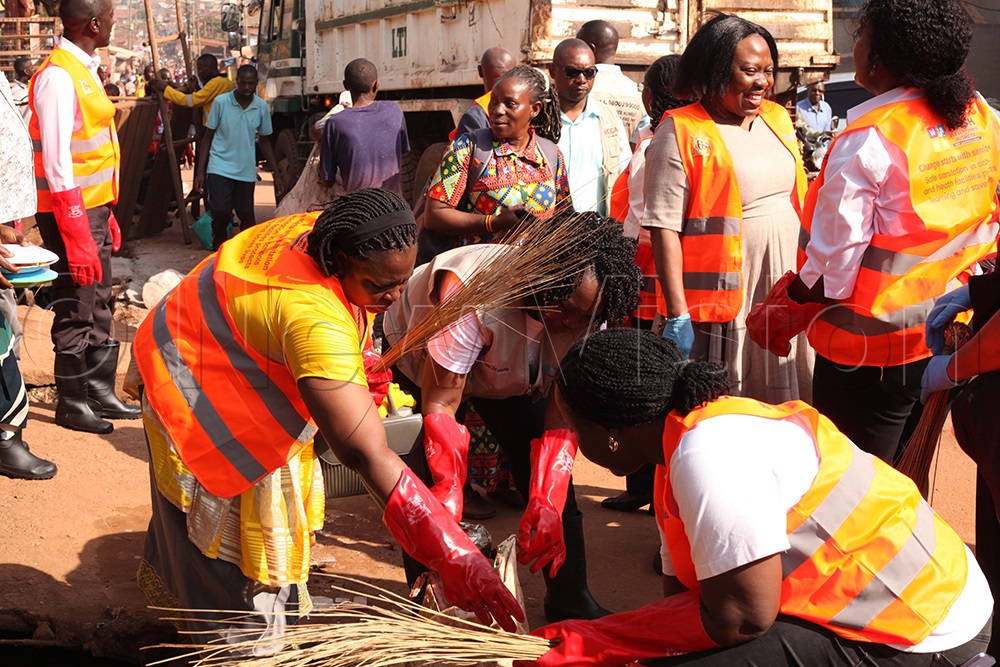
KCCA cleaners and officials cleaning Kamwokya parish 1. (Credit: John Musenze)
Recent outbreaks of Mpox and Ebola have disproportionately affected urban informal settlements in Kampala, where overcrowding and limited sanitation infrastructure increase the risk of disease transmission.
Officials said improving sanitation facilities in schools and health centres is also critical for protecting vulnerable populations.
The UNICEF country representative also said the lack of adequate sanitation in schools has been linked to increased absenteeism, particularly among girls. He added that providing proper sanitation facilities can improve school attendance and help reduce early marriages and teenage pregnancies.
Sharifah Buzeki, the executive director of KCCA, emphasised that sanitation goes beyond infrastructure and is essential for protecting human dignity and public health.
“Sanitation is more than infrastructure. It protects lives, it protects dignity and builds healthier communities,” she said.
Buzeki noted that KCCA has been implementing several initiatives to improve sanitation in Kampala, including expanding public sanitation facilities and promoting proper waste management practices.
She said the city has constructed 51 modern public sanitation facilities in markets and other public areas, some of which residents can use free of charge. The authority is also working to expand access to sewer connections and improve faecal sludge management in the city.
According to KCCA data, safely managed faecal sludge collection in Kampala has increased from 54% in 2015 to 65% by the end of 2025, with a target of achieving full coverage by 2030.
However, KCCA officials said many households remain unconnected to the national sewer network, forcing them to rely on on-site sanitation systems such as pit latrines. Buzeki urged residents to take responsibility for proper waste management, warning that poor sanitation practices can place a heavy burden on the health system.
“If we do not invest in proper sanitation and waste management, we end up paying much more in medical bills when diseases spread,” she said.
Dr Herbert Nabaasa, commissioner for environmental health at the Ministry of Health, said improving sanitation remains one of the most effective ways to prevent disease.
“About 75% of diseases are preventable through simple measures such as good sanitation and hygiene,” he said.
Nabaasa said the government is working with multiple agencies and development partners to strengthen sanitation policies and expand access to safe sanitation services across the country.
He added that the Ministry of Health is also working with Parliament to ensure that sanitation and hygiene are prioritised in national development plans.
Officials said increased investment, stronger community engagement and behaviour change campaigns will be critical to improving sanitation coverage in Uganda and reducing preventable disease outbreaks.