
Mulago receives keyhole hydrocephalus surgical equipment worth sh191m
The equipment allows surgeons to navigate deep brain structures through tiny keyhole-sized openings, while improving recovery times and reducing scarring compared to traditional surgery.
The executive director of Mulago National Referral Hospital, Dr Rosemary Byanyima (4th right), receiving the laparoscopy tour from the medical team from CURE Uganda hospital. (Credit: Agnes Kyotalengerire)
___________________
Mulago National Referral Hospital has received keyhole surgery equipment (neuroendoscopic tour) to aid modern treatment of hydrocephalus.
The equipment worth sh191m ($54,000) was donated by Mbale City-based CURE Uganda Hospital.
Mulago Hospital Executive Director, Dr Rosemary Byanyima, described the equipment as robust and said that it will serve the facility well.
Dr Byanyima further noted that the facility needs more similar equipment to meet the needs of patients grappling with Hydrocephalus.
Mulago Neurosurgeon, Dr Paul Okiror, said the equipment allows surgeons to navigate deep brain structures through tiny keyhole-sized openings, while improving recovery times and reducing scarring compared to traditional surgery.
CURE Uganda programme manager, Joshua Menya, said the partnership gives them confidence knowing that children who walk through the gates of Mulago Hospital will access this modern treatment, considering that previously, children grappling with hydrocephalus were treated using the shunt.
A shunt treats hydrocephalus by surgically implanting a flexible tube, or catheter, into the brain's ventricles to drain excess cerebrospinal fluid and relieve pressure.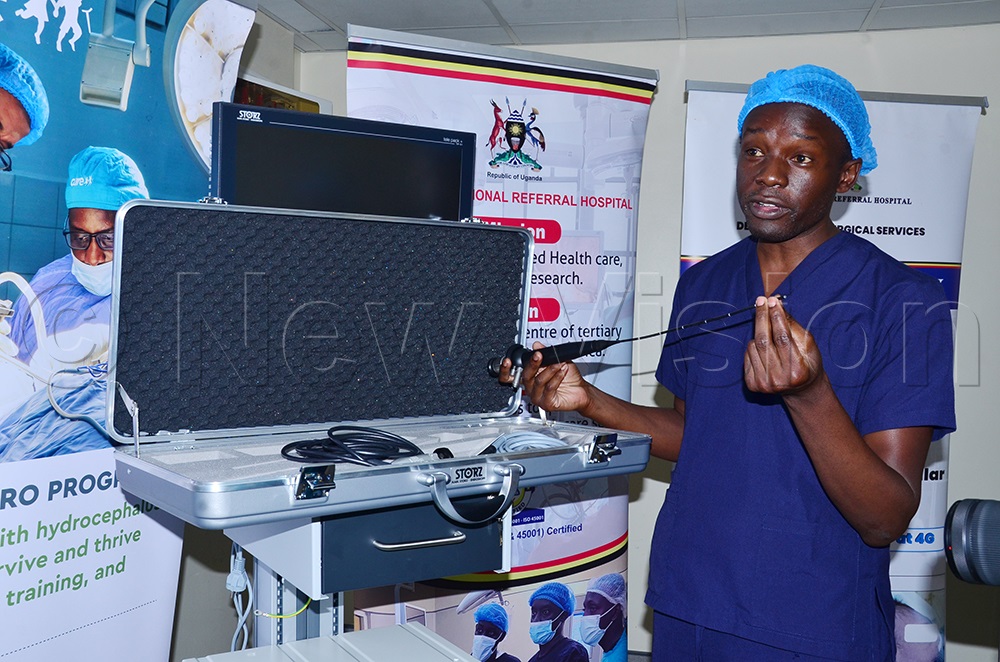
Dr Paul Okiror, Neurosurgeon, Mulago, explaining how the equipment works. (Credit: Agnes Kyotalengerire)
Paediatric neurosurgeon at Mulago Hospital, Dr Juliet Nalwanga, said the equipment comes in handy given the big patient number.
Dr Nalwanga estimated that every year, the hospital treats a total of 3,000 people (children and adults inclusive) suffering from hydrocephalus.
Understanding hydrocephalus
Hydrocephalus, often called "water on the brain," is a condition characterised by the abnormal build-up of cerebrospinal fluid within the ventricles or cavities deep inside the brain.
This accumulation causes the ventricles to enlarge and increases pressure inside the skull, which can damage brain tissue. It can be congenital (present at birth) or acquired later in life due to injuries, tumors, or infections.