
Luwero hypertension patients get creative with drug banks
“We have been advised to form a group and contribute as low as sh1,000 and sh5,000 to buy medicines to cover up for the days when the drugs at the facility run out of stock,” Nakibuuka says.
Fridah Nabadda, a clinical officer at Katikamu health center III checking the patient's blood pressure during routine clinic on Thursday. (Photos by Agnes Kyotalengerire)
________________
Hypertension patients in Luwero district are failing to adhere to their treatment due to a shortage of drugs.
Fridah Nabadda, a clinical officer at Katikamu Health Centre III in Luwero district, says the facility records more patients battling against hypertension compared to the amount of medicines the facility receives.
“The medicine supply is inadequate. For instance, today we have distributed all the medicine to the patients because we cannot send the patients back without drugs,” she says.
Nabadda says on the clinic days that happen every Thursday, they record 20 patients battling non-communicable diseases (NCDs) - the majority are women.
Nabadda says often the drugs are not enough and they have to distribute them in a phased manner to allow every patient to get some.
“Patients end up getting drugs to last them just three days instead of a week. This does not make economic sense considering the transport costs incurred (to go pick the drugs),” Nabadda says.
To ensure timely access, Nabadda says they are encouraging patients to form groups and choose a leader and treasurer responsible for collecting and keeping the money. “Once the drugs are bought, the group leader keeps them until the clinic day, when it is distributed to members who contributed money.”
Nabadda says patients have embraced the idea and have already contributed sh70,000. Nabadda is optimistic that other patients will join the group later.
Seventy-eight-year-old Kevin Nakibuuka travels a distance of 5km from her home in Bukeka village, Katikamu South, to pick her refill of blood pressure medication from Katikamu health center III. On average, she spends sh6,000 for this exercise. Due to inadequate drug supply, sometimes Nakibuuka fails to get a full dose of medicines to last her a month until her next refill date.
Fridah Nabadda, a clinical officer at Katikamu health center III sensitising hypertension patients during routine clinic on Thursday.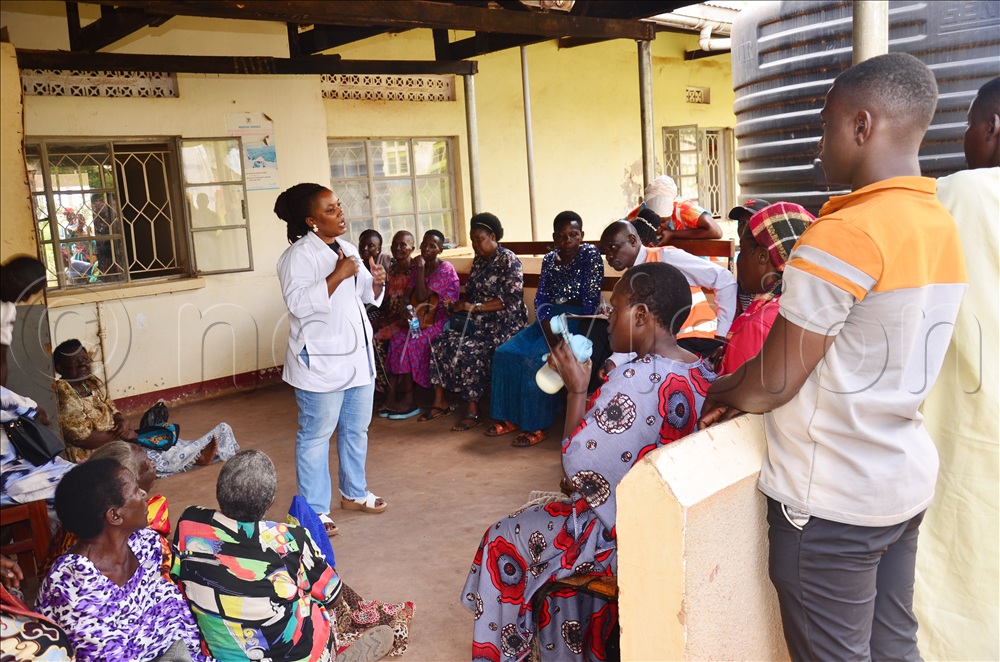
“Sometimes, I fail to get high blood pressure medicine, and I have to buy it from pharmacies,” she says.
The regular stock-outs become costly and inconvenient for Nakibuuka, considering that the money spent on transport and buying drugs, could have been invested on other economic ventures.
Another patient, Martia Byekwaso and resident of Bufumbanswa in Wobulezi, Luwero district, has battled with hypertension for the last eight months. Byekwaso often fails to access medicines from Katikamu Health Centre III in Wobulenzi. He is compelled to buy it from pharmacies.
Embracing the medicine bank
Margaret Nanyanzi, 67, of Kikasa village, confirms the development. Nanyanzi, who gets her refills from Bukalasa Health Centre III in Wobulenzi town council, says they have formed a group comprising 20 people. The members have decided to contribute sh2,000 a month. In the event that the health facility runs out of drugs, they can buy medicines for themselves and even for members who cannot afford them.
“We have been advised to form a group and contribute as low as sh1,000 and sh5,000 to buy medicines to cover up for the days when the drugs at the facility run out of stock,” Nakibuuka says.
Health ministry speaks out on diabetes drug banks
Government's medicine is not enough. To bridge the gap, the assistant commission Non-Communication Diseases (NCDs) at the Health Ministry, Dr Gerald Mutingi, says the NCDs department is encouraging patients on chronic care for hypertension and diabetes to form associations or clubs so that they can contribute money to access quality drugs at a lower price, other than going to the pharmacy to buy them expensively.
“It is an initiative we are aware of and we are encouraging it,” Dr Mutungi notes.
The burden
Hypertension is often regarded as a “silent killer” because many people live with it unknowingly if left untreated, hypertension leads to heart attacks, strokes, kidney failure, and sudden death.
Globally, hypertension affects more than 1.2 billion people. In Africa, nearly 1 in every 3 adults lives with hypertension. Here in Uganda, studies show that about 26% of adults have high blood pressure, which means at least one out of four adults is likely to be hypertensive.
The worrying bit is that majority of these people do not know they have the condition, because it often has no symptoms until it is in advanced stages.