
Inside Manafwa parents’ struggle to raise neurologically challenged children
“When Brighton made six months, I realised that something was wrong with him; he was not developing like other children. He has never sat, crawled or walked. He is always lying down. Doctors referred me to Mbale Hospital, but I did not have enough money to cover the bills."
A group of parents and their children, most of them with health complications, wait for visiting health professionals from Nairobi, Kenya. (Photo by Sam Wakhakha)
________________
At 11:00am in Bushakiro village, Bushakiro parish, Butiru sub-county, near the compound of New Dawn Primary School, a group of parents and their children, most of them with health complications, wait for visiting health professionals from Nairobi, Kenya.
In this crowd of about 200 are fathers and mothers with different parenting struggles. Some are changing their teenage children’s diapers, while others are struggling to restrain mentally unstable children from going haywire.
Seated at the back of the room is 19-year-old Evelyne Mukite with her three children. The youngest tries to play with the eldest, Brighton Bwayo, who is lying down on a mat. Despite provocations from his brother, Bwayo remains still and drooling.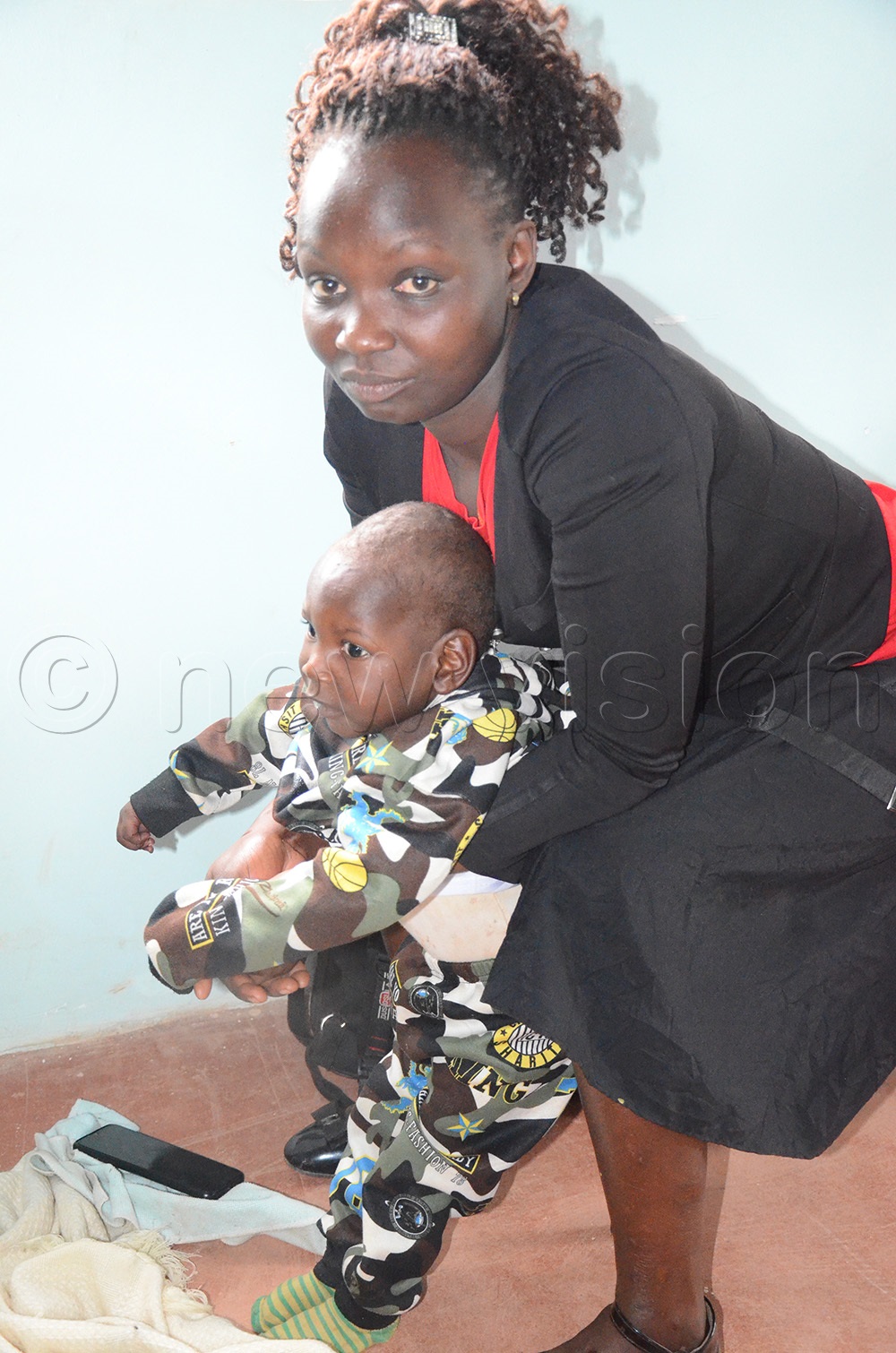
19-year-old Evelyne Mukite with her child, Brighton Bwayo, who suffers from a nuerologicl condition. (Photo by Sam Wakhakha)
In an interview with New Vision, Mukite explains the history of her son’s condition.
“When Brighton made six months, I realised that something was wrong with him; he was not developing like other children. He has never sat, crawled or walked. He is always lying down. Doctors referred me to Mbale Hospital, but I did not have enough money to cover the bills. So, I am here stuck with him,” she says.
Bwayo’s condition has also turned Mukite into a single mother at a tender age of 19.
“When his father discovered that he had a health problem, he abandoned us and went to Kenya, where he started another family. It was not long before my in-laws also sent me away from their homestead. They said I was becoming a burden because their son [Bwayo’s father] was not remitting money to take care of us,” Mukite explains.
Mukite is now jobless and depends on well-wishers in Lwanda village, Busumbu sub-county in Manafwa to feed her children.
Next to Mukite is Aaron Namawa. At 16, Namawa can be mistaken for a four-year-old, yet according to Bugisu culture, he should have undergone circumcision, a traditional rite of transition to adulthood. He suffers from a condition that makes him look like a child. He neither walks nor talks and is always under the watch of his father.
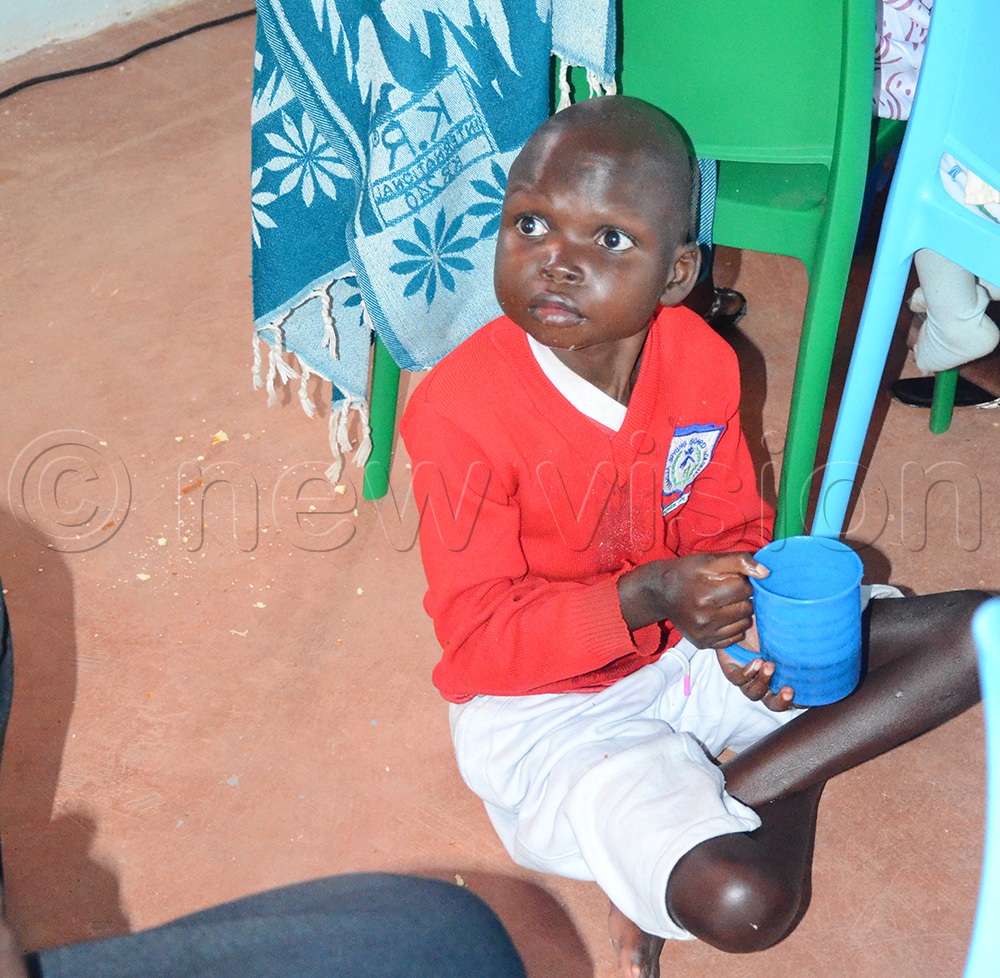
16-year-old Aaron Namawa taking porridge. (Photo by Sam Wakhakha)
“He [Namawa] needs me for everything. I help him in all aspects of life, including eating or easing himself,” Namawa’s father, told New Vision, during a health camp late last year. He was among the hundreds of people who had turned up for a health camp at New Dawn International Hidden People’s Home in Manafwa district. The facility is the only home for physically challenged people in eastern Uganda.
The home mainly deals with children with Celebral palsy, Spinal bifida, Autism, epilepsy and hydrocephalus.
“These conditions are misunderstood in communities. Many people think such children are possessed by demons yet these are mainly neurological conditions. We have slowly changed attitudes and made communities understand that these are health challenges that require professional solutions. We have partnered with organisations like Cure Children’s Hospital to help some of the parents and children, but a huge task still lies ahead,” Doreen Nakami, the facility’s country director, says.
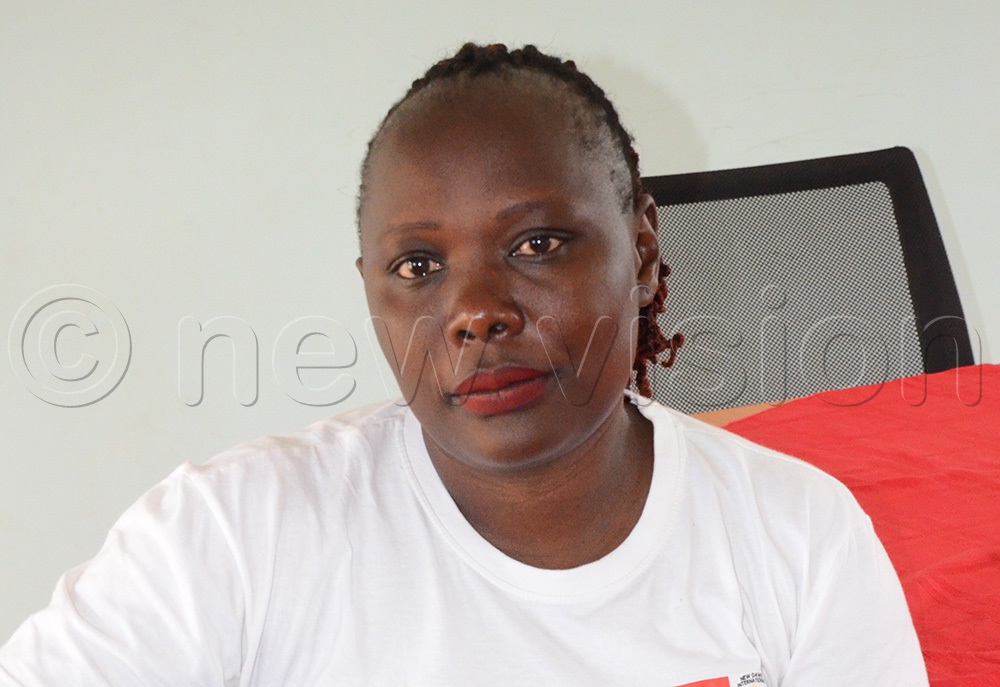
Doreen Nakami, the home's country director. (Photo by Sam Wakhakha)
Namawa’s father said that when his son made two, he noticed that something was wrong with him. His agemates crawled, walked and ran while Aaron hardly sat on his own.
“Some of his agemates have since been initiated into adulthood through circumcision, yet here I am stuck with him like a baby. I have tried all sorts of hospitals, without success. Now I need help in form of diapers and a wheelchair to help Aaron move around,” the father stated.
Seated next to Namawa was another parent with an equally sad story. Sylvia Namutosi, resident of Bunabwana village in Masaka town council, Manafwa district, was with her 11-year-old grandson, Joel Maumbe. Namutosi says at 11, Maumbe can neither walk nor talk.
“He cannot even ease himself well. It is common for Joel to soil himself, especially when I lock him in the house to attend to other needs,” she says.
Namutosi says her daughter gave birth to Joel during her first marriage, and when the husband realised that the child had health challenges, he left her.
“My daughter returned home with him [Maumbe] after the husband abandoned her. After sometime, she also left him with me for another marriage. Sometimes, we are forced to tie him with ropes as a form of restraint,” Namutosi says.
Since his mother left, Namutosi’s life has changed drastically.
“I have less time for work yet I have to earn money for our basic needs,” Namutosi, who does menial work on the neighbours’ farms for a living, says.
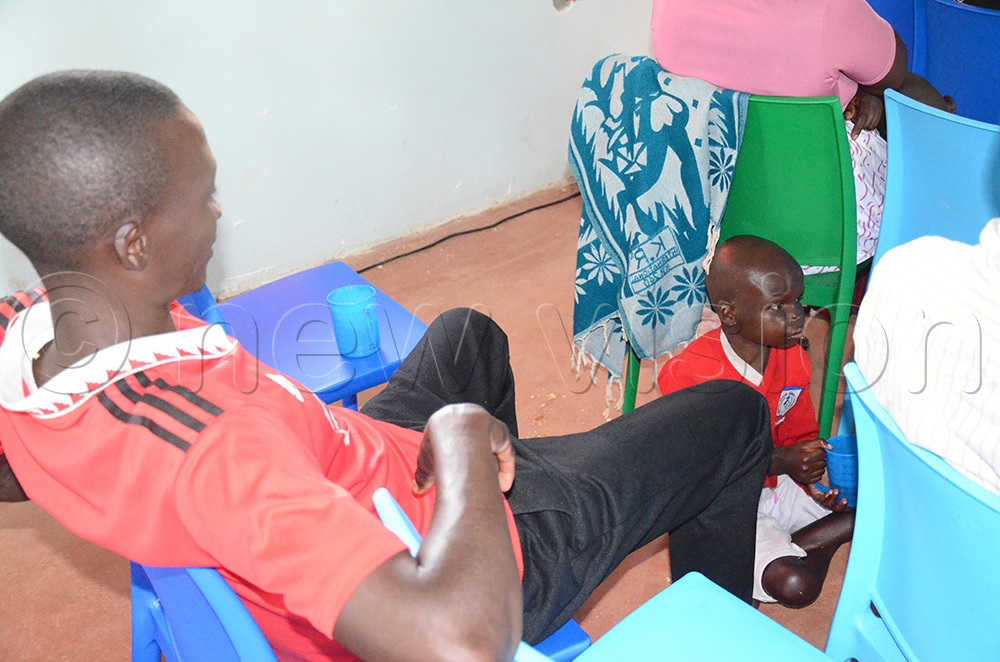
16-year-old Aaron Namawa (sitted down) with his father. (Photo by Sam Wakhakha)
Namutosi says she usually leaves him [Maumbe] with his cousins, but they distance themselves from him because he is also hostile to them.
Namutosi is a rural woman of humble means who is unable to take her grandson to medical specialists for treatment.
“At the moment, I need specialists to examine my grandson to see if there is any form of remedy that he can get. I want to also be free from being around him. A wheelchair and diapers will also be of great help,” Namutosi pleads.
For Eric Job, life has been one hell of a hardship. He is about 12 years old, but still in top class.
Despite being a man of humble means, his father, Yolamu Oridi of Bukhadala village in Manafwa district, says he will never give up the dream of seeing his child live like any other normal person.
“Job was born with a big swelling on the back. I have visited many hospitals, both in Manafwa and Mbale city, with little improvement. Initially, he could not walk, but at the age of six, health workers trained him, and he walked, but with difficulty. In 2016, he underwent surgery, but the health challenges persisted. I have spent over sh1m on treatment,” Oridi says, with visible sadness on his face.
He explained that despite his meagre earnings from tilling the land, he buys for his son diapers and takes him to school.
“He has no control over his bowels. In class, his diapers sometimes get full, and he is forced to go out and change them. He does not mix with his friends. In fact, they have dedicated a special corner for him,” Oridi says.
As Peter Mucheru, who led the six-member medical team from Kenya, wore gloves to examine the children, he knew their services would be a drop in the ocean in the rural community.
“About rehabilitative health, today we saw that there is a huge gap. There is a lot of work that needs to be done,” he said.
Mucheru’s team was among the many that always visit New Dawn International, the only hidden people’s home in eastern Uganda.
Nathan Namatati, the home’s co-founder, thanked the visiting team and called for more effort to support and rehabilitate people who need rehabilitative care.
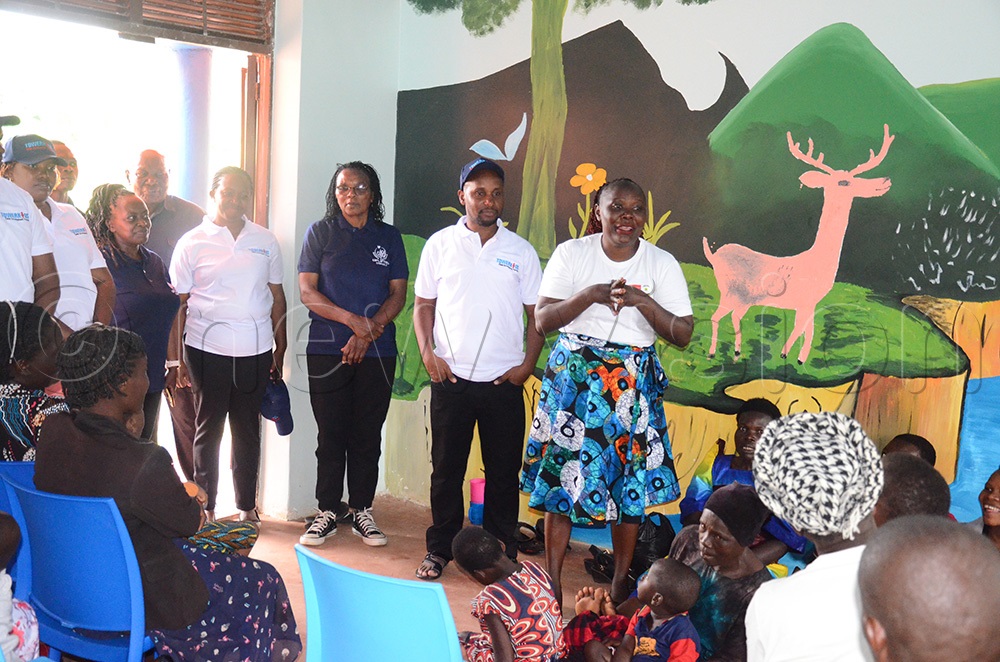
Doreen Nakami, the facility's country director, introducing the visiting team from Kenya to the parents. (Photo by Sam Wakhakha)
“People used to keep such children in hidden places for fear that they would bring them shame. Through sensitisation, however, they are now being accepted as members of families. We are also working with partners such as Cure International Children’s Hospital in Mbale to extend services to these people,” he said.
Namatati, a Ugandan living in the UK, founded the home with his wife Sonya in the year 2021.
“So far, it has extended services such as medical assessments, assistive devices like child protection chairs and wheelchairs, physiotherapy, speech therapy and occupational therapy. The caregivers have also received counselling services to change mindset and build acceptance of such children in communities. We also help such children get referrals to health facilities. We also do community outreaches to fight stigma,” he says.