
Criminal justice sector in renewed fight against HIV, TB and Malaria
The Fund has so far disbursed shillings five billion to support the Criminal Justice System in Uganda in mitigating the effects of HIV, TB and Malaria.
Dr Benard Ndiwalana (Left), the head of clinical services at the Uganda Police, with Festo Nsenga (Middle), the high court registrar, and Barbra Msinde, the program coordinator in the office of the DPP, speaking to the press. (Credit: Doreen Musingo)
________________
JINJA - The criminal justice sector (CJS) of Uganda has stepped onto the front line of the national response to HIV, tuberculosis (TB) and malaria, backed by critical support from the Global Fund.
Once seen only as an enforcer of law and order, the sector is now emerging as a key partner in public health protection.
The Uganda Prisons services, Uganda Police Force detention centres, and remand facilities have long been recognised as high-risk environments for the spread of infectious diseases due to overcrowding and limited access to healthcare.
However, after recognising these challenges, the CJS, in collaboration with the health ministry, with funding from the Global Fund have embarked on a comprehensive disease prevention and treatment programme across correctional facilities.
“Let me start by acknowledging the support from the Global Fund to Uganda as a country in the fight against HIV, Tuberculosis and Malaria, which have plagued us for decades,” Inspectorate of Courts deputy registrar Festo Nsenga says.
Nsenga adds that because of the effects of HIV, TB and Malaria on human capital development, the Government is making deliberate efforts to minimise their effects by 2030.
Nsenga made the remarks while closing a one-week orientation workshop for officials of the Program Management Unit (PMU) of the CJS, headed by the office of the Director of Public Prosecution (DPP), the Police, Prisons and various stakeholders at Nile Village Hotel in Jinja city.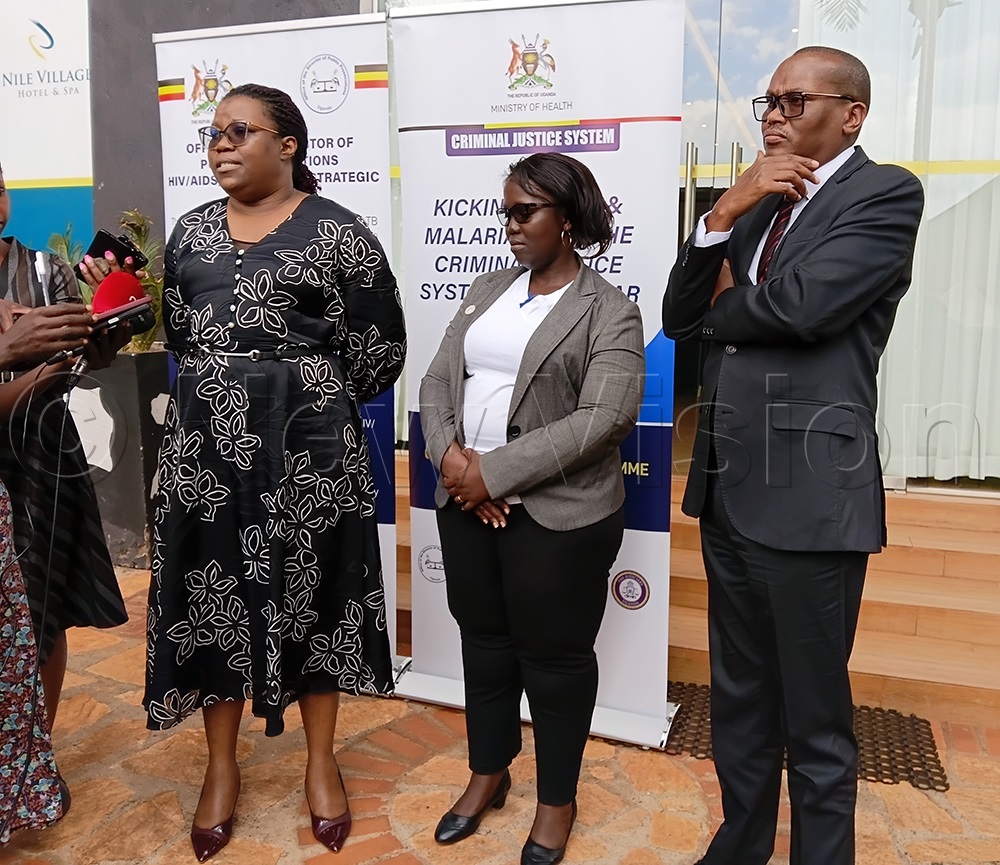
Justice Barbra Masinde (Left), the program coordinator in the office of the DPP, and to the right is the deputy registrar, Festo Nsenga, speaking to the press after the closure of the meeting. (Credit: Doreen Musingo)
“These efforts are targeting everyone using a whole government/multi-sectorial approach, including the CJS, thus leaving no one behind,” he said.
Nsenga said the health ministry came on board after realising that, while the DPP carries out its constitutional mandate, there is a gap in the respect and promotion of people’s rights, specifically the right to health, during their interaction with the criminal justice system.
“This has given birth to the ‘Breaking Down Barriers (BDB) initiative, whose overall aim is to be cognizant and address the barriers curtailing the full realisation of people’s rights, particularly key and vulnerable populations, including people in Police and prison detention,” he said.
He explained that the major role of the Program Management Unit is to ensure the DBD initiative is successfully implemented and embedded in the criminal justice sector processes.
Barbra Masinde, the Global Fund Coordinator in the Office of the DPP, said the Fund has so far disbursed shillings five billion to support the Criminal Justice System in Uganda in mitigating the effects of HIV, TB and Malaria.
She said the Office of the DPP started implementing the programme way back in 2018 after what was then referred to as the New Funding Model. She explained that the criminal justice sector was brought on board after a baseline survey report, which indicated an impediment on people’s access to their rights and specifically the right to health.
“Whereas we are responsible for the rights to justice in all our different sectors, it was noted that in dispensing our individual mandates, we affect people’s rights across specifically the rights to access to health, which we have now taken up through this initiative,” she said.
Masinde said major health challenges in correctional facilities were beyond individual institutions, citing inadequate funding amidst competing government priorities, adding that structural issues like small cells at Police stations and prisons pose significant hurdles.
“Efforts are underway to mitigate these challenges by working to establish isolation rooms for suspected individuals, which will help prevent the spread of these diseases and ensure that those who are sick receive the care they need,” she said.
Dr Bernard Ndiwalana, the head of clinical services of the Uganda Police, said the intervention at all facilities was aimed at identifying people who may be suspected of having been infected by either TB or malaria and will be done through a decentralised screening by non-medical personnel in the police, prison and judiciary.
“We are training non-medical personnel to screen for HIV, TB and malaria following the Standard Operating Procedures (SOPs) signed by the Inspector General of Police (IGP), which will enable us to identify potential cases early and refer them to health facilities for further management. Those found to be on treatment will be maintained, thereby improving access," she said.
She added that the country aims to eliminate HIV as a public health threat by 2030, with targets set by the Joint United Nations Program on HIV/AIDS known as 95-95-95 rate.
As the DPP’s office continues to prioritise health issues in correctional facilities in Uganda, it is clear that addressing HV, TB, and malaria is not only a health imperative but also a justice matter.