
AI-powered tools transform TB detection in Uganda
Village Health Teams (VHTs) and community health workers previously struggled with bulky paper-based systems. They carried large volumes of paperwork, which could easily be damaged by rain or lost, making it difficult to retrieve information.
(L-R) Dr. Henry Luzze, Jihee Ahn KOICA Country Director and Dr. Achilles Katamba interacting after a dissemination meeting at Hotel Africana. (Photo by Violet Nabatanzi)
_________________
A recent study has shown that adopting digital technologies in tuberculosis (TB) screening improves efficiency and service delivery.
Village Health Teams (VHTs) and community health workers previously struggled with bulky paper-based systems. They carried large volumes of paperwork, which could easily be damaged by rain or lost, making it difficult to retrieve information.
Dr Achilles Katamba, a senior lecturer in the Department of Medicine, College of Health Sciences at Makerere University, said during a dissemination meeting on Re-Imagining TB Care (RTC) in Uganda that the project also introduced an artificial intelligence-powered chatbot designed to support Community Health Workers in their daily tasks. The chatbot provides guidance and answers questions.
The RTC project aims to transform when, where and how TB services are accessed and delivered in Uganda. It focuses on bringing integrated TB care services such as screening, treatment and prevention as close as possible to communities.
The project is implemented by the World Alliance for Lung and Intensive Care Medicine in Uganda (WALIMU) and the Uganda National Tuberculosis and Leprosy Control Programme (NTLP).
He added that to ensure accessibility, the tool was translated into four local languages, Lumasaba, Lusoga, Luganda and Runyankore, reflecting the regions where the project was implemented.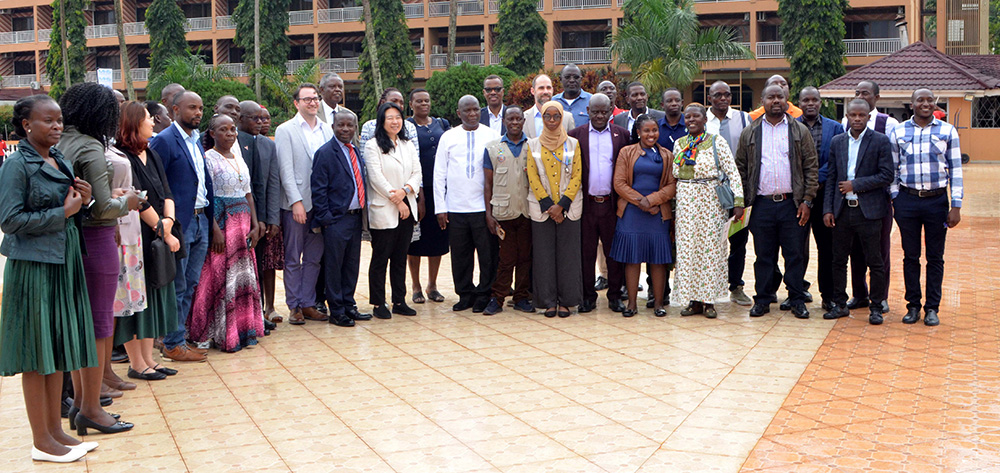
Dr. Henry Luzze, Jihee Ahn KOICA Country Director and Dr. Achilles Katamba (C) and other guests take a photo after the dissemination meeting at Hotel Africana. (Photo by Violet Nabatanzi)
Speaking on April 22, 2026, Katamba said this innovation has boosted the confidence and credibility of VHTs within their communities. “They are now more knowledgeable and respected because they can provide accurate information instantly,” he said.
Aloysius Musuza, a VHT, explained that the chatbot helped him understand that children can also contract TB and require treatment, information he previously did not know. Beyond answering single questions, the system offers broader, related guidance, making it a valuable learning tool.
However, Katamba emphasised the need for stronger infrastructure to fully harness digital health solutions. “As much as AI is a promising innovation, we must invest in power, internet connectivity, and supportive systems to enable its widespread use across different diseases and applications,” he said.
Uganda records an estimated 90,000 TB cases annually, with about 90% detected. However, about 8,000 cases remain undiagnosed each year. Among those diagnosed, about 92% successfully complete treatment.
The RTC project was conceptualised to shift from a top-down approach to a more community-centred model of healthcare delivery. Supported by the Centres for Disease Control and Prevention (CDC) and the Stop TB Partnership, with funding from the Korea International Cooperation Agency (KOICA), the project engaged communities to identify gaps in TB care.
Community members highlighted stigma as a key barrier and proposed integrating TB services with other health services, such as HIV and malaria. This approach allows health workers to conduct broader health talks rather than focusing solely on TB, which can discourage participation.
Another key recommendation was decentralisation, bringing services closer to communities instead of requiring patients to frequently visit health facilities.
The study was conducted across 34 clusters at the parish level in selected high-burden districts, with participants randomly assigned to either paper-based or digital methods.
Dr Henry Luzze, assistant commissioner of the National TB and Leprosy Programme at the Ministry of Health, Uganda, said the RTC project demonstrates how community-level interventions and digital technologies can address longstanding challenges in TB care.
He said the project shows that it is possible to screen, refer and follow up TB patients from the community level all the way to successful treatment.
‘’It strengthens the link between communities and health facilities,” he said.
Jihee Ahn, KOICA country director, cautioned VHTs already benefiting from the programme to use it effectively so that others in different regions can also have an opportunity to benefit from future programmes.