
Academia, researchers seek sh11.5b to scale up nutrition in schools
Of the required amount, UNICEF pledged sh600 million annually over the next five years towards implementation of the strategy.
Dr Peterson Kikomeko, a lecturer in the Department of Human Nutrition at Kyambogo University making his remarks. (Photos by Prossy Nandudu)
________________
Promoters of proper nutrition in schools and higher institutions of learning have launched an ambitious strategy aimed at promoting nutrition messages and research to improve nutrition outcomes across the country.
The strategy, titled Scaling Up Nutrition Academia and Research Institutions Network Uganda (SUN-ARINU), is valued at sh11.5 billion.
Under the strategy, researchers, academia and development partners will be mobilised to promote evidence-based nutrition messages. It also provides for the training of programme implementers to integrate nutrition considerations into their work, while facilitating the translation of research findings into national and sub-national policies.
The team leader of the strategy, Dr Peterson Kikomeko, who is also a lecturer in the Department of Human Nutrition at Kyambogo University, said during the launch on May 28, 2026, at the Kampala Serena Hotel, that the outcomes of the strategy will complement government efforts to build a healthy population capable of contributing to the Human Capital Development result area under the National Development Plan IV.
To fully realise the objectives of the five-year strategy, Kikomeko said sh11.5 billion will be required, with 50 percent expected from government, 30 percent from development partners, and the remainder from membership fees, research activities and other sources.
UNICEF country representative Robin Nandy said the organisation remains committed to supporting nutrition initiatives in Uganda.
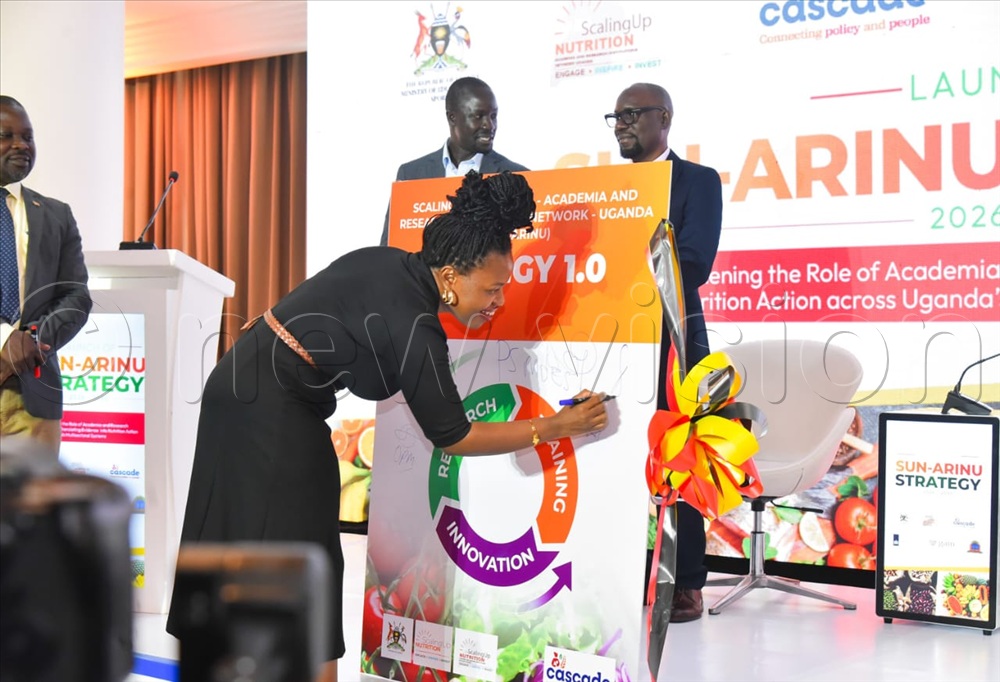
Damali Ssali, the Gain Country Director signing the strategy.
She said this conclusion is based on research and evidence generated so far. Additional findings from Kyambogo University indicate that for millions of Ugandans, healthy food remains out of reach.
“And that essentially means that we see the food we want to eat; however, it remains unaffordable for all of us. So, the strategy is at the centre because we also know that we focus more on undernutrition, but overnutrition is silently surpassing,” she said.
“The focus on overweight and obesity management should be addressed through networking, advocacy, innovation, and evidence generation, which is very critical as part of the strategy,” she added.
Nabisere noted that the strategy aligns with UNICEF’s systems approach across food, health, water and sanitation, education, and social protection systems, which seeks to address all forms of malnutrition.
Explaining the importance of the strategy, Damali Ssali, the country director of the Global Alliance for Improved Nutrition (GAIN), one of the promoters of the initiative, said it underscores the importance of evidence-based research in guiding interventions.
“We are really happy about the launch of the SUN-ARINU strategy because we do not do any intervention where we don't have evidence. So, we are really happy that academia, universities, and all research institutions in Uganda have come together with a strategy we are going to focus on,” Ssali said.