
New resource book launched to address rising succession cases in Uganda
The book provides guidance, practical insights, and a structured understanding of the principles and procedures governing succession matters.
Principal Judge Justice Jane Frances (third left) and the Uganda Law Reform Commission staff in a group picture at the launch of the succession resource book. (Photos by Isaac Nuwagaba)
________________
The Uganda Law Reform Commission has launched a new Succession Resource Book aimed at equipping legal officers with the necessary tools to tackle the reportedly growing number of succession law cases in the country.
The book provides guidance, practical insights, and a structured understanding of the principles and procedures governing succession matters.
Jackie Akuno, the commission's secretary, said succession law is a complex field that requires precision, sensitivity, and a deep understanding of legal principles.
“Succession law lies at the intersection of legal doctrine, human relationships, and societal values, shaping how wealth and property are transferred across generations,” she said during the launch at the Supreme Court in Kampala.
Akuno told reporters that the book offers a comprehensive and authoritative guide to succession law, covering key legal concepts, procedural guidelines, and relevant case law.
“Its user-friendly format makes it an invaluable tool for judicial officers, legal practitioners, and academics seeking to enhance their understanding and improve efficiency in case handling.”
Principal Judge Justice Jane Frances interacting with a judicial officer while attending the launch of the succession resource book in Uganda. 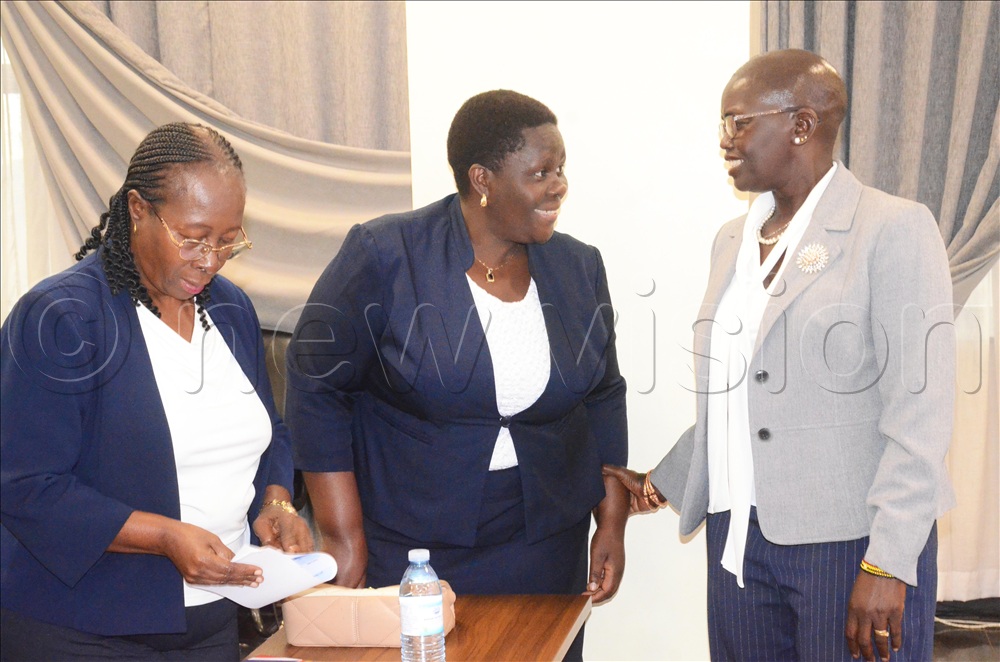
Principal Judge Justice Jane Frances Abodo was the chief guest at the launch of the book.
“It aims to deepen understanding of legal principles, support sound decision-making, and promote consistency and fairness in judicial determinations,” she said.
The work is a result of collaborative efforts between judicial officers, legal practitioners, academics, and legal experts who shared their knowledge and experience to advance the study and practice of succession law.
Abodo expressed hope that the resource book will serve as a catalyst for informed decision-making, ethical practice, and effective administration of justice in succession matters, while fostering professional growth, legal scholarship, and the continued strengthening of the rule of law in Uganda.
Justice Elizabeth Jane Alividza, the president of the International Association of Women Judges - Uganda (IAWJU), said the succession law needs a keen eye due to the fact that it is shaped by a combination of customary practices, colonial legal heritage, constitutional principles, statutory reforms, and evolving jurisprudence.
She said disputes around succession often involve deeply personal and sensitive questions affecting widows, widowers, children, and other dependents.
“Historically, some customary norms and legal provisions have disadvantaged women and other vulnerable groups," she said.
"However, progressive constitutional interpretation and legislative reforms, including the Succession (Amendment) Act, 2022, have strengthened the principles of equality and non-discrimination in succession matters."
Still, succession cases remain numerous and frequently intricate, requiring judicial officers and legal practitioners to navigate multiple statutes, evolving case law, and procedural requirements.
According to Alividza, the absence of a consolidated and practical reference had contributed to delays and inconsistencies in handling succession causes.