
Kalangala’s adolescent mothers, GBV survivors undergo skills training
Badda said skilling is a very sustainable way of improving the girls’ lives, their babies and families.
Teenage mothers and GBV survivors were flagged off to different institutions. (Photos by Ritah Mukasa)
________________
For years, Kalangala district has been grappling with a high rate of teenage pregnancies coupled with sexual and gender-based violence (SBGV).
The Government and other stakeholders have stepped up and put several interventions in place to ensure that adolescent mothers complete their education or get skilled.
For that reason, 74 teenage mothers and GBV survivors were flagged off to different vocational training institutions in the districts of Masaka and Kyotera, where they will get skills in hairdressing, tailoring, computer studies and plumbing.
This is courtesy of the Heroes for Gender Transformative Action Programme (Heroes 4GTA). The six-year (2020–2026) Ugandan initiative is funded by the Kingdom of the Netherlands and Iceland embassy and implemented by Amref Health Africa, Cordaid, and MIFUMI, a women rights organisation.
While flagging off the teenagers on February 19, 2026, at the Kalangala district headquarters, Resident District Commissioner (RDC) Fred Badda said skilling is a very sustainable way of improving the girls’ lives, their babies and families.
Willy Nkumbi, the district senior probation and social affairs officer speaking during the event.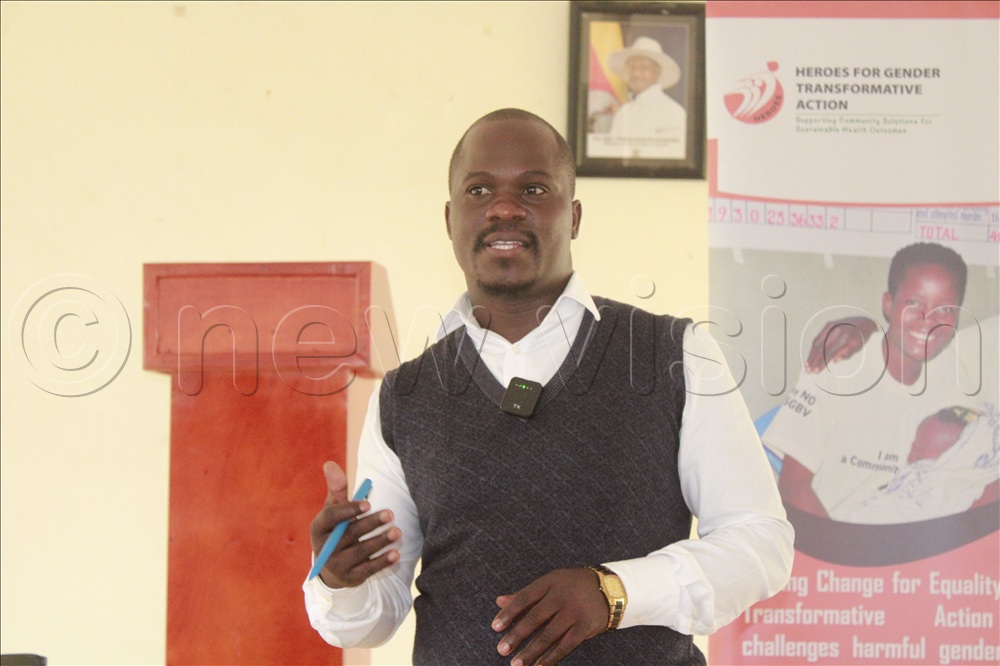
“The skills help them to forget the issues that pulled them down and instead, focus on turning their lives around,” he said.
Badda added, “We are hopeful that when these girls return later this year, they will be able to change their communities.” Upon graduation, the girls will become trainers. That way, they will pass on the skills to their peers and parents.
He also thanked the Heroes programme for not only spearheading the fight against teenage pregnancies but also SGBV and defilement over the past six years they have camped in Kalangala.
Improvement
On that note, district senior probation and social affairs officer Willy Nkumbi reported that the cases have reduced significantly.
For example, the teenage pregnancy rate has dropped from 32% to 19%. From 2021-2023, Kalangala recorded 60% prevalence of SGBV among women aged 15–49, with more than 30 cases being registered monthly. These have dropped to 20%.
Besides, defilement was widespread at 26%, with aggravated defilement (5-6 years) standing at 15% and 26% for girls between 14-17 years.
“Majority of these girls were defiled by older men,” Nkumbi said. And many perpetrators would get away with it. Currently, defilement stands at 22%.
Bufumira and Mugoye sub-counties were the most high-risk areas, according to Lucy Athieno, MIFUMI’s MERL (Monitoring, Evaluation, Research, and Learning) manager. She said communities can now identify, report and follow up cases.
Meanwhile, on how they chose the beneficiaries, Robert Bumba, the skilling co-ordinator, said they carried out due diligence and zeroed down to the neediest. He urged them to maximise the opportunity to transform their lives and their families.
Dorothy Nanteza, the mother of Mariah Nakigozi, one of the beneficiaries, thanked the donors, saying she has witnessed firsthand how teenage pregnancies shatter dreams.
“I gave birth to nine children but lost seven.”
For years, Nanteza held on to the hope that her surviving daughter Nakigozi, would complete school and turn the family’s fortunes around but fate had other plans. Nakigozi dropped out of school in Primary Five and is now a single mother at 16 years. “I pray that the hairdressing skills will enable her to provide for her baby.”
Kalangala’s population
Based on the 2024 National Population and Housing Census data, Kalangala, an island district, has a population of over 74,000 people. Of these, more than 29,000 are women representing 39%. Children (0-17 years) are 27,000.