
Woven in time: Exhibition celebrates Uganda's endangered mat-making tradition
Since mats are everywhere, and don’t need any special equipment to make, we take them for granted.
Guests get a crash course in mat-weaving at the Karibu Exhibition, Njabala Foundation, Nakwero, Gayaza. The exhibiion runs until March 31st, 2026. PHOTO: Kalungi Kabuye
Mats have for generations played a central role in homes in Uganda, especially in the central region. There were mats for different places, and mats for different occasions.
There were mats for the ordinary person, mats for members of the family, and mats for special guests. There were even special mats to be given out as gifts.
Since mats are everywhere, and don’t need any special equipment to make, we take them for granted. But with the onset of cheap, at times plastic, replacements, there is a very genuine fear that mats as we know them might disappear. Veteran artist Nuwa Nnyanzi insists that mat-making is the the solely genuine Ugandan craft we are left with. It would be a disaster if the craft got lost.
That is why I was excited on seeing the email from the Njabala Foundation announcing that this year’s exhibition is focusing attention to the ancient art of mat-making, traditionally done by women. While the weaving of mats from palm leaves is not exclusive to Uganda, the patterns and motifs shown are uniquely Ugandan.
The Foundation’s Karibu Project is ‘…committed to creating safe spaces for women artists to blossom’; and the exhibition ‘extends beyond conventional definitions of contemporary art, and foregrounds women’s creative labour across disciplines that have historically been rendered invisible, undervalued, or unnamed’.
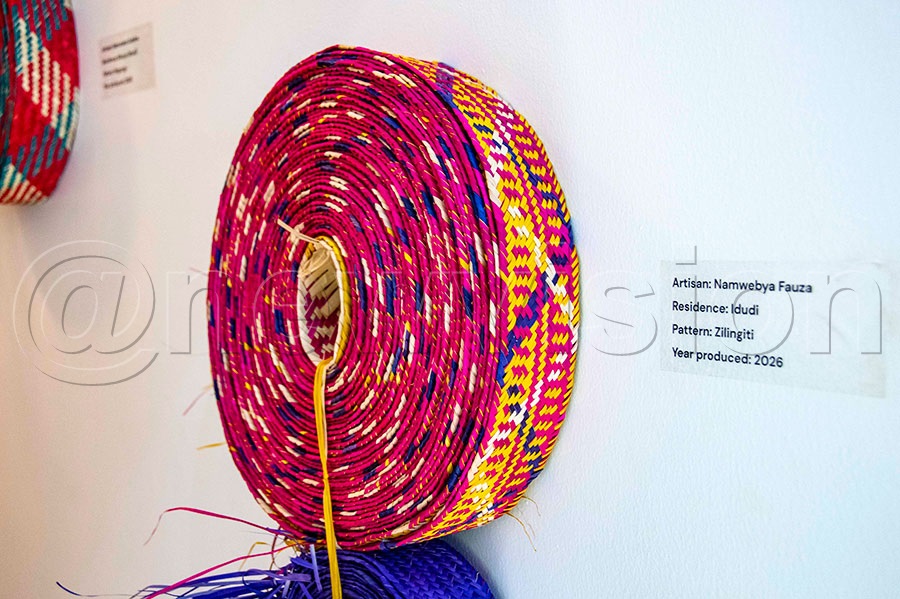
The 'zilingiti' mat pattern at the Karibu exhibion, Njabala Foundation, Nakwero, Gayaza, the exhibition runs till March 31st PHOTO: Kalungi Kabuye
The exhibition, which opened on Saturday and runs till March 31, has works from 16 women artisans from Iganga, and three contemporary artists from Njabala’s residency.
I have grown up with mats, but didn’t know that each particular pattern has a unique name, which signifies either the situation which gave rise to its creation, or what message the creator of the pattern wants to project. Thus, names like ‘zilingiti’ and ‘kabox’.
‘Mugongo’ (back-breaker) was a particularly popular choice of name, although different women created different patterns. There was also ‘kaguudo ka Railway’, inspired by the railway lines that go through the villages of Iganga.
Mat-weaving seems deceptively easy, but the guests who received an impromptu lesson discovered it is much more than just twisting bands of dried and dyed palm tree leaves together. Long strips are first woven, then they are sewn together to make the overall pattern. There is mathematics in foreseeing where the pattern lines will end up. And typically, each mat takes about a month to complete.
The Njabala Foundation has a new home, in Nakwero, just after Gayaza, and that is where the exhibition was held. Unfortunately, the opening ceremony started late, and my driver was afraid of the legendary Gayaza Road traffic jam. So, we left just after 6pm, but got caught up in it, anyway.
While the three contemporary artists (Darren Akoragye, Mary Diana and Olivia Namala) had a chance to talk about their creations, none of the artisans from Iganga did. I would have loved to hear more about the creation of the patterns and their inspiration. And I dare say there are probably patterns that have been handed down through generations, I would have loved to hear those histories.
While mats are traditionally for sitting on, these days there are more of decorative pieces. That could be a direction the artisans are encouraged to take.
There was no catalogue I could find. Maybe Njabala can do a more thorough job of identifying the different patterns, their stories and the individual women who made them.