Volunteer teachers keep learning alive in Napak
Efforts are supported by Save the Children, in partnership with Vision Group, publishers of New Vision, who provide newspapers to community schools free of charge to support classroom learning. Teachers are also trained on how to use the newspapers as tools to teach various subjects.
Teachers going through the New Vision newspaper to come up with a teaching plan. (Credit: Jacky Achan)
_________________
Teaching in Napak district, Karamoja, has increasingly become a voluntary role. Many teachers in community schools, waiting to be absorbed by the government, receive no pay or formal support. Yet, despite these challenges, some continue to step into classrooms whenever time allows, driven by their passion for educating children in their communities.
One such teacher is Gloria Sagal. She got her teaching certificate during the COVID-19 pandemic with support from Save the Children. The training allowed community members already involved in informal education to formalise their skills and improve their teaching methods.
However, since 2023, teachers holding certificates have been removed from the government payroll. The government now requires a minimum Grade III qualification for teachers to teach at the primary level, forcing many to divide their time between teaching and other work. As a result, teaching in many of these schools has largely become voluntary.
Sagal walks long distances from Kangole town to Longariama Community School, located on the Moroto Road, where she teaches English, science, social studies, art, and co-curricular activities to primary one and two students. The school has only two classes, and Sagal handles several subjects for the learners.
This is the reality for many other certificate-holding teachers in community schools across Napak district, where access to education often depends on the willingness of individuals to step forward and teach.
However, without a salary, many teachers must divide their time between teaching and other work to earn a living. “I go to school twice a week or even twice a month,” she says. “The rest of the time, I’m doing other things to earn a living because I’m not a paid teacher. I volunteer to teach.”
For these teachers, education continues largely because of personal commitment rather than institutional support. “The morale to teach is low,” Sagal says. “But we have continued to teach children voluntarily whenever time permits because we are passionate about teaching, even without support or payment from district authorities or the government.”
Their efforts are supported by Save the Children, in partnership with Vision Group, publishers of New Vision, who provide newspapers to community schools free of charge to support classroom learning. Teachers are also trained on how to use the newspapers as tools to teach various subjects.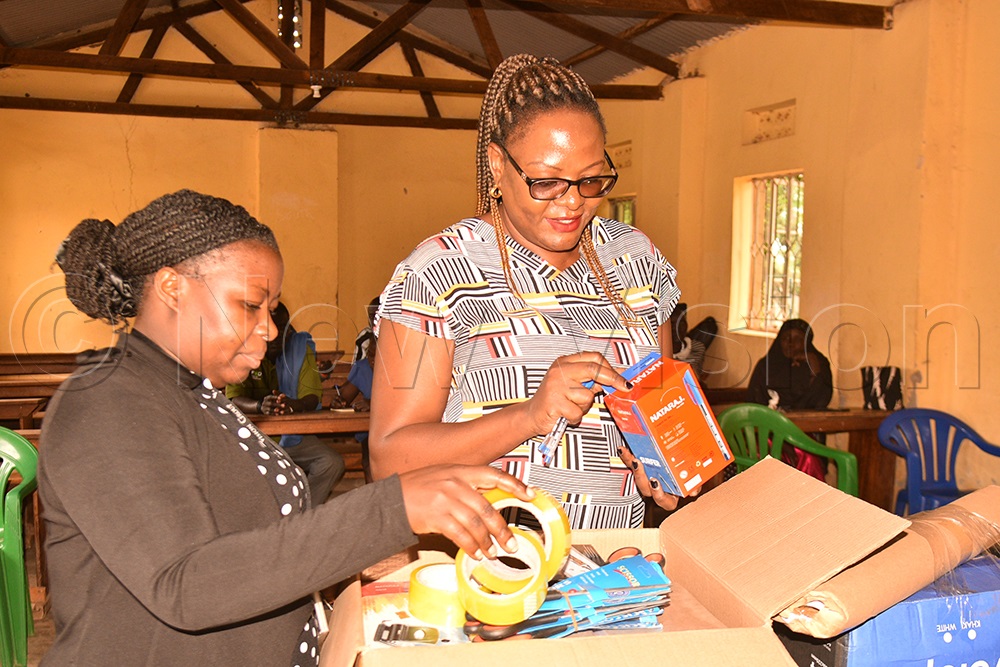
Esther Arinaitwe, Vision Group Newspaper in Education manager and Toto magazine editor, and Grace Nampiima, getting ready to train teachers in Napak in using newspapers in education. (Credit: Jacky Achan)
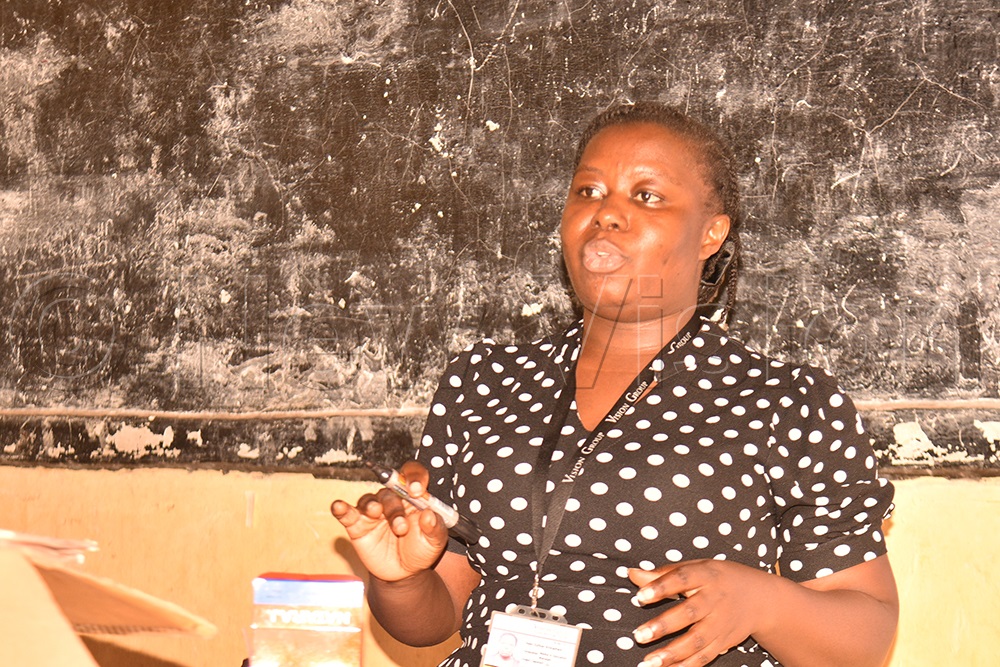
Esther Arinaitwe, Vision Group Newspaper in Education manager, training teachers in Napak to use Newspapers in Education. (Credit: Jacky Achan)
On Tuesday, March 3, 2026, at Kangole Boys Primary School in Napak, 23 teachers from different community schools received training on how to use newspapers to aid learning. This practice is embraced globally. Sagal was among the trainees.
“This continuous training on using newspapers for teaching is very relevant for us teachers in this area,” she says. According to Sagal, this was not her first time attending such training. “We keep learning. It’s adding knowledge.”
"The newspapers are used as learning tools because they contain fresh content daily and cover a wide range of subjects," says Esther Arinaitwe, Vision Group Newspaper in Education manager. "The material helps learners relate classroom lessons to real-life situations and inspires them to become responsible and successful citizens."
A collective effort
At Longariama Community School, Sagal who is the head teacher, works closely with Gabriel Lokee, the Chairperson of the School Management Committee. “He is a neighbour of the school,” Sagal explains. “When the newspapers are delivered, he picks them up and teaches the children.”
He is also a trained teacher and helps conduct lessons when Sagal is unavailable. Members of the Parent-Teacher Association occasionally step in to assist. “The children are always there,” she says. “The chairman of the school management committee is always there, and we even have play areas for the children.”
The use of newspapers has helped ensure that learning continues despite the shortage of formally supported teachers. Teachers agree that the newspapers contain educational content that can easily be turned into classroom lessons.
“When the newspaper is delivered, for instance, you get the Toto magazine for children and go straight to activities like matching words or even pictures,” Sagal explains. She says teachers guide pupils through activities such as matching words, filling in missing letters, and identifying numbers.
“The newspaper has so much information. All the subjects we teach are covered in the newspaper,” she says. Sagal states that teachers compare the newspaper’s content with the national curriculum to create lessons. “All we have to do is compare what is in the newspaper with what we have in the curriculum,” she says. “It’s a great tool helping us to teach. It keeps us active.”
Lessons beyond the classroom
The newspaper content also helps teachers address topics beyond the classroom curriculum. For example, Sagal says the materials have helped teachers discuss climate change and environmental conservation.
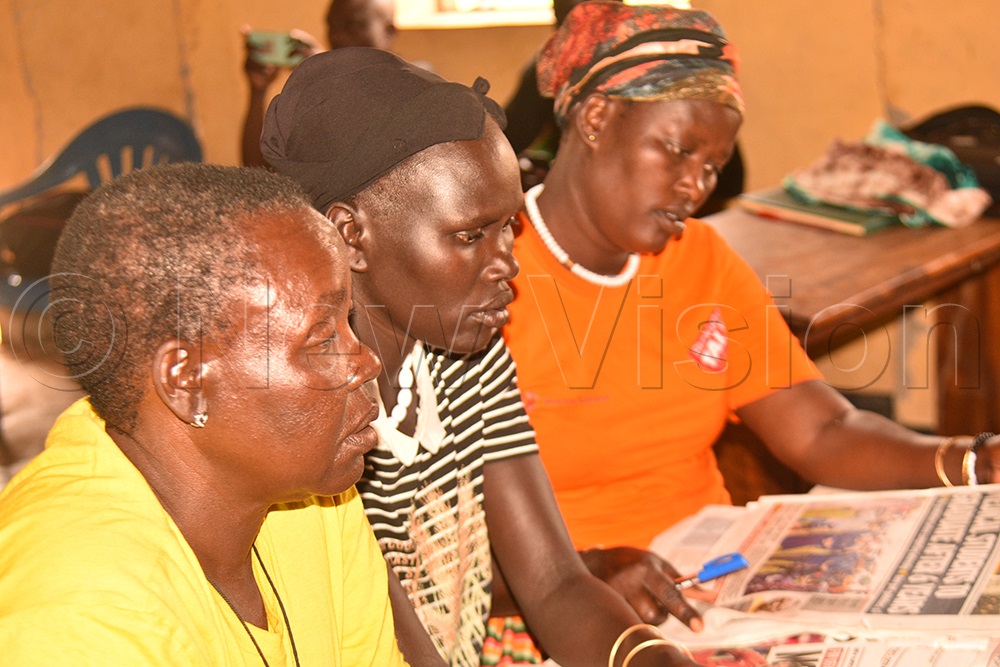
Sagal in the middle and fellow teachers going through the new vision and generating content they will use to teach pupils. (Credit: Jacky Achan)
“When it’s the dry season, we tell people to make fire lines,” she says. “It has helped us.” Teachers also involve students in environmental activities at school. “We plant trees in schools and water them to help them grow,” she says.
At Longariama Community School, Sagal and the school management committee chairperson have planted trees within the school compound.
Challenges remain
Despite these efforts, challenges persist for volunteer teachers in Napak. The biggest challenge, Sagal says, is being removed from the payroll and not being formally recognised.
Because of this, some teachers have stopped teaching altogether. “Those of us still teaching are the ones with the courage to be with the children.”
However, moments with the learners continue to motivate those who remain. “When you go to the field, the children say, ‘Madam, we missed you. Thank you for coming,’” she says.
Community involvement
Sagal says there have been attempts to find ways of supporting volunteer teachers within the community. During a meeting organised by Save the Children, community members were encouraged to contribute small stipends for teachers. Unfortunately, the idea did not succeed.
“It was all in vain because they could not afford it,” she explains. Many families in the area struggle to earn enough from farming and other livelihoods. “They can dig, but they may not get good yields from what they plant, so they cannot afford to set aside even sh500. They are vulnerable,” she says.
Pushing ahead
Despite the lack of pay, teachers like Sagal say they continue teaching whenever they can. “We have continued to teach children voluntarily whenever time permits, even without support or payment,” she says.
She believes that if education authorities or development partners supported volunteer teachers, they would be able to teach more consistently. “If education bodies could support us, we would be consistently present in schools,” she says.
Sagal also recommends that more teachers be trained to use newspapers as learning tools. “This training, I would recommend for other teachers,” she says. “We are appreciative of it. If I pick up the New Vision, I just go and teach learners using the educational materials and information in it.”
Call for support
Charles Adome, a teacher at Naguleangolol Community School in Napak district, says volunteer teachers, after being removed from the payroll, were advised to write letters to district authorities requesting permission to continue teaching voluntarily.

Teacher Carles Adome reading Weekend Vision to come up with a subject to teach. (Credit: Jacky Achan)
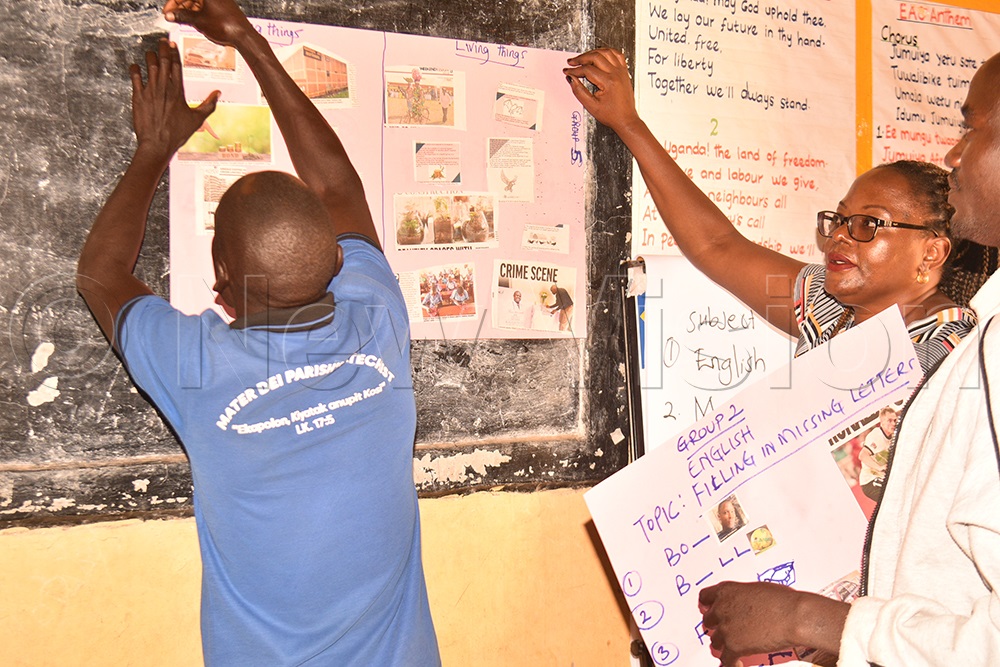
Teachers putting up teaching materials they have generated from the newspaper to be used in teaching pupils. (Credit: Jacky Achan)
He says teachers were also encouraged to seek support from Save the Children, but other schools were already receiving assistance under existing programmes. Volunteer teachers are now appealing to education stakeholders for support so they can continue serving their communities.
"We can be supported by education stakeholders in the country,” Adome says. “If they could listen to our plea for support and pool resources together, we would do better as teachers for the children in our district.”