
UMU vice-chancellor Kyamanywa calls for mission-oriented research
The Uganda Martyrs University (UMU) vice-chancellor is also pushing for impactful research, which provides effective solutions to societal and global challenges.
The Vice-Chancellor of Uganda Martyrs University, Prof. Patrick Edrin Kyamanywa delivers his speech for the official opening of the university's 16th annual research conference at the university's main campus at Nkozi, in Mpigi district. (Photo by Mathias Mazinga)
___________________
Prof. Patrick Edrin Kyamanywa has called for contemporary academicians to prioritise mission-oriented research that tackles real-world problems such as climate adaptation, food security, antimicrobial resistance, and digital inclusion.
The Uganda Martyrs University (UMU) vice-chancellor is also pushing for impactful research, which provides effective solutions to societal and global challenges.
“The research we do should go beyond academic accolades, to emphasise the pathways to scale and translation, co-creation with end users, and clear theories of change leading to potential impact. Success increasingly depends on teams that blend engineering with public health, economics with data science, and the arts with community engagement. For example, we have seen the “grand challenges grants” and several World Bank projects looking for community representation, institutional collaborations and multi-disciplinary teams in the project profiles. A soil scientist must work with a public health nutritionist and community leadership.”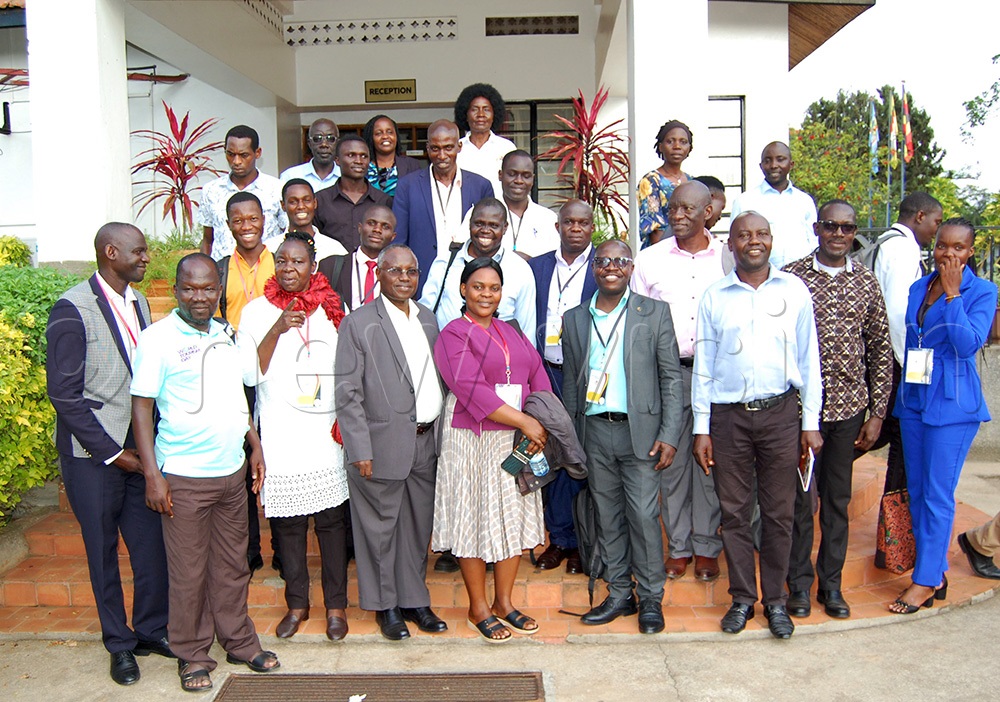
The academicians/researchers who graced UMU's 16th Research Conference share a photo moment after the closing ceremony. (Photo by Mathias Mazinga)
“The attention is quickly shifting from how many letters come after your name and how many publications are cited on your CV to how many patents, policies and true knowledge translation is attributed to you. Academically, the number of citations of your work is more important than the number of publications. Therefore, there is a growing expectation for research to show measurable outcomes such as policy influence, enterprise creation, improved services and community wellbeing,” Kyamanywa says.
He was presiding over the official opening of the 16th annual Uganda Martyrs University research conference at the university’s main campus at Nkozi, in Mpigi district, recently.
Kyamanywa called for strategic partnerships/collaborations in the advancement of modern research.
“Many large grants today favour collaborative consortia: universities working with industry, government ministries, civil society, and international partners. The capacity to convene and steward these partnerships has become a competitive advantage. The recent changes in funding policy by the US government should tell us the cheese has moved. Beyond classic grants, we shall start to see growth in public–private partnerships, climate finance, impact investment, philanthropic challenge funds, and outcome-based financing.”
“Furthermore, funding bodies are increasingly prioritising interdisciplinary research that addresses societal challenges. This emphasises the need for us to adapt and evolve in our research priorities. Winning funding will now require both scientific excellence and strong business and implementation models, where sustainability will be a critical criterion. Collaboration is not a slogan but an operating model. Our national priorities for socio-economic transformation, and the Sustainable Development Goals, will not be achieved by any single actor. Not even your personal growth. We need a whole-of-society approach.”
“We have often enjoyed our ivory towers and not linked up with the immediate consumers of our research and our graduates – the industry and especially the private sector. Remember the public sector has not been, at least in Uganda, a major employer for nearly 40 years now. It behoves us to invite our private sector partners to the heart of the research process, from framing problems to piloting solutions”.
“Industry brings market intelligence, manufacturing capacity, potential funding, and pathways to scale; universities bring deep knowledge, talent, and neutrality. Together, we can shorten the distance from the lab bench to the marketplace and from prototype to policy and product. Such an ecosystem is what will transform universities to true engines of development and socio-economic transformation. Community members are not beneficiaries; they are co-researchers, co-creators and co-innovators. Therefore, our research efforts must champion participatory research that respects indigenous knowledge, shares benefits fairly, and builds local ownership to not only improve our relevance to the communities we serve but also for the sustainability of our efforts. Solutions that are not co-designed with communities rarely endure.”
The conference attracted government representatives, industry and development agencies, partners from civil society and local communities and students, among several other stakeholders. It convened under the theme: Advancing Sustainable Development through STEMS and Multidisciplinary Innovations and Research in Health, Agriculture, Environment and Climate.