
Uganda parliament passes law to professionalise teaching sector
The Bill seeks to operationalise the National Teachers’ Policy adopted by Cabinet in 2019, by embedding its provisions into law and introduces a comprehensive regulatory framework to standardise teacher training, registration, licensing and professional conduct.
Speaker Anitah Among (left) during plenary. This was on 23 April 2026. (Photos by Miriam Namutebi.)
________________
Parliament has passed the National Teachers Bill, 2024, marking a significant legislative shift aimed at professionalising and regulating the country’s teaching workforce.
The Bill seeks to operationalise the National Teachers’ Policy adopted by Cabinet in 2019, by embedding its provisions into law and introduces a comprehensive regulatory framework to standardise teacher training, registration, licensing and professional conduct.
The Bill was approved during a plenary sitting presided over by Speaker Anita Among, on Thursday, April 23. State Minister for Higher Education John Chrysostom Muyingo says that once enacted, the law will establish a statutory body, the National Teachers Council, mandated to oversee the registration and licensing of teachers, enforce ethical standards, and administer disciplinary procedures.”
Jonathan Odur (Erute County South, UPC), observed that the Bill comes against a backdrop of persistent challenges in Uganda’s education sector.
”This Bill will address teacher absenteeism, weak professional standards, low qualifications and limited oversight mechanisms,” he said.
(left to right) Opolot Okaasai, Minister for State for Energy, Sheema Municipality MP Dickson Kateshumbwa, and Finance Committee Chairperson Amos Kankunda during plenary. This was on 23 April 2026. 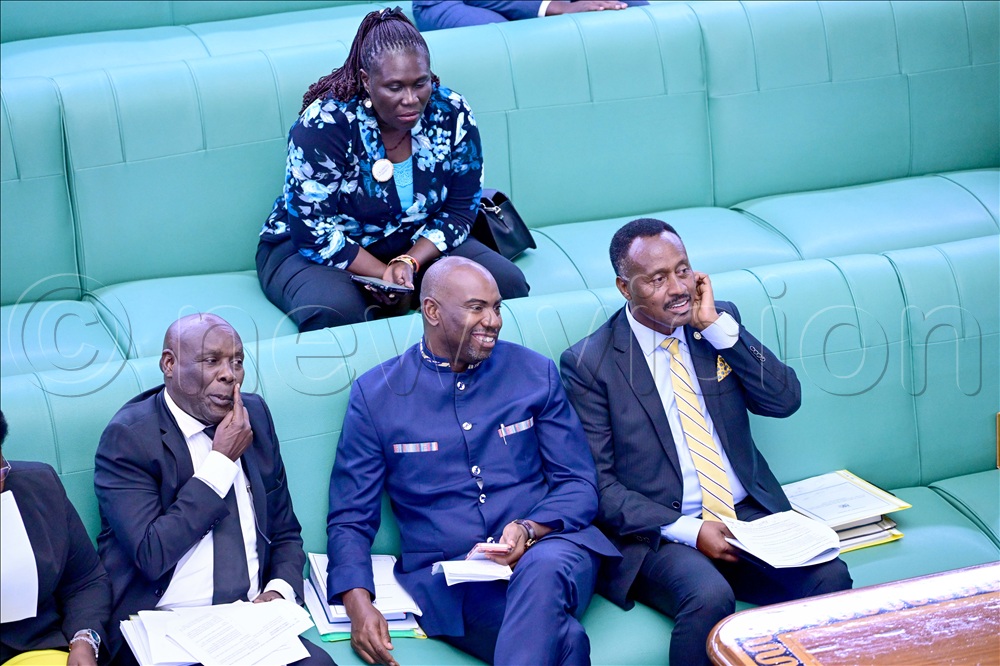
While the Education (Pre-Primary, Primary and Post-Primary) Act, 2008 provides for teacher registration and licensing, argued that it lacks “a coherent institutional framework to regulate the profession comprehensively.”
Nathan Nandala Mafabi (FDC, Budadiri West County) pointed out that the new law aims to close these gaps by consolidating scattered provisions into a single, robust legal regime.
“It aligns with broader public sector reforms, including the phasing out of certain administrative positions that previously created ambiguities in teacher management,” he said.
The Chairperson Committee on Education and Sports, James Kubeketerya, outlined that the National Teachers Bill introduces several far-reaching reforms that include mandatory registration and licensing, teacher and internship programme and continuous Professional Development (CPD), among others.
“All teachers will be required to register with the National Teachers Council and obtain a valid teaching licence before practising,” Kubeketerya said.
He added that the Bill provides for collaboration between the proposed Council and the National Council for Higher Education in accrediting teacher training programmes.
The Committee noted that the Bill would “promote, maintain and protect ethical standards” while providing a clear institutional framework for teacher management. The Bill will be forwarded to the President for assent.
Highlights of the National Teachers Bill:
Establishment of the National Teachers Council: The statutory body will be created to oversee teacher registration, licensing, ethical standards, and disciplinary procedures.
Teaching Licenses: Teachers must obtain a license to practice, which must be renewed every four years, contingent on continuous professional development (CPD).
Mandatory Bachelor’s degree: To qualify for registration, all teachers, including those in pre-primary and primary schools, must possess a minimum of a bachelor’s degree.
Professionalism & Regulation: The proposed law seeks to eliminate teacher absenteeism, improve professional standards, and ensure that only qualified individuals teach.
Welfare and Promotions: The bill formalises regulations for acting appointments, ensuring teachers in such roles are confirmed and remunerated within one to six months.
Mandatory Internship: The proposed law requires teachers to complete a 12-month intensive internship program to gain practical skills.
Teacher Qualification Transition: A transition period will be provided for current staff with certificates or diplomas to upgrade to degree levels.
In addition, the Bill grants any person aggrieved by decisions of the proposed Teachers Council the right to appeal to the High Court.
It outlines general offences, including: falsely presenting oneself as a teacher, using fraudulent means to obtain registration or licensing, and aiding others to do so. Individuals convicted of such offences face fines of up to 250 currency points (sh5m), imprisonment of up to two years, or both.