
Students lead fight for better campus nutrition amid rising hunger
Founded in 2025, Learn and Lunch is a student-led movement working to address food insecurity and nutrition gaps in higher institutions. Through its ambassador programme, the initiative has reached at least 1,800 students with information, advocacy and practical solutions around affordable and healthy eating.
The training, organised by the student initiative Learn and Lunch in partnership with Body and Soil on April 25, brought together student leaders who will drive the campaign about healthier diets and nutritious feeding. (Photo by Sharon Nabasirye)
______________
Many university students spend several days without proper meals, while those who manage to often rely on cheap, stomach-filling food that does little to keep them healthy.
However, at Kyambogo University, students are now stepping in to change the trend by promoting affordable, healthier eating as concern grows over rising hunger on campus.
During a training organised by the student initiative Learn and Lunch in partnership with Body and Soil on April 25, 2025, student leaders expected to drive the campaign about healthier diets and nutritious feeding were brought together. The training came at a time when increasing hunger across universities is colliding with a quieter but equally serious crisis: Poor nutrition among the country’s future professionals.
Earlier this month, the New Vision highlighted how a growing number of university students are skipping meals altogether due to financial strain. However, even among those who manage to eat, the options are often limited to cheap, filling foods that offer little nutritional value. From chapati and black tea in the morning to chapati and beans or fried snacks later in the day, many students are surviving on diets heavily loaded with carbohydrates, oils and sugars.
“Hunger is not a student’s failure; it’s a systemic problem. For a long time, campus hunger was normalised. But it’s not normal, and it shouldn’t be accepted,” said Mercy Lawino, a student at Kyambogo University and a member of Learn and Lunch.
Founded in 2025, Learn and Lunch is a student-led movement working to address food insecurity and nutrition gaps in higher institutions. Through its ambassador programme, the initiative has reached at least 1,800 students with information, advocacy and practical solutions around affordable and healthy eating.
The Kyambogo training is part of a broader campaign that seeks not only to raise awareness but also to challenge how universities and policymakers respond to student welfare. Lawino noted that the issue goes beyond individual choices, pointing instead to gaps in funding, weak regulation of food vendors and a lack of structured nutrition support systems on campuses.
“If we don’t act now, this becomes the norm for years to come,” Lawino said. “But if students come together, we can change that story.”
Nutrition experts working with the programme warned that the consequences are already visible. Alfred Atuhungira Mihanda, a nutritionist from Nutrisafe supporting the initiative, said many students are consuming diets made up of as much as 80% carbohydrates, with little access to proteins, vegetables or fruits.
“That kind of diet gives energy, but it doesn’t build the body or protect it. We are seeing students falling sick multiple times in a semester, which points to weak immunity,” he said.
Concerns also extend to food safety. A recent study by Makerere University found that a significant proportion of cooking oil used by street food vendors contained harmful compounds linked to cancer. With fried foods dominating the student diet, experts warned that the long-term health risks cannot be ignored. According to Mihanda, most students, particularly those living off-campus, rely on low-cost street food because it is accessible and filling.
According to Hendry Ruma Daniel, an assistant lecturer in nutritional sciences at Kyambogo University, this creates a difficult trade-off between cost and health.
“Students are choosing what they can afford, not necessarily what is healthy. Many are eating foods high in fats, salt and sugar simply because they are convenient and cheap,” he said.
He emphasised that it is this reality that initiatives like Learn and Lunch are trying to change, not by prescribing unrealistic diets, but by promoting practical alternatives. During the training, students were introduced to ways of improving everyday meals, such as incorporating vegetables, using more nutritious local ingredients, and modifying common foods like chapati to make them healthier.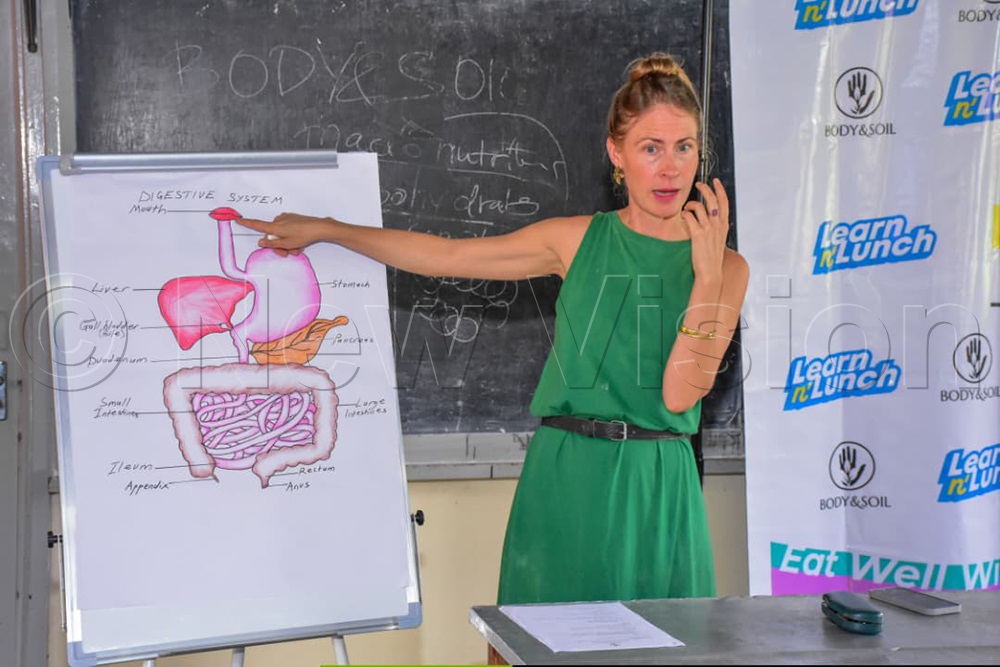
Maria Eva Schiffer the founder of body & soil and a Agro-Nutritionist Consultant, emphasised the importance of shifting both knowledge and demand. (Photo by Sharon Nabasirye)
Maria Eva Schiffer, the founder of body&soil and a Agro-Nutritionist Consultant, emphasised the importance of shifting both knowledge and demand.
“We can’t just tell people to stop eating what they know. We have to show how those same foods can be made more nutritious and accessible. If students understand what their bodies need, they can start influencing what is produced, sold and served,” she said.
She also pointed to the need to revive indigenous foods such as millet and sorghum, which are often more nutritious but less commonly consumed among young people.
“If we don’t change the demand of what people are eating, we cannot change the system. We need to bring back local, indigenous foods that are actually more nutritious. Government has a key role to play by supporting scalable nutrition education and integrating it into schools and universities, while also investing in systems that make healthy, local food more accessible to young people.”
Beyond awareness, the initiative is also pushing for structural change. Organisers are calling on other universities to strengthen oversight of food vendors, improve student welfare systems and create spaces where affordable, healthy meals can be accessed. There are also plans to expand the campaign to other institutions and build a national platform for advocacy around campus hunger and nutrition.