
Soroti University launches interfaith dialogue to address mental health
The concept for the prayer breakfast emerged after a survey conducted by religious leaders at Soroti University revealed a significant level of depression among students and staff stemming from stress, academic pressures and heavy workloads.
The clergy emphasised the importance of bridging differences across religious groups, highlighting the idea that, as one community, much can be accomplished together. (Credit: Delux Emmy Alomu)
SOROTI - Soroti University has launched the first of its kind interfaith prayer breakfast, a pioneering initiative aimed at fostering unity and addressing mental health challenges among students and staff.
The event took place on April 17, 2026, at the university dining hall and was organised by the Dean of Students and university chaplains, including an Imam.
It centred on the theme "Unity in spite of Diversity”, drawing inspiration from Matthew 3:16-17 and Quran 5:2.
The concept for the prayer breakfast emerged after a survey conducted by religious leaders at Soroti University revealed a significant level of depression among students and staff stemming from stress, academic pressures and heavy workloads.
The gathering brought together individuals from various faith backgrounds, including Muslim staff, faculty, support personnel, university administrators and students.
The clergy emphasised the importance of bridging differences across religious groups, highlighting the idea that, as one community, much can be accomplished together.
Their goal is to nurture a culture of tolerance and acceptance within the university, encouraging a collaborative spirit that benefits the wider community.
Policy and inclusion
Wilfred Ocen, the university guild president, raised an issue regarding the formal recognition of religious groups.
He called for a reassessment of the university's religious policy, noting that the Soroti University council currently recognises only three religions, Muslims, Anglicans and Catholics.
Ocen advocated for equitable support and funding for all recognised religious groups to enable them to carry out their activities effectively.
Zaitun Okot, the Dean of Students at Soroti University, announced plans for the university to host similar events twice a year, specifically every last Thursday in September. She said the initiative aims to address concerns raised by the guild president and foster harmony within the university community.
James Gregory Okello, the Academic Registrar and chief guest representing Vice Chancellor Prof. John Robert Ikoja Odongo, emphasised the institution’s commitment to being a secular space that embraces diverse perspectives and practices.
Okello shared his personal experience of navigating different faiths in his family, stating that as a Protestant married to a Catholic, they have learned to respect each other's choice of worship on Sundays.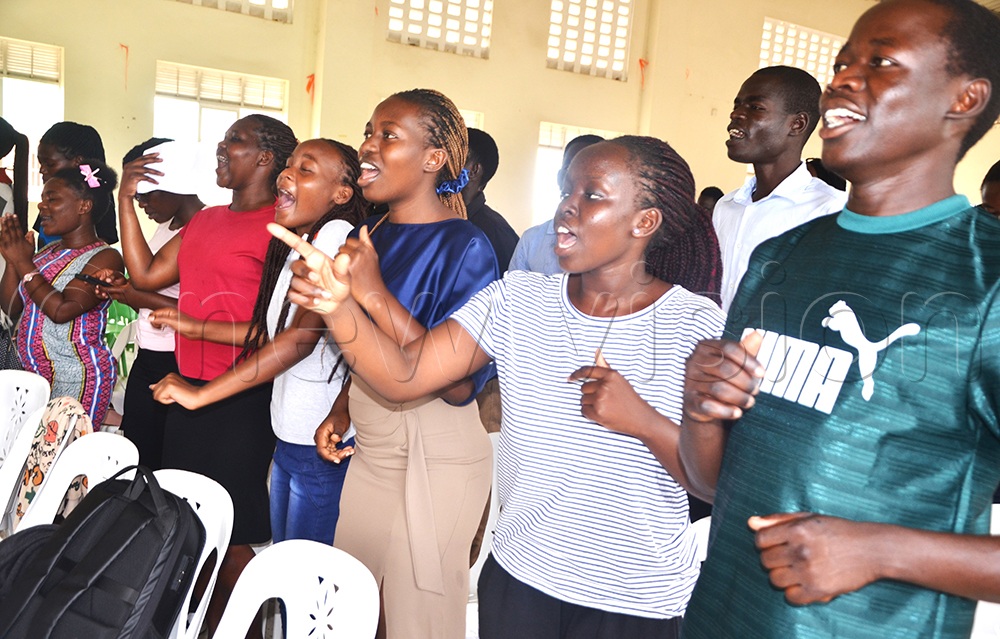
Soroti University students enjoying praise and worship songs during the launch of interfaith prayer breakfast. (Credit: Delux Emmy Alomu)
The Academic Registrar highlighted the significance of faith in their lives, encouraging mutual respect among different beliefs at Soroti University.
He mentioned the intention to refine guidelines that will allow all religious groups on campus to freely conduct their activities.
Sheikh Abubakar Umar Obilan, the university Imam, said this approach is vital for inclusivity, especially for those facing stress, academic pressure or seeking a supportive environment.
He noted the importance of reflection during challenging times, as it provides relief and rejuvenation.
Sheikh Obilan, who also serves as the regional assistant mufti for Teso and Karamoja, said that despite diverse religious backgrounds, there is a tendency to separate along these lines.
He noted that the aim is to build a more united community that transcends religious boundaries.
During the reflection session under the theme “Religious Tolerance: A Critical Antidote to Bigotry in Society,” Sheikh Obilan emphasised that each individual is accountable for responsibilities entrusted by God.
He stated, "Yes, you may be a Muslim, but God desires humility, love, and compassion extended not only to those who share your faith but to everyone, regardless of their religious denomination.”
Sheikh Obilan urged the audience to understand the significance of their existence and avoid self-discrimination based on faith.
He announced that the prayer breakfast will now take place annually in September, highlighting its role in fostering unity among religious leaders within the university community.
The Sheikh advocated for respect, collaboration and peaceful coexistence, reminding participants to treat others as they would wish to be treated.
Rev. Fr. Dr. Jerome Agelu, the Catholic university chaplain, led a reflection on the theme “Called to Establish a Profound Relationship with God.”
He underscored the importance of self-evaluation in one’s relationship with God, noting that life feels incomplete without it.
Fr. Agelu encouraged a deeper relationship with God, asking, “Are you truly connected? Do you love Him?”
The chaplain urged the academic community not to become too preoccupied to reflect on God.
He warned that suffering, pain and poverty can distract individuals and cautioned against allowing earthly desires to interfere with spiritual life.
He emphasised the importance of maintaining a prayer life, studying the Bible and fostering fellowship.
Rev. Canon Dr. Samuel Opol, the Anglican university chaplain, led a reflection under the theme “God First Despite Work,” stressing the need to recognise God as the foundation of life and work.
He said work is a means through which God provides and that a strong spiritual foundation is essential.
A report from Makerere University’s Public Health department highlights the prevalence of depression among university students in Uganda.
Studies indicate rates rose to about 80% during the COVID-19 pandemic, underscoring the urgency of the challenge.
Key contributors include financial difficulties, academic pressure, experiences of sexual abuse and relationship challenges.