
Somalia benchmarks Uganda’s higher education system
Welcoming the delegation on Thursday at the NCHE headquarters in Kyambogo in Kampala, Prof. Mary Okwakol, Executive Director of Uganda’s NCHE, described the engagement as a reflection of growing regional cooperation in higher education.
Mary J.N Okwakol, the Executive Director of the National Council for Higher Education, looks on as Mohamad Ali Farah, the Deputy Chairperson of the Somali National Council for Higher Education speaking during a meeting at the National Council for Higher Education on May 14, 2026. (Photos by Nancy Nanyonga)
________________
Uganda’s National Council for Higher Education (NCHE) has hosted a high-level delegation from Somalia’s National Commission for Higher Education as the Horn of Africa nation moves to strengthen regulation and quality assurance in its rapidly expanding university sector.
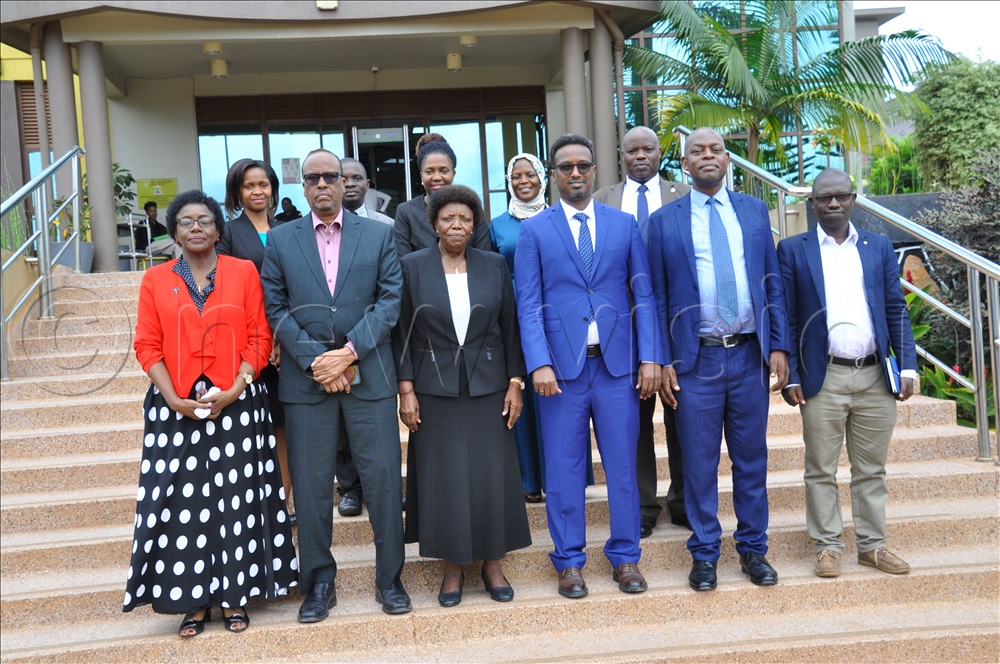
The Somali delegation, led by Dr. Abdinur Sheikh Mohamed, Chairperson of Somalia’s National Commission for Higher Education, is in Kampala for a benchmarking visit aimed at studying Uganda’s higher education regulatory systems and institutional governance frameworks.
Welcoming the delegation on Thursday at the NCHE headquarters in Kyambogo in Kampala, Prof. Mary Okwakol, Executive Director of Uganda’s NCHE, described the engagement as a reflection of growing regional cooperation in higher education.
“In a special way, on behalf of the National Council for Higher Education, I welcome the delegation from the Commission for Higher Education from the Federal Republic of Somalia, led by Dr. Abdinur Sheikh Mohamed. We are honoured to host you during this benchmarking engagement,” Prof Okwakol said.
She said the visit builds on regional efforts to strengthen collaboration following the first Regional Conference on the East African Community Common Higher Education Area (EACHEA), held last September.
Prof. Okwakol noted that Uganda’s higher education regulatory framework has evolved over more than two decades under the Universities and Other Tertiary Institutions Act, enacted in 2001 and later amended in 2003 and 2006. The National Council for Higher Education became operational in 2003.
She explained that the council is mandated to regulate and guide the establishment and management of universities and other tertiary institutions in Uganda.
According to Prof. Okwakol, NCHE oversees institutional licensing and accreditation, accredits academic and professional programmes, and ensures compliance with minimum standards across the higher education sector.
“NCHE accredits programmes after certifying that institutions of higher education have adequate and accessible physical infrastructure and qualified staff to support the programmes they offer,” she said.
The council also oversees the comparability of qualifications awarded by public and private institutions, sets standards for student admissions, and monitors compliance with national higher education requirements.
Prof. Okwakol highlighted the Directorate of Quality Assurance and Accreditation as the council’s core operational arm, responsible for institutional licensing, programme accreditation, quality audits, monitoring and compliance, recognition and equating of qualifications, as well as gender and equity matters.
She added that NCHE has invested heavily in digital systems through its Directorate of Information, Communication, Technology, Research and Innovation, which manages higher education data, research, statistics and innovation.
Other departments include Finance, Planning and Administration, Legal Services, Internal Audit and Risk Management, Public Relations and Corporate Affairs, and Procurement and Disposal.
Speaking during the engagement, Mohamed said one of their most urgent priorities is to bring all universities in Somalia under a formal regulatory framework.
The Somali commission noted that Somalia currently has about 130 universities operating across the country, many of which are yet to undergo formal registration or accreditation.
“One of our most urgent and immediate priorities is to register all operating universities and grant them temporary accreditation. This is the first step toward bringing the entire sector under a credible and structured regulatory framework.”
He said his delegation is particularly interested in Uganda’s systems for institutional licensing, programme accreditation, quality assurance, monitoring and compliance, as well as the National Qualifications Framework and Higher Education Management Information Systems.
He also expressed interest in Somalia’s NCHE establishing a formal cooperation framework with Uganda’s NCHE to support technical assistance, staff capacity building and exchange programmes.
“We believe that a formal cooperation framework or a Memorandum of Understanding between NCHE Uganda and NCHE Somalia could serve as a foundation for this partnership,” he said.
The benchmarking visit comes as Somalia intensifies efforts to reform its higher education sector amid concerns over unaccredited institutions and inconsistent academic standards.
The delegation is expected to hold a series of technical discussions and presentations with officials from the Ministry of Education and Sports as part of broader efforts to align Somalia’s higher education system with regional and international standards, including those of the East African Community and the Inter-University Council for East Africa.