
Over 100 professionals graduate from Grant Thornton Skills Academy
The six-month programme, which focuses on practical workplace training, leadership, and professional development, comes at a time when thousands of educated young Ugandans continue to struggle to secure jobs despite completing university education
Cohort V graduands of the GT Academy graduated on Friday, seated in the middle, the chief guest Sanjay Rhougan with Anil Patel, Prof Vicent Bagiire and other academy staff. (Courtesy)
________________
More than 100 young professionals have graduated from the Grant Thornton Skills Academy in a move aimed at addressing Uganda’s growing unemployment and workplace skills gap among graduates.
The six-month programme, which focuses on practical workplace training, leadership, and professional development, comes at a time when thousands of educated young Ugandans continue to struggle to secure jobs despite completing university education.
Uganda produces tens of thousands of graduates every year from universities and tertiary institutions, but many employers argue that a significant number of job seekers lack practical workplace skills, communication abilities, and professional exposure required in the modern labour market.
This mismatch between academic qualifications and industry expectations has increasingly left many young professionals trapped in prolonged job-hunting cycles.
Speaking during the graduation ceremony held at the company’s offices on Friday, Vicky Kemigabo, Director of the Grant Thornton Practical Schools Academy, said the institution was established specifically to respond to the growing challenge of graduate unemployment and limited employability skills.
“The growing challenge facing our country is limited job opportunities, and that is the vision on which the academy was conceived,” Kemigabo said. “We are preparing graduates for the job market by equipping them with practical skills, professional knowledge, and the confidence needed to compete effectively.”
She noted that while many graduates possess academic qualifications, employers today are looking for individuals who can adapt quickly to workplace demands, demonstrate integrity, communicate effectively, and solve problems in real-time environments.
According to Kemigabo, the academy receives more than 300 applications for each intake, reflecting the increasing demand for employability and practical skills training among Uganda’s youth. However, only a limited number are selected for the intensive programme.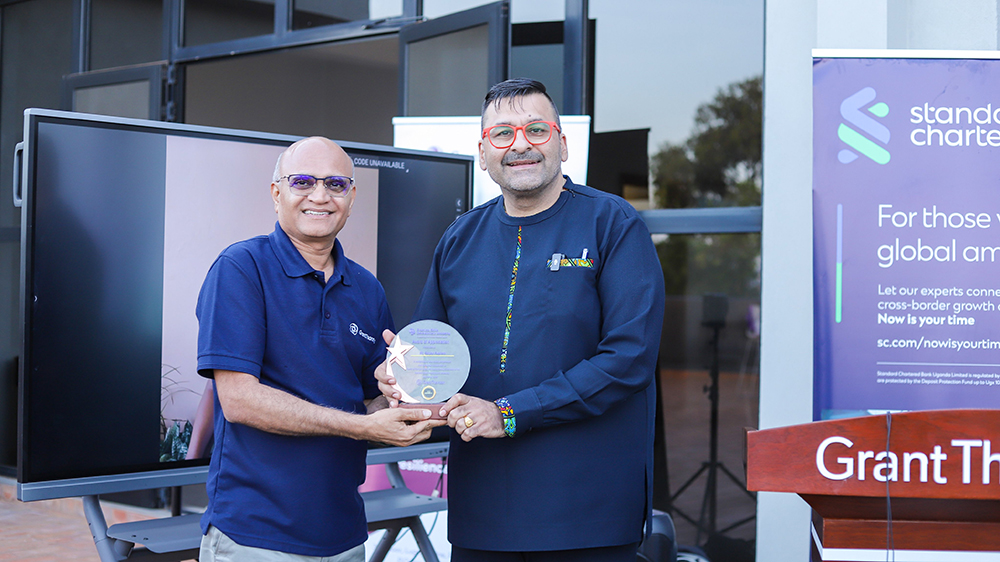
Grant Thornton Executive Chairman Anil Patel handing over a gift to Sanjay Rhougan, the chief guest and the CEO of Stanchart Bank Uganda. (Courtesy)
The curriculum was developed in partnership with the Ministry of Education and Sports, Makerere University Business School, and the Institute of Certified Public Accountants of Uganda to ensure it responds directly to labour market realities.
Participants undergo training in leadership, ethics and integrity, taxation, accounting fundamentals, communication, personal branding, and workplace professionalism.
“We focus on building professionals who can fit into the changing demands of the economy and contribute solutions to society,” Kemigabo added.
Prof. Vincent Bagiire, one of the architects of the academy’s modules, said the programme was designed after consultations with both government and private sector actors to identify the major gaps affecting graduate employability in Uganda.
“We realised there was a disconnect between what students learn in school and what employers expect in the workplace,” Bagiire said. “Universities provide theoretical education, but institutions like this academy provide the practical touch and industry orientation that graduates need.”
Uganda’s private sector has repeatedly highlighted concerns over limited hands-on experience among job applicants, especially in areas such as communication, critical thinking, teamwork, and problem-solving. Many companies are now investing in internal training and graduate development programmes to bridge the gap.
The Executive Chairman of Grant Thornton, Anil Patel, said the firm established the academy after consistently receiving large numbers of internship and job applications from young professionals struggling to gain workplace exposure.
“We were receiving nearly 25 internship applications every month, yet we could only take a few candidates,” Patel said. “That is why we decided to create an academy that could support more graduates and prepare them for employment opportunities.”
He explained that experienced professionals from the company mentor trainees weekly, exposing them to practical workplace realities and career guidance.
Patel added that some graduates are absorbed into Grant Thornton while others are connected to opportunities within the company’s wider corporate network.
“Every year, we recruit more than 50 staff into Grant Thornton, and many of them come through this programme,” he said. “At least 25% of the trainees are eventually placed within our ecosystem or client companies. We are trying to bridge the gap as much as we can.”
He also revealed that the company invests more than sh600 million annually in training programmes and activities implemented under the Grant Thornton Foundation.
The Chief Guest, Sanjay Rughani, urged the graduates to remain innovative and position themselves for opportunities emerging in Uganda’s transforming economy.
“Be curious and take time to understand where you want to belong in this changing world,” Rughani said. “Uganda’s economy is expanding and sectors such as oil and gas are creating new opportunities. Use your skills creatively, embrace innovation, and position yourselves to benefit from these emerging opportunities.”
He encouraged young professionals to continuously upgrade their skills, embrace technology, and remain adaptable as industries evolve and competition for jobs intensifies.