
Inside Kapelebyong’s struggle: Why PLE performance remains low
Following the release of the 2025 PLE results, the district inspector of schools, Stephen Olinga, pointed to a web of persistent structural challenges undermining learning across the district’s 41 Universal Primary Education (UPE) schools.
Opot Primary school that has managed to maintain the number one position with performance in the Kapelebyong district. (Photo by Alfred Atwau)
________________
For yet another year, Kapelebyong district has ranked near the bottom of the Primary Leaving Examination (PLE) performance tables in the Teso sub-region. However, education leaders insist the problem is not learner ability, but a school system stretched far beyond its capacity.
Following the release of the 2025 PLE results, the district inspector of schools, Stephen Olinga, pointed to a web of persistent structural challenges undermining learning across the district’s 41 Universal Primary Education (UPE) schools.
Out of 1,623 registered candidates, only 28 passed in Division One, 818 in Division Two, 491 in Division Three, and 105 in Division Four, while 28 candidates did not sit the examinations. The pattern mirrors previous years. In 2024, only 22 pupils scored Division One, reinforcing a trend that has proved difficult to reverse.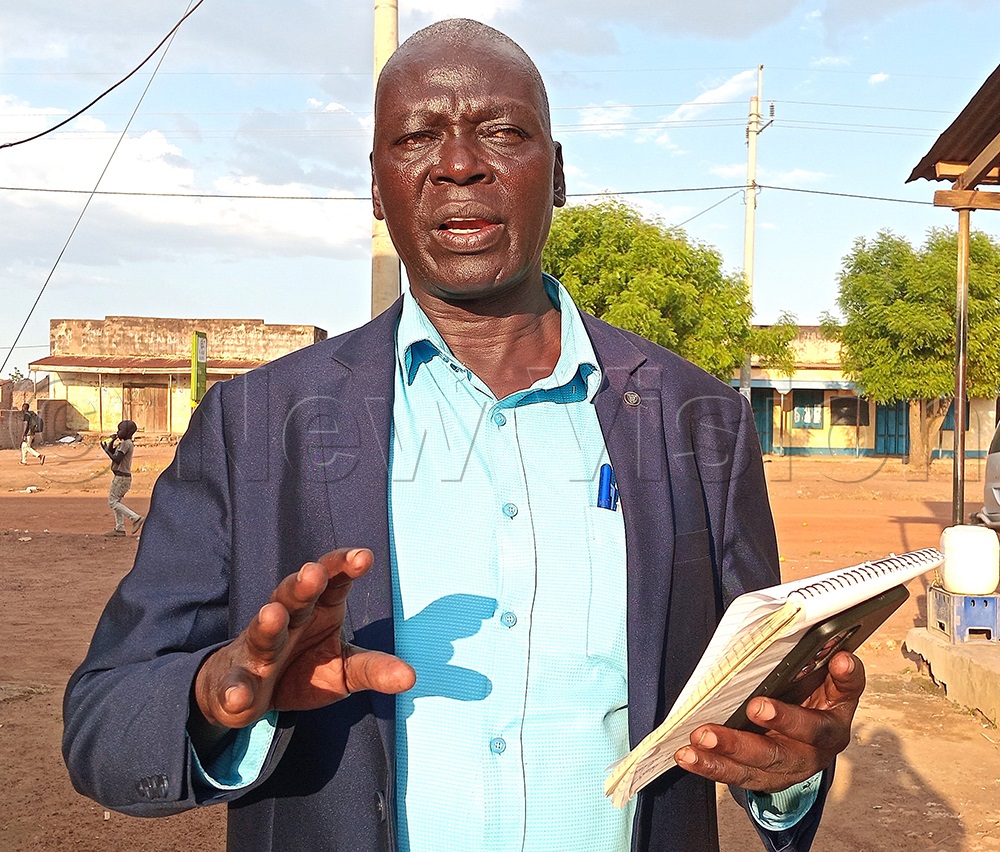
Stephen Olinga, the Kapelebyong district Inspector of Schools, explaining the challenges that affected the PLE performance for 2025. (Photo by Alfred Atwau)
Behind the numbers, Olinga says, are schools struggling to function under severe constraints.
Overcrowded classrooms, overstretched teachers
“In some schools, one teacher handles multiple classes from Primary Four to Primary Seven,” Olinga explained. “This overload reduces teaching effectiveness because teachers are overstretched and learners lack adequate academic support.”
Low staffing levels remain the district’s biggest challenge. In many schools, a small number of teachers manage hundreds of pupils spread across seven class levels.
At Opot Primary School, the district’s best performer with nine Division One candidates, headteacher Naboth Olado describes conditions that would overwhelm even well-resourced schools.
The school enrols more than 1,200 pupils but has only 13 teachers.
“Each class from P1 to P7 can have more than 300 pupils. One teacher cannot effectively manage such numbers,” Olado said. “We are doing our best, but we are teaching against the odds.”
If this is the situation in the district’s top-performing school, leaders say conditions in smaller and more remote schools are significantly worse.
Limited funding weakens supervision
Olinga also highlighted inadequate funding for the district education department, which he said has crippled inspection and academic monitoring.
“With the limited funds we receive, it is extremely hard to facilitate school inspections, monitoring, and teacher support supervision, yet these activities directly influence performance,” he noted.
Many planned school visits are cancelled due to a lack of transport and operational resources.
“When we divide the small funds into data, airtime, and essential materials, nothing remains for field supervision. Schools are left without professional guidance and accountability,” he added.
Without consistent inspection, struggling schools receive little structured support to improve teaching standards.
Parental involvement declining
Beyond institutional challenges, education officials also point to declining parental involvement as a growing concern.
Olinga says some parents have resisted contributing towards PTA teachers, who help to bridge staffing gaps in many UPE schools.
“Education is a shared responsibility, but some parents have neglected their role. Learners come without books, without lunch, and attend irregularly,” he said.
Absenteeism spikes during planting and harvesting seasons, when children are kept at home for domestic and farm work.
“Pupils miss school for days or weeks and are still expected to perform well in national exams. That is unrealistic,” Olinga stressed.
Strike disruptions hurt candidate classes
The recent nationwide teachers’ strike further disrupted learning, particularly for Primary Seven candidates.
“When teachers laid down tools, learning came to a standstill in most government schools. The time lost could not be fully recovered,” Olinga said. “Candidate classes were the most affected.”
Although the district acknowledges teachers’ grievances, officials say learners bear the greatest cost.
Islands of resilience
Despite the challenges, several schools continue to show resilience.
Opot Primary School led the district with nine Division One candidates, followed by Obalanga Primary School with five, Kapelebyong Primary School with three, and Akore Primary School in Acowa with two. Schools including Alupe, Odukul, Angerepo, Acowa, Aakum, Alaso, Alito, Angolebwal, and Agonga each registered at least one Division One candidate.
Still, Olado questions how rural schools can fairly compete with better-resourced urban institutions.
“We are the best school in the district, yet we operate under extreme pressure. Think about schools with even fewer teachers and classrooms competing with well-facilitated schools in Kampala,” he said.
Limited access to textbooks and learning materials continues to widen the gap.
A persistent downward trend
Since being carved out of Amuria district in 2018, Kapelebyong has consistently ranked among the lowest-performing districts in Teso.
Year Candidates Registered Division One Passes
2018 1,731 41
2019 1,698 17
2020 1,752 10
2022 1,860 35
2023 1,456 24
2025 1,623 28
Performance trends show fluctuations but no sustained improvement over time.
Call for urgent intervention
Education leaders say these figures reflect systemic strain rather than declining learner potential.
Olinga believes meaningful change requires direct intervention from the Ministry of Education and Sports, particularly in staffing, funding, and inspection.
“We need more teachers recruited, increased funding, and stronger inspection mechanisms in rural districts,” he said. “Without this, performance will remain low despite the commitment of teachers.”
He is urging stronger cooperation between the government, parents, educators, and community leaders.
“We are committed to improving performance, but schools cannot do it alone. Parents, leaders, and the community must work with us,” he emphasised.
As Kapelebyong reflects on another disappointing PLE outcome, education leaders insist the narrative should not be about failure, but about a district striving under severe limitations.
“Our teachers are committed. Our learners are capable,” Olinga said. “What we lack are the resources and systemic support to match the expectations placed on us.”
Until those gaps are addressed, the district fears it may continue to appear at the bottom of performance tables, not for lack of effort, but for lack of means.