
Govt policy banning nursery schools running day care sections launched
Under the new policy, daycare services will be limited to designated home settings or approved institutional environments such as corporate workplaces, markets and shopping malls that wish to provide childcare facilities for their employees.
(L-R) Cotilda Nakate Kikomeko, the Minister for Social Service in Buganda Kingdom and Robin Nandy UNICEF Country Representative look on as Joyce Kaducu, the Minister of State for Primary Education cuts a ribbon during the launch of the Early Childhood Care and Education policy at Nakivubo Blue Primary School on April 30, 2026. (Photos by Nancy Nanyonga)
________________
A new government policy banning pre-primary schools, including nursery schools and kindergartens, from operating daycare centres has been launched.
The Early Childhood Care and Education (ECCE) policy was unveiled today, April 30, 2026, at Kampala city-based Nakivubo Blue Primary School by primary education state minister Dr Joyce Moriku Kaducu, on behalf of First Lady and Minister of Education and Sports Mrs Janet Museveni.
Pupils handing over Early Childhood Care and Education policy report 2025 to Joyce Kaducu, the Minister of State for Primary Education. This was during the launch of the Early Childhood Care and Education policy at Nakivubo Blue Primary School on April 30, 2026. 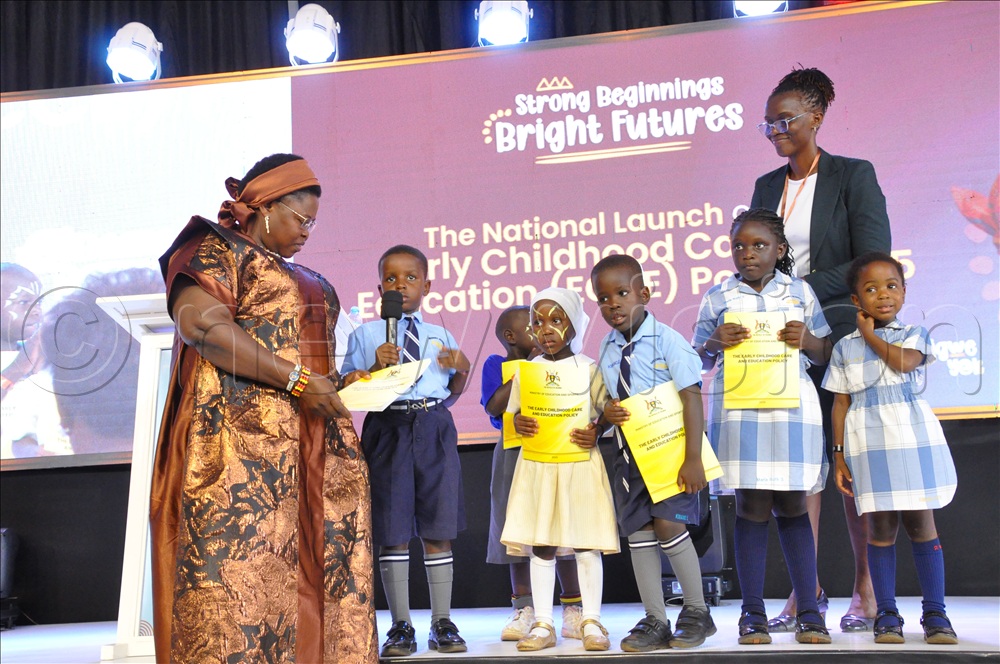
Under the new policy, daycare services will be limited to designated home settings or approved institutional environments such as corporate workplaces, markets and shopping malls that wish to provide childcare facilities for their employees.
The policy further stipulates that daycare centres will only cater to children aged zero to three years and will operate strictly as day facilities.
Additionally, daycare centres will not be permitted to introduce formal academic instruction. Instead, they will focus on social development and essential life skills, such as interactive play, proper feeding, and basic socialisation.
Children enrolled in daycare centres will also not be required to wear uniforms, as the facilities are intended to serve as temporary care spaces while parents or guardians attend to other responsibilities.
Why the policy?
In a speech delivered by Kaducu, Mrs Museveni said that every child, regardless of background or circumstances, deserves a strong beginning, nurturing and equitable start in life.
According to Mrs Museveni, research has shown that what happens during early childhood periods shapes the future of the child and the nation.
“Investing in early childhood is investing in better learning outcomes, healthier communities and a more productive society,” she said.
Citing an African proverb, “The child who is not embraced by the village will burn it down to feel its warmth”, Mrs Museveni said the Early Childhood Care and Education Policy directly speaks to the future of Uganda as enshrined in the Fourth National Development Plan and Vision 2040.
The First Lady stated that the National Resistance Movement (NRM) government considers the policy a serious national priority that includes every child, whether at home, in the community, daycare, nursery school, primary school attachment, refugee settlement, rural village or urban informal settlement.
She revealed that the policy targets children from birth to three years and three to six years as a strategy to get them ready to enter primary one under the universal primary education programme.
United Nations Children's Fund country representative Dr Robin Nandy said at the age of five, more than 90% of a child's brain development has already occurred, adding that the early years shape a child’s ability to learn, thrive and reach their full potential.
He noted that when children receive nurturing care, stimulation, protection, and early learning, they are more likely to perform better in school, remain in education longer and grow into healthy and productive adults.
“For too long, access to quality early childhood care and education in Uganda has depended on where a child is born, the income of their parents, or whether services exist in their community,” Nandy noted.
Dr Safinah Kisu Museene, the Assistant Commissioner in charge of Pre-Primary Education, said that the education ministry placed early childhood care and education within the broader human capital development agenda.