
Chevening alumni mentor 10,000 students to combat poor waste disposal
On April 9, 2026, at Hotel Africana, Chevening alumni brought together students from nine schools across the Kampala division to showcase creative items they had made from waste materials and to recognise their outstanding work with awards.
The British High Commissioner to Uganda Lisa Chesney looks at a basket made out of recycled plastic bottle tops and recycled polythene bags exhibited by students from St. Peters Senior Secondary School Nsambya. This was during her tour around a students’ exhibition themed sustainable waste management sponsored by the British High Commission through the Chevening Alumni Association of Uganda at Hotel Africana in Kampala on April 9, 2026. (Photos by Maria Wamala)
________________
When Shamim Ibrahim, the project lead and community liaison of the Chevening Alumni Group, first returned to Uganda after completing her master’s degree in occupational and organisational psychology at the University of Sussex in the United Kingdom in early 2025, she brought with her more than academic knowledge.
Ibrahim brought a vision to transform how young people think about waste management in Kampala.
“I realised that everything begins with culture. The behaviours we practice as individuals and as a society ultimately define whether we build a positive or negative culture around waste management, littering, and environmental responsibility,” she said.
Shamim Ibrahim, the Project Head Community Liaison, Chevening Alumni Association of Uganda in an interview with New Vision on April 9, 2026. 
On April 9, 2026, at Hotel Africana, Chevening alumni brought together students from nine schools across the Kampala division to showcase creative items they had made from waste materials and to recognise their outstanding work with awards.
Ibrahim said the first step was understanding existing behaviours and inspiring change. She noted that students have already understood the problem and have seen the consequences, which include flooding, pollution, and environmental hazards.
“So, we move from awareness to responsibility. We ask them: What is your personal responsibility? And beyond that: Do you have the capacity to act on it?” she said.
Her approach was not just about individual action but also community support, noting that sustainability is achievable when people come together for a common goal.
Given her sustained efforts, the initiative, Students for Sustainable Waste Management, quickly grew beyond initial expectations. What began as school club engagements expanded to full assemblies.
At Kololo Senior Secondary School alone, Shamim and her team spoke to about 5,000 students over two days.
“We also work with environmental and wildlife clubs. In these smaller groups, we take a more interactive approach. We encourage students to ask questions, investigate, and own the solutions. One of our initiatives was to turn students into ‘climate detectives.’ They don’t just identify litter, they find the cause, gather evidence, and propose solutions,” she said.
The British High Commissioner to Uganda Lisa Chesney listens to students from Kitante Hill S.S as they exhibit their pavers made from recycled plastic and sand. This was during her tour around a students’ exhibition themed sustainable waste management sponsored by the British High Commission through the Chevening Alumni Association of Uganda at Hotel Africana in Kampala on April 9, 2026. 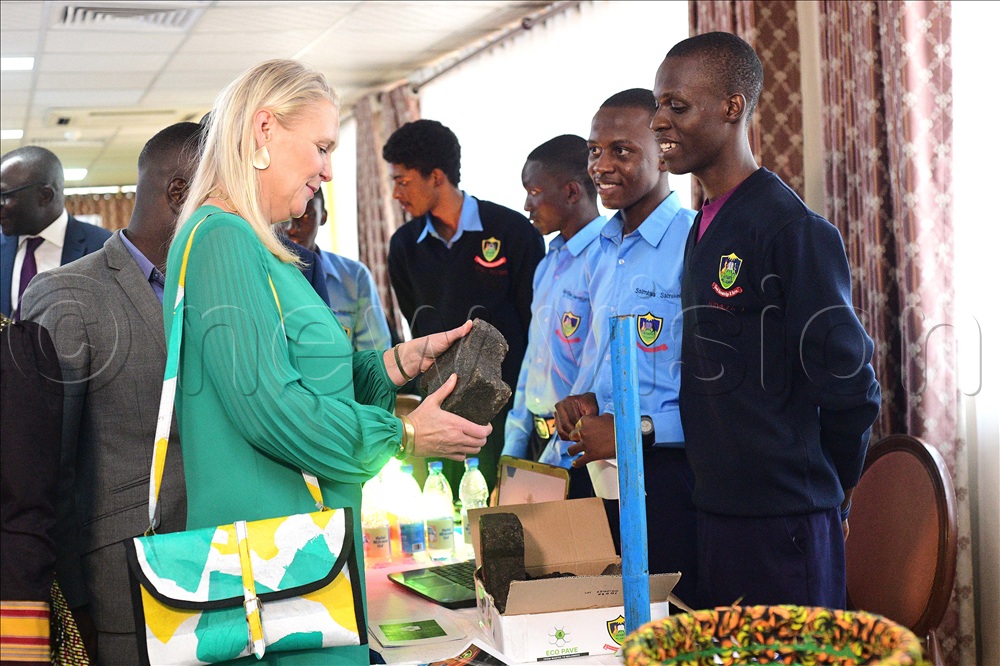
The scale of impact impressed even the British High Commissioner to Uganda, Lisa Chesney. “This project has reached 10,000 students across all five divisions of Kampala,” she said.
“They’re not only raising awareness about climate change and waste management, but they’re embedding community habits and turning ideas into practical action.”
Lisa Chesney, the British High Commissioner to Uganda, highlighted the critical role of Chevening scholarships in fostering this work.
"Achieving scholarships invests in future changemakers. Scholars go to the UK to study, then return to tackle challenges in their home countries. Shamim Ibrahim is a perfect example. She returned with a project that is making a real difference in waste management here in Kampala,” she said.
“The project works with the Kampala Capital City Authority, local schools, alumni networks, and other partners. Climate action and environmental management are collective efforts. And when done well, waste management doesn’t just protect the environment; it creates jobs and economic opportunities,” she added.
Economic value of waste
James Bond Kunobere, the deputy director of public health and environment, said reinforcing an economic perspective among people could be transformative. He noted that Kampala’s waste problem also represents an untapped opportunity that many residents have not yet realised.
“The city produces hundreds of thousands of metric tons of waste daily, but waste is not just a problem; it’s a resource. At landfill sites, over 700 waste pickers collect and sort materials to sell. For them, waste is a livelihood,” he said.
The British High Commissioner to Uganda Lisa Chesney looks at a basket made out of recycled plastic bottle tops and recycled polythene bags exhibited by students from St. Peters Senior Secondary School Nsambya. This was during her tour around a students’ exhibition themed sustainable waste management sponsored by the British High Commission through the Chevening Alumni Association of Uganda at Hotel Africana in Kampala on April 9, 2026. 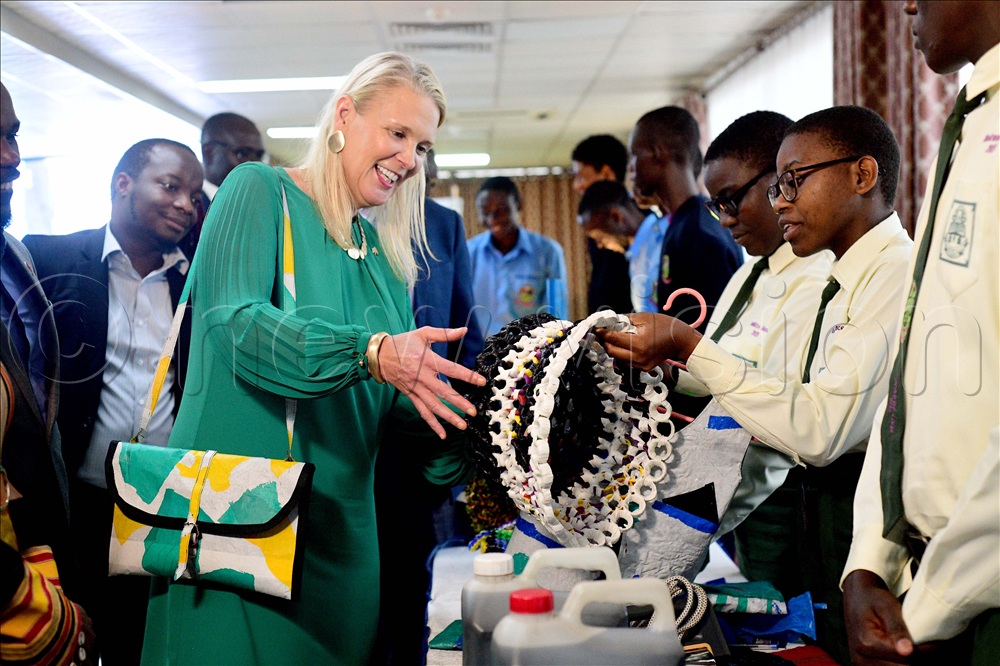
Kunobere shared an anecdote about why garbage workers prefer landfills over city collection:
“Transport costs are lower, buyers come directly to them, and many live nearby. Waste management is not only an environmental issue; it’s also a social and economic system,” he said.
He added, “We are all generators of waste. A universal system of paying for waste based on volume encourages responsible consumption. The less unnecessary waste you produce, the less you pay. And the principles are simple: reduce, reuse, recycle, and refuse.”
Students were encouraged to become champions of proper waste management. Segregation at source: “Mixing organic waste with paper reduces the value of both. " Simple habits, multiplied across thousands of people, can transform communities,” he noted.
With the involvement of students, he said, the results speak for themselves. Students are taking ownership, creating innovative solutions, and even producing recycled products. One recycled bag made by Reform Africa comes directly from Kiteezi landfill, showing that when waste is managed well, it can create opportunities and livelihoods.