
Adopt team teaching to improve curriculum delivery, educators told
“Develop team teaching to reduce topic gambling in the new curriculum,” Dr Bategeka told participants.
The Secretary of the Uganda National Institute for Teacher Education (UNITE), Dr Levi Kabagambe Bategeka addressing teachers at Ridar Hotel Seeta in Mukono Municipality on Thursday, April 23. (Photos by Isaac Nuwagaba)
________________
The secretary of the Uganda National Institute for Teacher Education (UNITE), Dr Levi Kabagambe Bategeka, has called on teachers to embrace team teaching as a deliberate strategy to end ‘topic gambling’ under the new competence-based curriculum.
Bategeka made the remarks on Thursday, April 23, 2026, during the official opening of a two-day induction training for academic, administrative and support staff of UNITE, held at Ridar Hotel Seeta in Mukono Municipality, Mukono district.
“Develop team teaching to reduce topic gambling in the new curriculum,” Dr Bategeka told participants.
“We cannot continue with a system where teachers pick and choose what to teach and what to leave out. That is gambling with the future of our learners because team teaching brings accountability, collaboration and subject mastery,” he observed.
UNITE teachers in an induction training meeting for academic, administrative and support staff at Ridar Hotel Seeta in Mukono Municipality on Thursday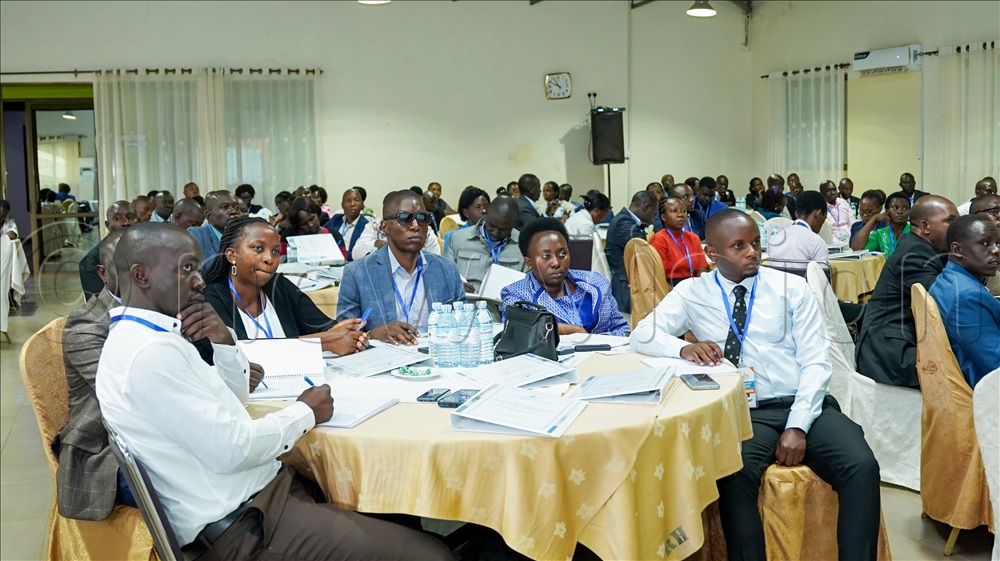
Bategeka questioned the continued practice of teaching topics that educators may not fully understand.
“Some teachers of let say Physics did not grasp well the topics of ‘light,’ ‘waves,’ and ‘heat’ when they were still students and many were failing ‘algebra,’ ‘matrix,’ and ‘vectors’ but still want to insist in teaching their students because they were hired to teach those subjects when others who handle Chemistry or Biology subjects in similar schools mastered such topics,” he argued.
The workshop, which runs from Thursday to Friday, drew over 200 staff members ahead of UNITE’s full operationalisation as Uganda’s apex teacher training institution following the phasing out of national teacher training colleges across the country.
Ending ‘topic gambling’
Topic gambling, according to Prof. Betty Akullu Ezati, the vice chancellor of UNITE, is the practice where some teachers selectively teach only parts of the syllabus they are comfortable with, leaving learners unprepared for national assessments and real-world application.
The new competence-based curriculum for lower secondary, rolled out by the Ministry of Education and Sports, requires learners to demonstrate skills across all topics, not only those favoured by individual teachers.
“Under the old system, a teacher could survive by specialising in three topics and ignoring the rest. The competence-based approach exposes that. If you do not teach the full scope, the learner fails to demonstrate competence,” she insisted.
“Team teaching means no single teacher owns a class. A team owns the learning outcomes,” Akullu observed.
She explained that UNITE will first model the approach internally. Lecturers in Mathematics, Sciences, Languages and Humanities will be grouped into teaching teams to jointly plan lessons, co-deliver content and co-assess learners.
Prof. Betty Akullu Ezati, the Vice Chancellor UNITE addressing teachers during the induction meeting at Ridar Hotel Seeta in Mukono Municipality. 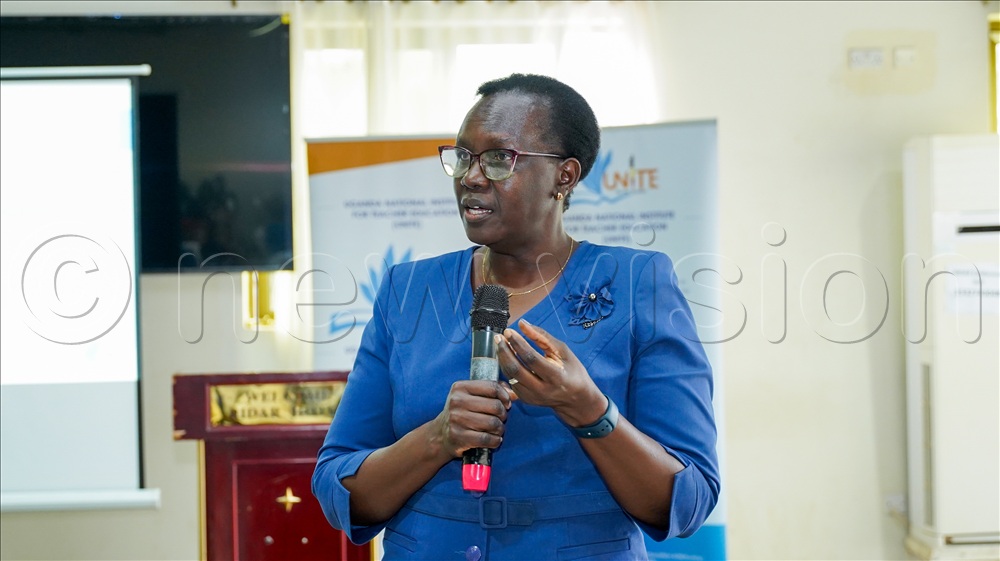
“The model will then be cascaded to the 23 national teachers’ colleges and primary teachers’ colleges that UNITE is mandated to coordinate as our regional campuses.”
Why team teaching now
The push comes as Uganda transitions all teacher training to degree-level qualifications under UNITE, established by the UNITE Act 2024.
The institute is tasked with professionalising teacher education and aligning it with the competence-based curriculum introduced in secondary schools from 2020.“Parents are asking why learners finish P7 or S4 but cannot apply what they learned. Employers say graduates lack skills. Part of the problem is fragmented teaching,” Akullu noted.
Prof. Joyce Ayikoru said that when teachers work in teams, History, Geography and Literature educators can jointly handle concepts such as conflict resolution across subjects. “That is the spirit of competence-based curriculum.”
Ayikoru added that when team teaching is strengthened, accountability shifts from individuals to teams. “If a topic is not taught, the team answers, not one person. That ends gambling.”
Rev. Prof. Dr Samuel Luboga, the chairperson of the Education Service Commission, urged teachers to uphold honesty, respect, responsibility, fairness and trust in all academic matters.
“Education has become a label, but there is need for practical practice, but do not be the ones to assist in cheating on examinations. Make sure that the examinations and research papers represent the individual’s understanding and efforts.”
Luboga emphasised academic integrity as key to fostering respect for intellectual property and creating a safe environment for critical thinking.