
31 Graduate in Palliative Care at Institute of Hospice, Makerere
Dr. Ekiria Kikule, Executive Director of IHPCA, addressed the graduates, urging them to embrace compassion as the cornerstone of their work. She also emphasised that education is the fastest way to spread palliative care and called for more people to join the profession.
A happy graduate celebrating with family at the graduation ceremony in Makindye on Wednesday, February 25, 2026. (Credit: Bridget Ahurira)
KAMPALA - A total of 31 health professionals have graduated with diplomas, degrees, and master’s qualifications in palliative care at a ceremony hosted by the Institute of Hospice and Palliative Care in Africa (IHPCA) and Makerere University.
The graduation, held on Wednesday, February 25, 2026, at IHPCA in Makindye, Kampala, marks a significant rise in the number of trained palliative care specialists in Uganda and the region.
Seven graduates were awarded diplomas and postgraduate diplomas in clinical palliative care, as well as a postgraduate diploma in psychosocial and spiritual palliative care by IHPCA. Meanwhile, Makerere University conferred diplomas, bachelor’s degrees, and master’s degrees in palliative care to 24 graduates in collaboration with IHPCA.
This academic achievement is the result of a collaborative training framework between the two institutions.
Additionally, 16 medical practitioners graduated with certificates in morphine prescription after completing a six-week intensive training program.
This certification equips them to safely prescribe, dispense, and manage morphine for patients in severe pain, an essential aspect of palliative care.
While Makerere University formally conferred the degrees and master’s qualifications earlier on Wednesday, IHPCA later hosted a separate ceremony to bring together all the graduates, including those with diplomas, degrees, and master’s qualifications, to celebrate their collective achievement.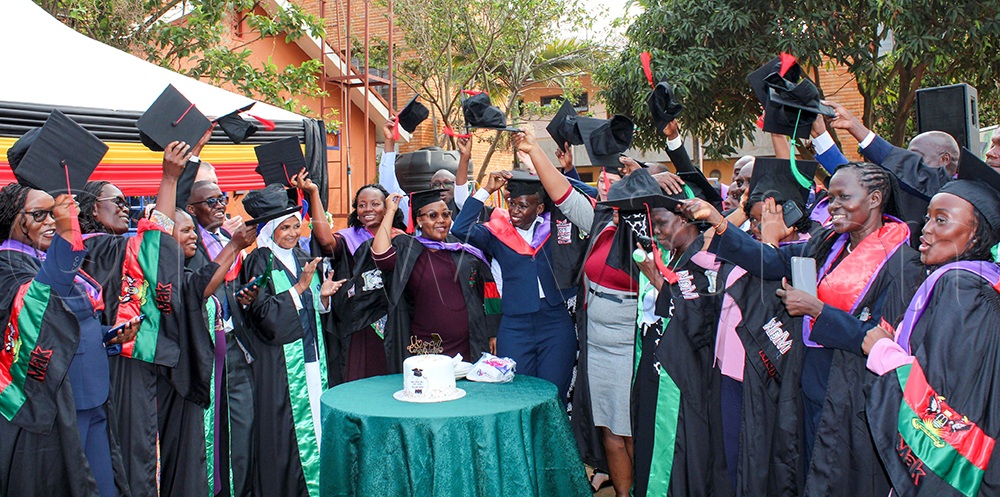
Graduates share a celebratory moment at the Institute of Hospice and Palliative Care premises in Makindye on Wednesday, February 25, 2026. (Credit: Bridget Ahurira)
In a poignant moment, Peter Isoka, a graduate who passed away during surgery, was honored posthumously. Isoka had been involved in an accident a year prior and tragically died during surgery to remove metals fixed in his leg.
He had pursued a postgraduate diploma in psychosocial and spiritual palliative care.
Dr. Ekiria Kikule, Executive Director of IHPCA, addressed the graduates, urging them to embrace compassion as the cornerstone of their work. She also emphasised that education is the fastest way to spread palliative care and called for more people to join the profession.
Prof. Harriet Mayanja Kiiza, Chair of the IHPCA Governing Council, also stressed the need for more palliative care specialists.
“You are our backbone,” she told the graduates.
Rose Kiwanuka, Uganda’s first palliative care nurse, encouraged the graduates to care for patients with love and compassion, making their lives more comfortable.
“Their illnesses need people like you and me,” she said. She also reminded them that palliative care should begin at diagnosis, not just at the end of life, ensuring no one has to live with pain.
According to the Palliative Care Association of Uganda, non-communicable diseases (NCDs) are responsible for 34% of deaths in Uganda. These include cardiovascular diseases, cancers, diabetes, chronic respiratory diseases, and other NCDs.
The prevalence of NCDs among older persons, especially those suffering from age-related conditions, further highlights the need for palliative care in Uganda.
Prossy Nakyanja, Executive Director of Hospice Africa Uganda (HAU), highlighted the important responsibility the graduates now carry to ensure palliative care is accessible to all in Uganda and across Africa.
IHPCA continues to draw students from across Africa. This cohort included graduates from Uganda, Kenya, and Malawi, reflecting the institute's expanding regional footprint and the growing recognition of palliative care as a crucial component of healthcare on the continent.