
Former Paibona clan chief Rwot Torach remembered as unifying force in Acholi
In his homily, Archbishop Odama described the late Rwot as a God-fearing leader who guided his people in faith and unity.
The Most Rev. John Baptist Odama, Emeritus Archbishop of Gulu Archdiocese laying a wreath on the Rwot Torach's casket. (Photos by Christopher Nyeko)
________________
Rwot Raymondo Torach, the cultural chief of Paibona chiefdom and one of the oldest surviving traditional leaders in Acholi, has been laid to rest at his palace in Paibona, Gulu district, in a ceremony marked by deep cultural pride and solemn tribute.
Rwot Torach, a renowned promoter of peace and human dignity, passed away on March 2, 2026, at the age of 91. He was buried on Saturday, April 25, 2026, at 3:35 pm in his royal tomb.
Thousands of mourners attended the burial, including cultural leaders, political figures, religious authorities and members of royal families, alongside relatives and friends. The palace compound was filled to capacity as people gathered to celebrate the life of a respected leader.
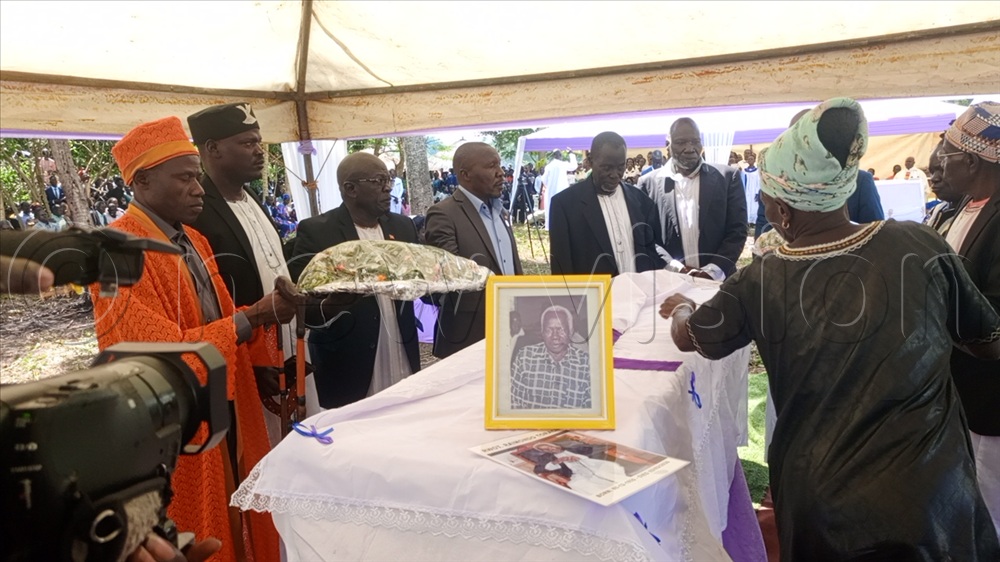
The ceremony blended Acholi cultural traditions with Christian rites. Cultural performances such as the myel lyel burial dance, Aguma, Larakaraka, Bwola and royal dances were performed alongside a Holy Mass led by the Most Rev. John Baptist Odama, Emeritus Archbishop of Gulu Archdiocese.
In his homily, Archbishop Odama described the late Rwot as a God-fearing leader who guided his people in faith and unity. He urged Acholi leaders to emulate his example by fostering cohesion and spiritual leadership within their communities.
He also called on the Acholi people to support transformational initiatives championed by Amb. Olara Otunnu and Chief Justice Emeritus Alphonse Owiny-Dollo, citing concerns over disunity, drug abuse and declining communal responsibility.
Captain David Drisi, the internal security officer in charge of Acholi, representing director general of ISO Arthur Mugyenyi, described Rwot Torach as a custodian of African culture and a peacemaker.
He noted that the late chief played a significant role during the LRA conflict, advising government on reconciliation, cultural preservation and land protection.
“He was not only a leader but also a unifying figure who bridged tradition and modern governance,” Drisi said.
Condolences from the Acholi paramount chief, David Onen Acana II, were delivered through Stella Kijange Lajiri of Ker Kwaro Acholi. Acana described Torach as a mentor and a reservoir of cultural knowledge, noting that he imparted wisdom on leadership, including the value of restraint and silence.
He urged the people of Paibona to support Rwot Torach’s successor, Charles Lamony, and accord him the same respect given to his father.
Other speakers, including Moses Ogwang, the Gulu district police community liaison officer, praised the late chief for his honesty, transparency and dedication to cultural preservation.
Amb. Otunnu called on the Acholi community to revive their commitment to education and hard work, urging parents to prioritise schooling and communities to invest in high-value crops such as coffee, cocoa, bananas and cashew nuts to combat poverty.
Rwot Torach’s successor, Charles Lamony, pledged to uphold his father’s legacy and called for unity and responsible parenting.
The burial followed strict Acholi customs. Rituals included the slaughtering of animals and symbolic rites intended to ensure spiritual harmony. The chief’s body was removed from a modern coffin and wrapped in a black bull’s hide before being laid to rest in a specially prepared earthen grave.
According to burial committee chairperson Jackson Ayoli pa Oyuta, all necessary cultural procedures were performed using the required regalia. These included the sprinkling of sheep’s blood at the palace entrance to ward off bad omens and allow cultural leaders to safely participate in the rites.
A cave-like grave was prepared using only soil, in line with tradition, and an empty casket was buried alongside, symbolising the integration of modern and cultural practices.
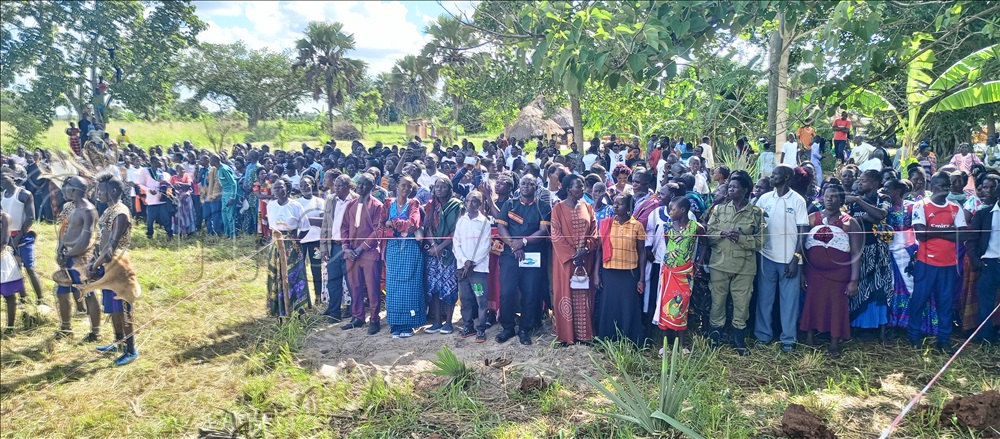
The royal family announced that the coronation of the new chief, Charles Lamony, will take place in July after a mourning period. Preparations are underway, with traditional regalia already secured in accordance with Paibona customs.
Background
Paibona chiefdom is one of the oldest in Acholi, tracing its lineage to Labongo II. The line of chiefs includes several revered leaders, culminating in Rwot Raymondo Torach and his successor, Charles Lamony.
Born on December 5, 1935, in Paibona-Goo, Torach was the son of chief Yocero Okeny. Before ascending to the throne in 2000, he served in the Kenya Police and later in the Kenya and Uganda Prisons Services.
He was crowned chief on January 31, 2000, during a time when many of his subjects were living in internally displaced persons camps due to the LRA insurgency.
Legacy of service
Rwot Torach played a key role in peacebuilding efforts during the LRA war, participating in reconciliation talks between the government and rebels. He worked closely with political and cultural leaders to promote unity and healing in Acholi.
He also championed land protection, youth mentorship and the promotion of cultural values, while discouraging practices that undermined human dignity.
Widely regarded as the “Acholi dictionary,” he served as chairman of the Acholi land committee in West Acholi and remained a respected voice in matters of culture and governance.
He is survived by children, grandchildren, and a legacy deeply rooted in service, peace and cultural preservation.