
Christ the King parish marks 95 years
According to the records of the Church, the plan of building Christ the King Church was conceived by two Mill Hill Prelates, namely Bishop John Biermans and Bishop John William Campling, who initially secured a plot of land at Buganda Road (Plot 24).
A spectacle of Christ the King Church Kampala. (Photo by Mathias Mazinga)
___________________
Christ the King Church, Kampala, generally acknowledged as one of the most famous Catholic parishes in Uganda and East Africa, has a very interesting history, which dates back to 1930, when the Mill Hill Missionaries, who then had their headquarters at Nsambya (in Makindye Division), took the option of building a church in the centre of Kampala city.
Their main aim was to relieve the Indian Catholics in Kampala City of the burden of trekking to Lubaga and Nsambya for prayers. Most of those Indians happened to be hailing from the Indian state of Goa, the reason why the natives nicknamed them ‘Abagoowa.’
The pioneer Goan Indians had come to Uganda three decades earlier, in 1900, to construct the Uganda Railway.
According to the records of the Church, the plan of building Christ the King Church was conceived by two Mill Hill Prelates, namely Bishop John Biermans and Bishop John William Campling, who initially secured a plot of land at Buganda Road (Plot 24).
They nonetheless later discovered the plot to be unsuitable for the project. They deemed it to be too small. Consequently, they went into talks with one Indian, Mahomedali Allibhai Ramji, who agreed to give them Plot No. 14 on Colville Street (where Christ the King Church currently stands), on an exchange basis.
The first church was built by the Dutch Mill Hill priest, the Rev. Fr. H Janssen, who had already worked among the Goans between 1921 and 1926. It is reported to have been a very small church that accommodated just about 200 congregants.
Fr. Janssen started the work literally from zero. He had to cut the tall elephant grass, level the hills, make the bricks. He worked with a Dutch architect, M. Nelissen, who drew the plan for the church. A contractor was sourced to carry out the work.
The choice fell on Budh Singh (an Indian), who agreed to do the work to completion at a cost of 7,500/= (a huge amount of money then). Fr. Janssen made/baked his bricks at Luzira (then part of Nsambya Mission). But he soon ran out of funds and returned home to seek financial assistance.
The foundation stone of the church was laid by the then Mill Hill Bishop of Nsambya, the Rt. Rev. John Campling on October 27, 1929 (the Catholic Feast of Christ the King). During the progression of the work, Fr. Janssen was assisted by P. J Currivan. Together, they spent endless hours at the site supervising and directing the work and were not afraid to stick out a hand themselves.
Bishop Campling is recorded to have opened and blessed Christ the King Church on October 26, 1930. The Prelate was assisted by Fr. V.G Minderop and Fr. W. Fink, who was then the Superior of the Mill Hill Fathers’ Mission of Nsambya.
The joyful event climaxed with a dinner at the Grand Imperial Hotel. The church’s presbytery was nonetheless completed two decades later, in 1953, and that was when the parish became fully detached from the Mill Hill Fathers’ Mission of Nsambya.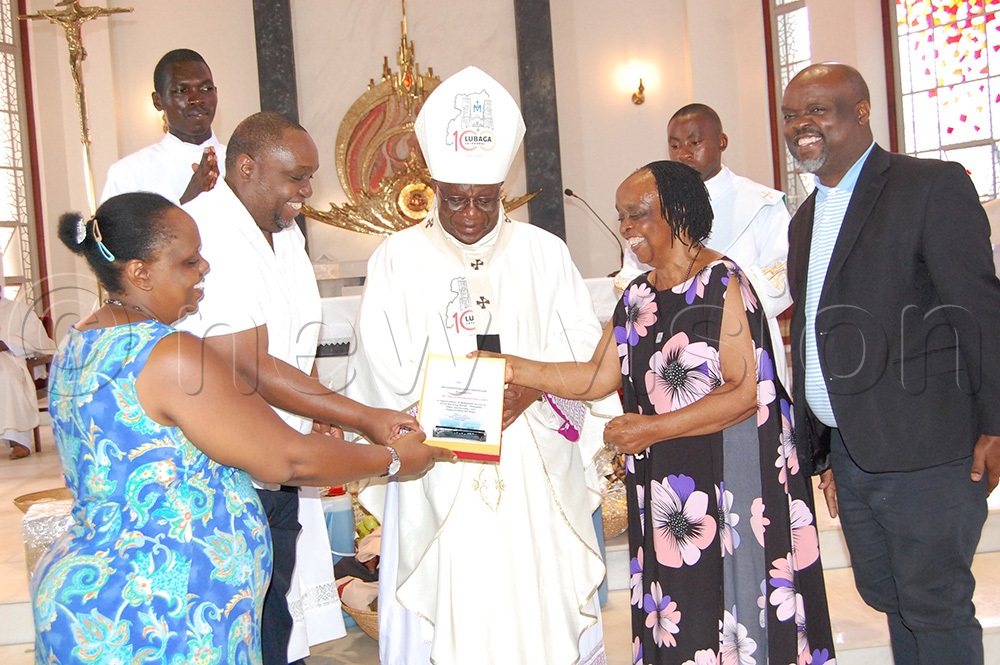
Family members receiving an accolade from Archbishop Paul Ssemogerere. (Photo by Mathias Mazinga)
In 1934, Janssen was appointed to Nyenga parish (in Buikwe district) and was succeeded by the Irish Mill Hill priest, the Rev. Fr. Joseph Martin. Decades later, administration of the parish was handed over to the local clergy. The church also became cosmopolitan. Native Ugandans from various parts of the country started worshipping from it. And today, it is deemed to be the most influential parish in the country. Emmanuel Cardinal Wamla once described it as “the heart of Kampala Archdiocese.”
Of course, over the years, the number of worshippers at Christ the King Church kept growing, and the church had to be renovated/expanded a number of times. By the 2000s, the congregations had grown even more massively that the pastoral council of the church had no alternative but to come up with a plan for a mega expansion of the church and its presbytery. The proposed modifications could nonetheless not be done after the engineers found the foundation of the old church too weak to hold the weight of the same modifications.
So, the project manager, Architect Henry William Ssentoogo (RIP) designed a completely new structure, which, of course, maintained the image of the old church. The new 1,500-seater church was officially blessed/consecrated/rededicated on November 18, 2023.
Archbishop Paul Ssemogerere and Msgr. Gerald Kalumba presided over the function under the theme: The glory of this present house will be greater than the glory of the former house (Haggai 2:9).
Christ the King Church, Kampala, marks 95 years
On November 23 (2025), the parishioners and friends of Christ the King Church gathered at the church in Kampala to celebrate the parish’s 95th anniversary. The Thanksgiving Mass was presided over by the Archbishop of Kampala Archdiocese, Paul Ssemogerere. The reigning parish-priest, the Rt. Rev. Msgr. Gerald Kalumba and several other priests concelebrated the highly colourful mass.
During the function, selected Christians, who have demonstrated exceptional commitment to the church over the years, were recognised and given accolades of appreciation.

A spectacle of the parishioners of Christ the King Church Kampala during the Pontifical mass fot the parish's 95th aniversary. (Photo by Mathias Mazinga)
Among the many parishioners that were awarded was the late Henry William Ssentoogo, a globally acclaimed architect and philanthropist who designed the new Christ the King Church and also supported its main choir, Christ the King Church Choir Kampala. Ssentoogo’s wife, Lady Mildred Warugaba Ssentoogo, was also honoured for her long liturgical music ministry and leadership at the church.
Others that were honoured include the parish’s former head of the laity, John Walusimbi, John Chrysostom Ssekatawa (also a former head of the laity), Catechist Baguma and Lady Anunciata Ssebuggwawo, just to mention a few.
The parishioners also congratulated Msgr. Joseph Mugamba, the parish’s long-serving curate who celebrated 100 years of age and 70 years in priesthood.