
'Uganda ready to produce sustainable aviation fuels'
Verlarde noted that Uganda has the potential and the capacity to produce sustainable aviation fuels mainly based on the use of waste.
Some of the stakeholders present during the hand over of a report on a feasibility study in sustainable aviation fuels. (Credit: Julius Luwemba)
_________________
Uganda's combination of biomass availability, waste management needs and strategic infrastructure provides a strong foundation for the deployment of sustainable aviation fuels (SAF). This was revealed in a feasibility study report presented on December 1, 2025, to different stakeholders in a meeting held at Imperial Golf View Hotel in Entebbe municipality.
The feasibility study was conducted under the guiding rules of the International Civil Aviation Organisation (ICAO) with support from the United Kingdom's department for transport.
"With quantified technical potential exceeding 300-850 million litres per year, certified pathways and airport readiness, Uganda is positioned to progress from feasibility to first-generation production within this decade. A robust policy framework, blended finance support and coordinated leadership will enable Uganda to become a regional SAF pioneer, advancing energy security, economic diversification and climate-aligned growth in East Africa," the report reads.
Background
In 2024, the United Kingdom made a voluntary financial contribution to ICAO to fund at least three feasibility studies on sustainable aviation fuels for states, including Uganda. The study assessed the potential for producing and utilising sustainable drop-in SAF in Uganda, ensuring alignment with the environmental and socio-economic sustainability criteria in ICAO's carbon offsetting and reduction scheme for international aviation.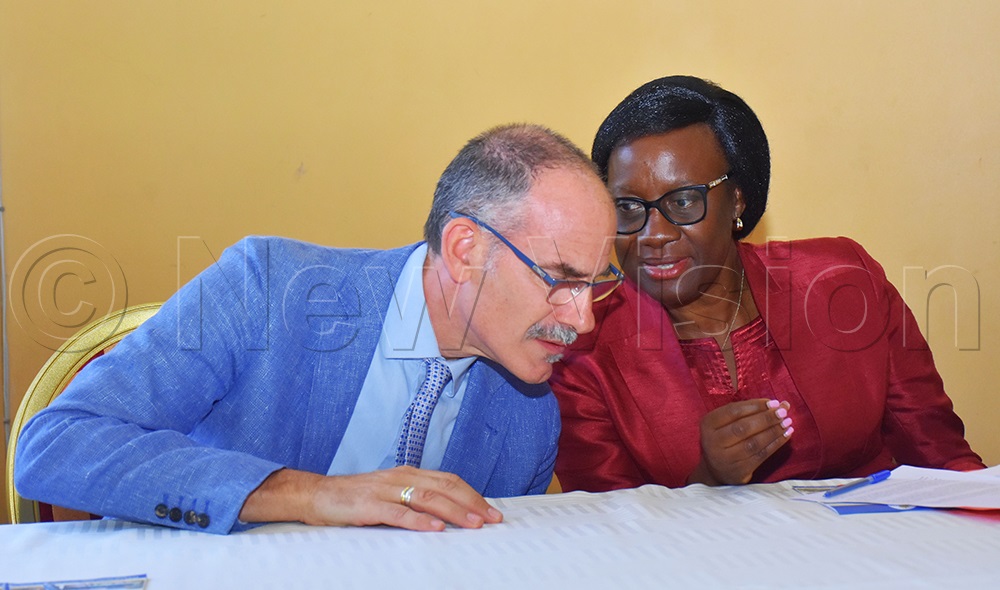
Olive Birungi Lumonya (right) the UCAA deputy director general talking to Cesar Verlarde representing the ICAO director of Air transport bureau during the hand over of SAF report on Monday. (Credit: Julius Luwemba)
While releasing the study report on Monday, Cesar Verlarde, representing the ICAO director of Air Transport Bureau, noted that Uganda has the potential and the capacity to produce sustainable aviation fuels mainly based on the use of waste.
"Once we identify that a certain state (country) has the potential and stock in the future to produce SAF, we proceed with another step known as business development study that goes from potential to real identification of a business case that would make a SAF production plant viable in the country," Verlarde said.
He further noted that some ICAO member states, like several European countries, India and Brazil, among others, are already establishing mandatory use of small amounts of SAF in growing proportions throughout the years.
According to the study, Uganda generates significant quantities of sugarcane, maize, cassava, among other agricultural residues, while its rapidly growing urban centre produces an increasing volume of municipal solid waste.
"With the aviation sector expanding through Entebbe International Airport and the new domestic routes, the opportunity to decarbonise air transport and strengthen national energy security is substantial," UCAA spokesperson Vianney Luggya said.
He stated that the study evaluates the technical and economic feasibility of SAF production in Uganda, identifies key enabling factors and provides a roadmap for implementation aligned with ICAO's regulations and Uganda's Vision 2040.
Embrace the opportunity
Irene Atto, who represented Ronny Barongo, the director for safety, security and economic regulations, expressed UCAA's commitment to champion sustainability within the sector, fostering innovation and ensuring that Uganda keeps pace with global advancements in green aviation technologies.
"Together, we need to embrace this opportunity to position Uganda as a regional leader in sustainable aviation, to support national climate objectives and to achieve a collective global goal of reducing international aviation's carbon emissions by 5% in 2030 through the use of SAF, lower carbon aviation fuels and other cleaner energies," Atto said.
Olive Birungi Lumonya, the UCAA deputy director general assured that Uganda will proceed to the next phase of the business plan.

Entebbe airport. (Credit: Julius Luwemba)
According to Lumonya, Uganda recognises that achieving ICAO’s long-term aspirational goals requires a comprehensive approach, including advancements in aircraft technology, operational improvements for air navigation and aerodromes, plus the use of Sustainable Aviation Fuels.
Quoting the study, the UCAA deputy director general said Uganda is actively participating in global efforts towards the progressive and collective decarbonisation of air transport, as well as transitioning to cleaner aviation energy sources, in order to adapt aviation operations to the growing risks posed by climate change.
"The mandates for using SAF blends are already being implemented in Europe and other regions of the world; even our national carrier operating in the UK is required to uplift SAF-blended fuel on its return route from London. At UCAA, we believe that fast-tracking the production and deployment of our own SAF will not only reduce costs for our national carriers but also contribute to environmental sustainability and create economic opportunities for the business community," Lumonya said.
She further stated that the ministry of energy and mineral development, as well as the Uganda National Oil Company (UNOC), are expected to play a pivotal role in steering the national SAF and cleaner aviation energy programme, while UCAA will continue to serve in an advisory capacity.
Other agencies consulted during the feasibility study include, the agriculture ministry, the National Environment Management Authority, the Ministry of Works and Transport, the Electricity Regulatory Authority and the Uganda Investment Authority.
In June 2022, ICAO launched a programme geared towards assistance, capacity building and training for sustainable aviation fuels in order to aid developing states in their transition to cleaner energy for aviation. Later, the 41st ICAO assembly adopted a long-term global aspiration for international civil aviation; collectively targeting net-zero carbon emissions by 2050 as a contribution to global climate action.