
Traders push for VAT threshold hike to sh500m to shield small businesses
Traders say the government’s proposal to raise the VAT threshold from sh150 million to sh250 million does little to address the financial realities faced by small and medium enterprises, particularly those operating in Kampala’s busy Kikuubo business hub.
Amos Kankunda, the committee chairperson and Rwampara legislator. (Credit: Maria Wamala)
__________________
Traders across Uganda are urging Parliament to raise the Value Added Tax (VAT) registration threshold to sh500 million, arguing that the proposed increase to sh250 million is too low to shield small businesses from mounting tax compliance costs.
The call was made during a meeting on April 13, 2026, between the Uganda National Traders Alliance (UNTA) and the Parliamentary Committee on Finance, Planning and Economic Development.
Traders say the government’s proposal to raise the VAT threshold from sh150 million to sh250 million does little to address the financial realities faced by small and medium enterprises, particularly those operating in Kampala’s busy Kikuubo business hub.
(L-R) Rwabwogo Businge, General Manager Operations Mukwano Industries (U) Ltd, Geoffrey Ekanya MP Tororo County North and Dickson Kateshumbwa MP Sheema municipality interact after appearing before the finance committee of parliament on April 13, 2026. (Photo by Maria Wamala)
Deus Musiime, a tax adviser and clearing agent working closely with traders, told lawmakers that a higher threshold would provide breathing space for struggling businesses.
“With the new proposed tax proposals, government is basically saying that if your net annual sales hit sh150 million, you need to register as a VAT-compliant trader. Now they are increasing the threshold to sh250 million, which we are still saying is very low,” Musiime said.
He revealed that traders had initially proposed a threshold of sh1 billion in a recent meeting with President Museveni, but later adjusted their position to sh500 million as a more practical compromise.
“Even bringing it to sh500 million will keep the lay businessman in business. Many people downtown in Kikuubo cannot afford to hire tax experts, let alone purchase expensive gadgets meant to assist with tax calculations,” he said.
Musiime linked the proposal to the high cost of complying with the Electronic Fiscal Receipting and Invoicing System (EFRIS), which requires traders to invest in devices and professional tax services.
“You have to buy gadgets and even pay tax experts to help you file returns. Increasing the threshold will help people remain in business while those who can afford to comply continue paying as others grow,” he added.
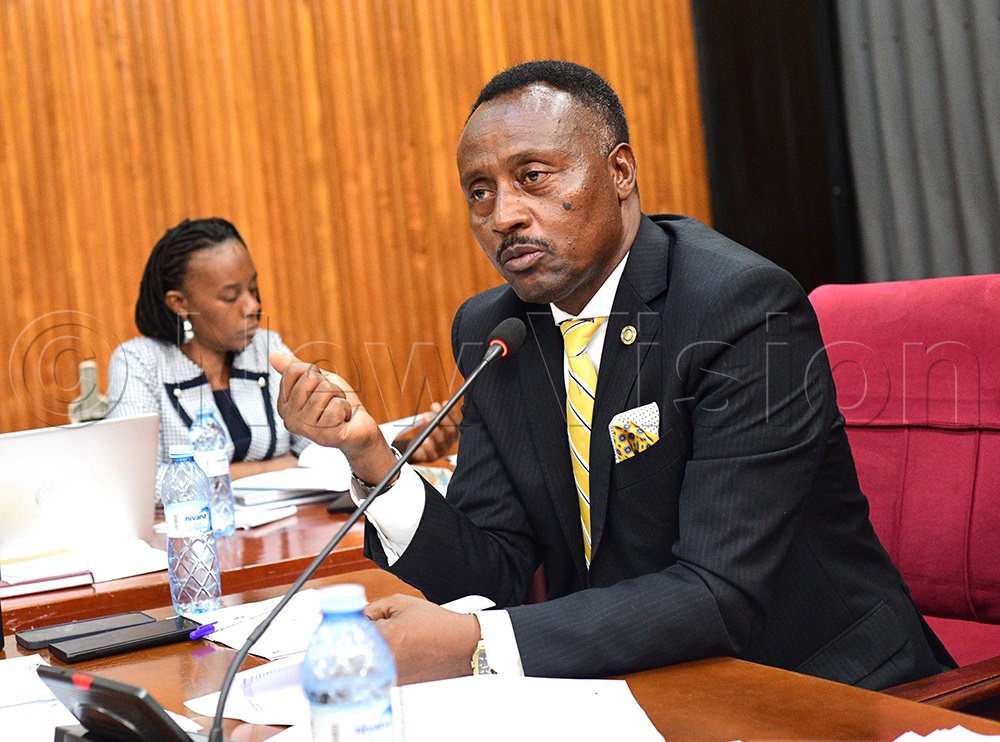
Amos Kankunda, the committee chairperson and Rwampara legislator. (Credit: Maria Wamala)
Lawmakers acknowledged the concerns, with Amos Kankunda, the committee chairperson and Rwampara legislator, assuring traders that their views would be considered in the ongoing scrutiny of tax proposals.
“I want to assure you that you have the listening ear of Parliament,” Kankunda said, while urging stakeholders to focus on submissions relevant to the finance committee.
Mwebiha Muzamiru, speaking on behalf of the Kampala Arcaders Advocacy Forum (KAAFO), warned that keeping the threshold low could push more businesses into informality.
“These tax measures risk suppressing investment appetite, reducing disposable income and ultimately threatening economic growth,” he said.
He added that traders are already grappling with a difficult operating environment marked by exchange rate volatility, inflationary pressures, and global supply disruptions.
Dr Julius Byaruhanga from the Private Sector Foundation Uganda (PSFU), who represented Shirley Kongai, chairperson of the Policy Advocacy Committee of the PSFU Board, said the foundation supports the amendment on the VAT threshold but with safeguards.
“There is need for Uganda Revenue Authority (URA) to strengthen enforcement on fragmentation, enhance taxpayer education, and adopt risk-based monitoring of near-threshold firms. However, we propose that this threshold is reviewed after 2 to 3 years,” he said.
Byaruhanga said the proposal aligns with efforts to ease cost pressures on small and medium enterprises, where compliance costs are disproportionately high relative to turnover.
“It allows URA to focus on high-yield taxpayers, improving efficiency. However, given Uganda’s revenue target of sh37.2 trillion (FY2025/26), safeguards are necessary to prevent abuse and protect the tax base. A balanced approach promotes formalisation, growth, and compliance while maintaining revenue integrity,” he noted.