
Trade Order reinforcement to continue, says Cabinet
Local Government Minister Raphael Magyezi and the Minister of Kampala, Hajjat Minsa Kabanda, on Tuesday April, 28, said that the Cabinet on Monday discussed the matter and agreed that it must continue and specific guidelines be given out.
Raphael Magyezi, the Minister of local government addressing journalists during a press conference at the Uganda Media Centre on April 28, 2026. (Photo by Nancy Nanyonga
_______________
The government has insisted that trade order enforcement operations across the country must go on despite earlier parliamentary communication that it had been temporarily suspended.
Local Government Minister Raphael Magyezi and the Minister of Kampala, Hajjat Minsa Kabanda, on Tuesday April, 28, said that the Cabinet on Monday discussed the matter and agreed that it must continue and specific guidelines be given out.
The statements offer a different stand from the statements by Trade Minister David Bahati, who told Parliament on Friday, April 24, that the government had suspended operations to allow further consultations with stakeholders, including the Inter-Religious Council of Uganda and trader associations.
Addressing journalists at the Media Centre on Tuesday, he said the trade order initiative remains central to decongesting cities, improving sanitation, and ensuring that businesses operate only in designated and gazetted spaces.
He said the implementation will now focus more on stakeholder inclusion and phased enforcement.
“We shall strengthen community sensitisation to ensure everyone is on board. One of the concerns raised was that implementation was rushed without adequate consultation,” he said.
He added that a dedicated task force will be established to coordinate implementation with vendors, religious institutions, and local governments.
“We shall work with stakeholders to ensure those who have not yet found space in formal markets are reassigned without compromising their livelihoods,” he said.
(L-R) Minsa Kabanda Minister for Kampala, Raphael Magyezi Minister of local government,David Sserumagga, Charles Magumba Commissioner Urban Administration and Daniel Nuwabiine Spokesperson KCCA interacting after a press conference at the Uganda Media Centre on April 28, 2026. 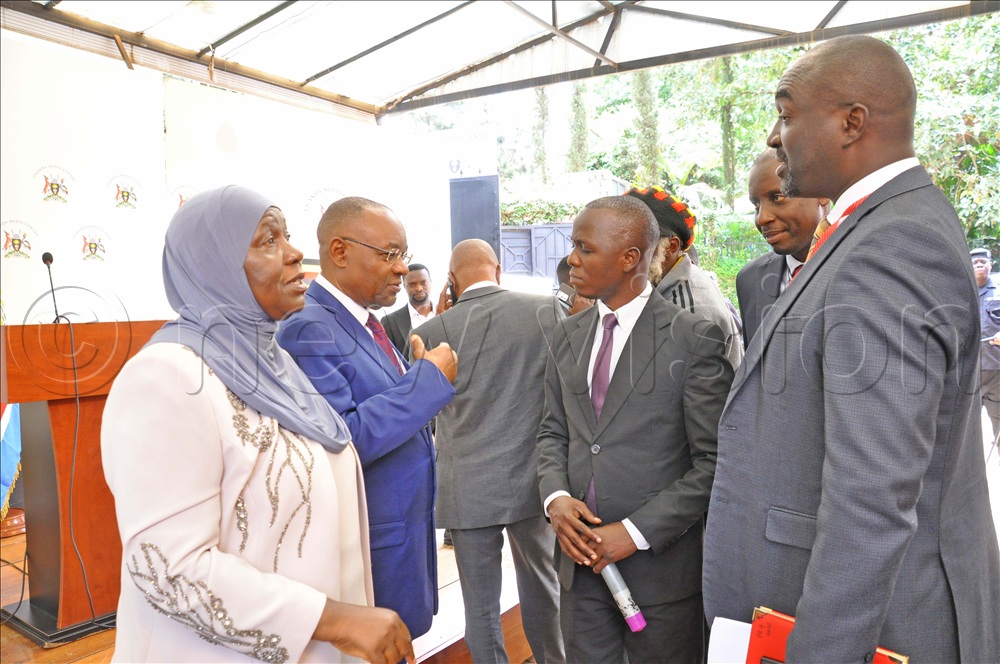
KCCA Corporate Affairs head Emmanuel Niweabine reported significant progress in market reorganisation and compliance.
He noted that of the 2,520 market spaces previously advertised, 1,663 have already been taken up, leaving 857 still available for allocation.
Niweabine also revealed that KCCA has repossessed stalls and lockups that remained unused for over 90 days under provisions of the Markets Act.
“In Busega Market alone, 107 spaces that had been booked but remained unused were repossessed and are now being reallocated.
We have seen reduced traffic obstruction in areas such as Ntinda, Nakasero, Allen Road, Ndeeba, Busega and even Kalerwe, where movement was previously difficult, ” he said.
He further highlighted improvements in sanitation and drainage, noting that flooding in the Central Business District has significantly reduced, with water now draining within minutes after rainfall.
Kampala authorities maintained that while operations outside the capital had faced implementation challenges, Kampala itself had recorded measurable improvements and would not reverse gains already achieved.
Kabanda confirmed that the next phase of urban reform will focus on transport regulation, including boda boda operations and the introduction of structured bus systems in Kampala.
However, officials emphasised that reforms will be rolled out gradually.
“Boda boda operators are already organising into federations, and engagement will continue before full regulation is implemented,” Kabanda said.
She said the goal is not displacement, but transformation of urban spaces into cleaner, safer, and more organised economic hubs.