
Regional telecom regulators unite to address cross-border connectivity challenges
“Affordable, seamless and reliable cross-border communication is no longer simply a telecommunications issue; it is a practical requirement for the realisation of the EAC Common Market and the emerging Single Digital Market,” Hon. Malueth said.
EAC Deputy Secretary General, Hon. Andrea Aguer Ariik Malueth delivers opening remarks during the meeting in Dar es Salaam. (Courtesy photos)
________________
Heads of Communications Regulatory Authorities from East African Community (EAC) Partner States have convened to advance discussions on a harmonised regional mobile roaming framework aimed at improving cross-border connectivity, lowering communication costs, and strengthening regional integration.
The high-level policy meeting, which took place on Thursday in Dar es Salaam, Tanzania, brought together regulators, technical experts, regional organisations, and development partners to review the draft Enhanced Regional Mobile Roaming Framework, which seeks to facilitate affordable, seamless, and secure roaming services across East Africa.
Opening the meeting, the EAC Deputy Secretary General in charge of Infrastructure, Productive, Social and Political Sectors, Hon. Andrea Aguer Ariik Malueth, said digital connectivity has become central to trade, investment, and service delivery within the region.
“Affordable, seamless and reliable cross-border communication is no longer simply a telecommunications issue; it is a practical requirement for the realisation of the EAC Common Market and the emerging Single Digital Market,” Hon. Malueth said.
He noted that the proposed framework is intended to strengthen regulatory coordination and improve the daily communication experience of citizens, businesses and travellers moving across Partner States.
Speaking on behalf of the Director General of the Tanzania Communications Regulatory Authority, Eng. Peter Mwasalyanda, John Wallace Daffa, Director of Licensing and Compliance, reaffirmed Tanzania’s commitment to regional digital integration and competition within the communications sector.
Daffa said Tanzania currently has five mobile network operators competing in the market, adding that regional roaming reforms are already demonstrating positive results in reducing communication costs.
“We can now witness the benefits when moving within the region. Roaming is no longer considered a luxury. This is aligned with the EAC vision of free movement of people, goods, and services and reducing the cost of doing business,” Daffa said.
Delegates pose for a group photo during the High-Level Meeting of Heads of National Communications Regulatory Authorities in Dar es Salaam, Tanzania. 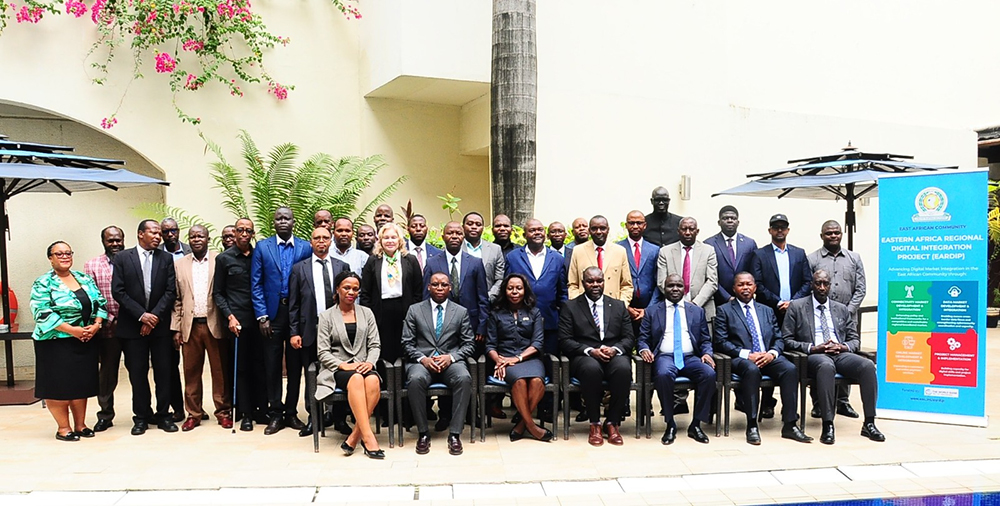
Representing the Executive Director of the Uganda Communications Commission, Hon. Nyombi Thembo, Eng. Alfred Joseph Bogere, Director of Engineering and Communications Infrastructure, said access to ICT services is now essential for economic and social participation.
“We recognise that access to ICTs is no longer a luxury. It is now central to education, healthcare, commerce, governance, employment, and social participation, and has become a core element of regional integration,” Eng. Bogere said.
The meeting reviewed key issues affecting the implementation of a harmonised roaming framework, including pricing structures, consumer protection, compliance monitoring, dispute resolution, and operational coordination among telecommunications operators.
Under the proposed framework, national regulators are expected to play a central role in ensuring roaming services remain affordable, reliable, and consumer-centred across the EAC region.
The regulators will also coordinate on common approaches regarding pricing, inter-operator arrangements, and quality of service standards to ensure fair and transparent roaming charges.
In addition, the framework seeks to strengthen cooperation among regulators on issues such as interoperability, fraud prevention, traffic management, data exchange, and service continuity to improve customer experience for citizens travelling within the region.
Consumer protection has also emerged as a major focus area, with regulators expected to enhance transparency in roaming charges, increase consumer awareness, and establish safeguards against unfair billing practices and service disruptions.
Regional regulators say harmonised roaming arrangements will help reduce communication costs, facilitate the movement of people and goods, strengthen regional trade, and improve digital inclusion across East Africa.
The proposed framework is also expected to create a more predictable regulatory environment capable of attracting investment, encouraging innovation and supporting sustainable growth within the telecommunications sector.
The meeting was organised by the EAC Secretariat through the Eastern Africa Regional Digital Integration Project (EARDIP) with support from the World Bank, the East African Communications Organisation (EACO), and the Smart Africa Alliance.