
Business
Partnership to enable miners get modern equipment
Established in Uganda three years ago, Feldstein Trading Ltd engaged in gold refining and value addition, refining gold to the international purity standard of 999.9 in accordance with Ugandan government regulations.
(Courtesy)
By: Charles Etukuri, Journalists @New Vision
___________________
Thirty-four-year-old Rose Nawakol has been mining gold for the last 20 years in the Karamoja region-based Amudat district. She is part of a group that digs deep pits to extract ore, which is then pounded into dust using manual, traditional crushers.
The pounded soil is then placed in a Karaya with Angalia (a local basin that is used to mine and a local hoe) to get gold.
“I do it every day as my main activity, and I learned mining by seeing others do it,” she said.
Nawakol says it's tedious work because each scoop is a gamble. Each scoop of earth is placed in a Karaya basin, taken into the river and washed with the hope that they will identify gold particles from it.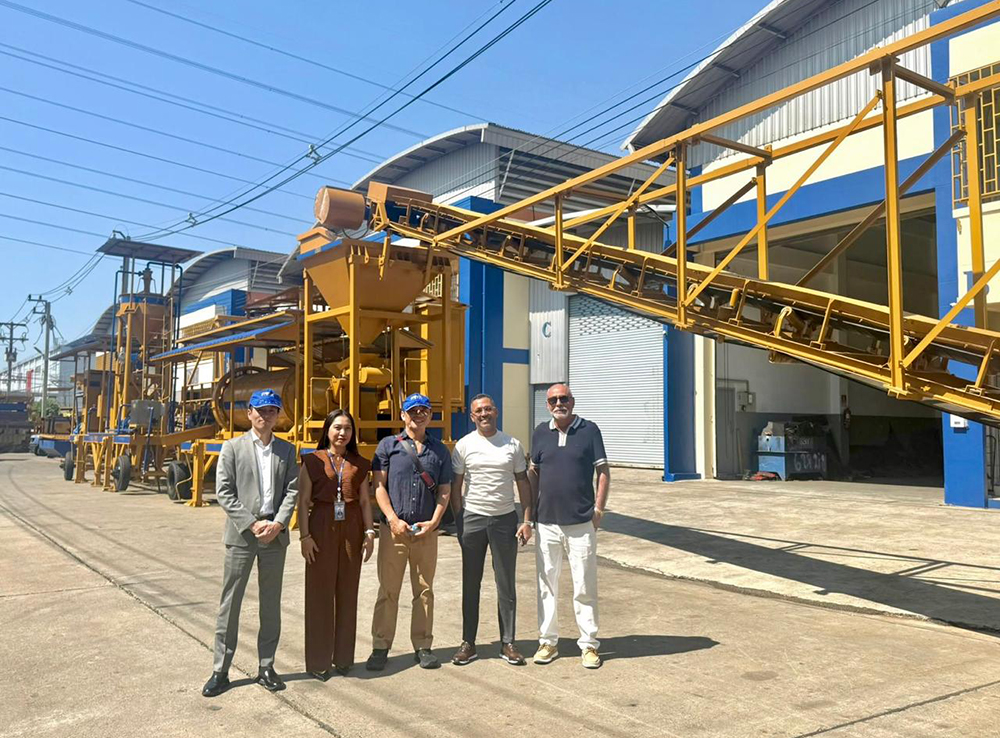
(Courtesy)
“You can even scoop soil and wash more than ten times without identifying a single piece of gold. But you have to continue digging the soil and putting water until you get some gold,” she says.
Such rudimentary methods are the problem Feldstein Trading Limited, a licensed gold refinery operating in Uganda, is hoping to solve by partnering with DOVE Equipment and Machinery Co., Ltd, a manufacturer of professional mining and processing equipment based in Thailand.
Established in Uganda three years ago, Feldstein Trading Ltd engaged in gold refining and value addition, refining gold to the international purity standard of 999.9 in accordance with Ugandan government regulations.
“Gold has been central to Africa’s history, and when managed responsibly, it can still play a meaningful role in improving livelihoods and supporting development across the continent. As an investor, my focus is to contribute responsibly, add real value to the sector, and support the continued growth and professionalism of Uganda’s mining industry,” Feldstein founder Carlos Cohen said.
Under this arrangement, Feldstein Trading Ltd has been appointed as DOVE’s agent for the East África region, enabling the local supply of professional mining and processing equipment.
In addition, the agreement outlines a longer-term plan to develop a manufacturing and assembly facility in Uganda, subject to feasibility studies and regulatory approvals. This future facility would support local capacity building, technical training, and regional equipment supply, further strengthening Uganda’s role as a hub for mining and processing activities in East Africa.
The availability of such equipment is particularly important for artisanal and small-scale miners, who form a significant part of Uganda’s mining sector. Modern processing technology improves recovery rates, reduces losses, and supports safer and more organised mining practices.
These improvements align with ongoing government efforts to formalise the sector, increase production, and ensure that mining contributes more effectively to national revenue and community development.
With this step, Feldstein says, it reinforces its role as a serious, long-term participant in Uganda’s mineral sector, combining refining, processing, and mining investments with international partnerships and strong local engagement.
Nawakol and hundreds of others in districts like Kassanda, Mubende, Busia, Moroto and Kotido, who have been relying on rudimentary gold extraction using basic tools, have the opportunity to ease operations.
Association welcomes development
John Bukya Bosco, the chairperson of the Uganda Association of Artisanal and Small-Scale Miners (UGAASM), welcomed the partnership.
“It’s a good innovation because one of the issues we are struggling with is the total elimination of mercury from the mining sites. We need technology that is effective and efficient that can remove 90% of the gold that is in the ores,” Bukya said.
Bukya added that mercury is widely used in artisanal and small-scale gold mining to extract gold by forming a mercury-gold amalgam, a cost-effective method where mercury binds to fine gold particles. This amalgam is then burned, vaporising the mercury to leave behind solid gold.
“We had advised our members to control the use of mercury because there is spillover into the swamps and streams. We now want a total elimination because we are committed to working with the Government to ensure we eliminate the use of mercury and when we get companies like Feldstein and Dove coming in and improving production and efficiency, that will be the best thing that will have happened to this sector,” Bukya stated.
He said they were urging fellow stakeholders, UGAASM, to come together and partner with Feldstein and increase production, efficiency and safety.
Energy ministry commissioner for the mines department, Agnes Alaba, said they would support the artisanal miners and stakeholders in the sector get the best equipment.
She said they were currently advocating for a transition from purely artisanal methods to more structured, productive, and safe mining, aiming to move miners from "artisanal to mechanised, from small-scale to medium and then large-scale mining".
As part of this next phase of expansion, Feldstein is preparing to move into mining operations, beginning with its first project in the Karamoja region. Central to this plan is the acquisition of a SuperMiner 100-ton-per-hour mobile processing plant, designed to support efficient and environmentally responsible mineral recovery. The plant is currently under production at DOVE’s facilities in Thailand and is expected to arrive in Uganda in mid-April 2026.