
Is cash standing in the way of money laundering fight?
With Uganda’s economy largely informal and cash-driven, officials from the Financial Intelligence Authority (FIA) say the dominance of untraceable transactions creates fertile ground for illicit financial flows.
Journalists from Northern Uganda pose for a photo after a media engagment with Financial Intelligence Authority (FIA). (Photo by Nelson Omoya)
_________________
Uganda’s continued dependence on cash transactions is emerging as a significant obstacle in the fight against money laundering and terrorism financing.
Despite the rapid growth of digital financial services in recent years, a large segment of Uganda’s population, including businesses, institutions and informal sector players still relies heavily on physical cash for day-to-day transactions.
With Uganda’s economy largely informal and cash-driven, officials from the Financial Intelligence Authority (FIA) say the dominance of untraceable transactions creates fertile ground for illicit financial flows.
In recent years, the Bank of Uganda, through its annual reports, has reported that mobile money transactions are worth trillions of shillings annually, underscoring the size of financial flows circulating in the economy. Yet cash remains deeply embedded in trade, transport and rural commerce, making monitoring and enforcement difficult.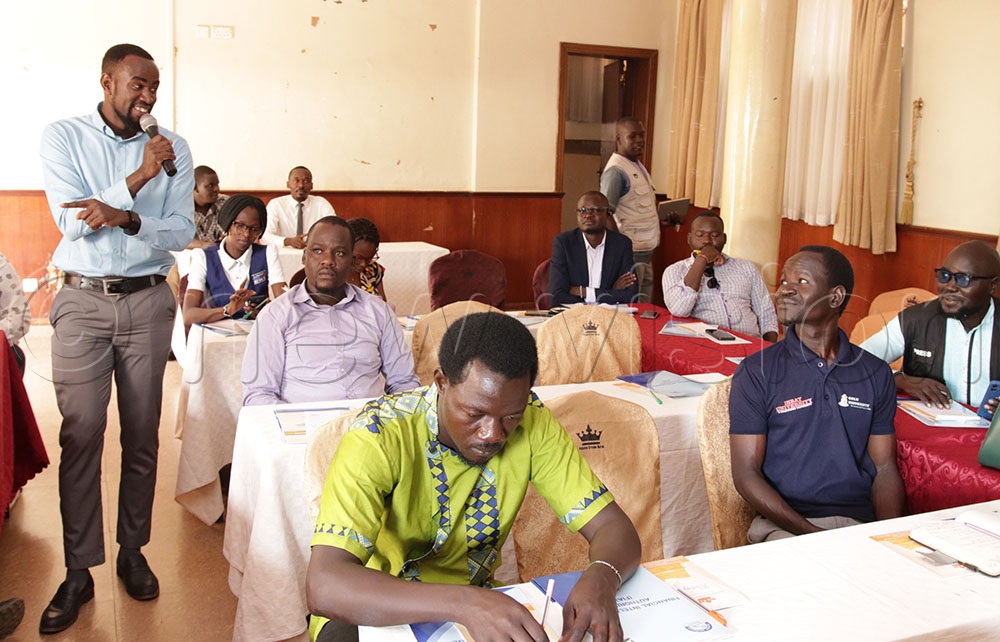
Journalists from Northern Uganda attending a media engagment with Financial Intelligence Authority (FIA). (Photo by Nelson Omoya)
Joshua Otim, an analyst with the FIA, says the most vulnerable sectors in Uganda include transport, mobile money businesses, charity organisations, real estate and savings and credit co-operative organisations (SACCOs).
Speaking during a Media engagement at Palema Crown Hotel in Gulu city on February 17, 2026, Otim explained that public transport systems are increasingly being exploited to move illicit cash and, in some cases, dangerous items disguised as courier packages.
“In some instances, large sums of money are wrapped and transported as parcels on buses, sometimes without the knowledge of the transporters,” Otim noted. “Because these items are not properly declared at loading or during transit, it becomes nearly impossible to flag suspicious movements unless another crime brings it to light.”
According to Otim, the FIA often only uncovers potential money laundering or terrorism financing schemes after another crime has been reported and financial links are established.
“In many cases, we get to know of money laundering when there is a predicate offence, such as fraud, trafficking or terrorism that triggers financial investigations,” he said. “Without that trigger, cash transactions remain largely invisible.”
He cited the West Nile region and parts of northern Uganda as areas where mobile money platforms have occasionally been exploited by criminal networks and suspected terrorist groups due to porous borders and high transaction volumes.
Globally, the Financial Action Task Force (FATF) has consistently warned that cash-intensive economies face heightened risks of money laundering because such transactions leave little or no audit trail.
Uganda has previously been placed under increased monitoring by the FATF grey list, prompting reforms aimed at strengthening anti-money laundering and counter-terrorism financing frameworks. While the country has made legislative improvements, enforcement gaps and limited capacity continue to pose challenges.
Annual training
Meanwhile, on the side of the same media engagement, Allan Kaganzi, a senior compliance and outreach officer at FIA, told New Vision Online that the authority has rolled out annual training initiatives targeting actors in high-risk sectors. These include transport operators, insurance companies, mobile money agents, real estate dealers and charity organizations among others.
“We have prioritised training in the most vulnerable sectors to enhance awareness and reporting of suspicious transactions,” Kaganzi said. “Our approach is to build capacity among managers and top officials in the most vulnerable sectors who are expected to transfer the same knowledge acquired to their lower staff.”
However, he acknowledged that limited funding has constrained the scale of these interventions.
“Resource limitations have affected our ability to cover the entire country physically,” he explained. “As a result, we have adopted virtual training through internet platforms and strengthened collaboration with security agencies and sector regulators to widen our reach.”
Kaganzi further pointed to weak regulatory frameworks in some sectors as a major impediment.
“Some of the high-risk sectors operate with minimal regulation and limited enforcement mechanisms,” he said.
However, even with all that in mind, Kaganzi says significant strides have been taken up by government to come out with proper laws and regulatory frameworks to ensure more effective monitoring of financial flow in the country.
As Uganda works to modernise its financial systems and align with international anti-money laundering standards, authorities say sustained political will, adequate funding and stronger regulatory enforcement will be essential.
With billions of shillings circulating daily in largely untraceable cash transactions, the challenge remains urgent and the stakes, officials warn, could not be higher.