
Govt tables regulations to operationalise Competition Act 2024
The Speaker directed the committee to scrutinise the regulations to ensure they are consistent with the law.
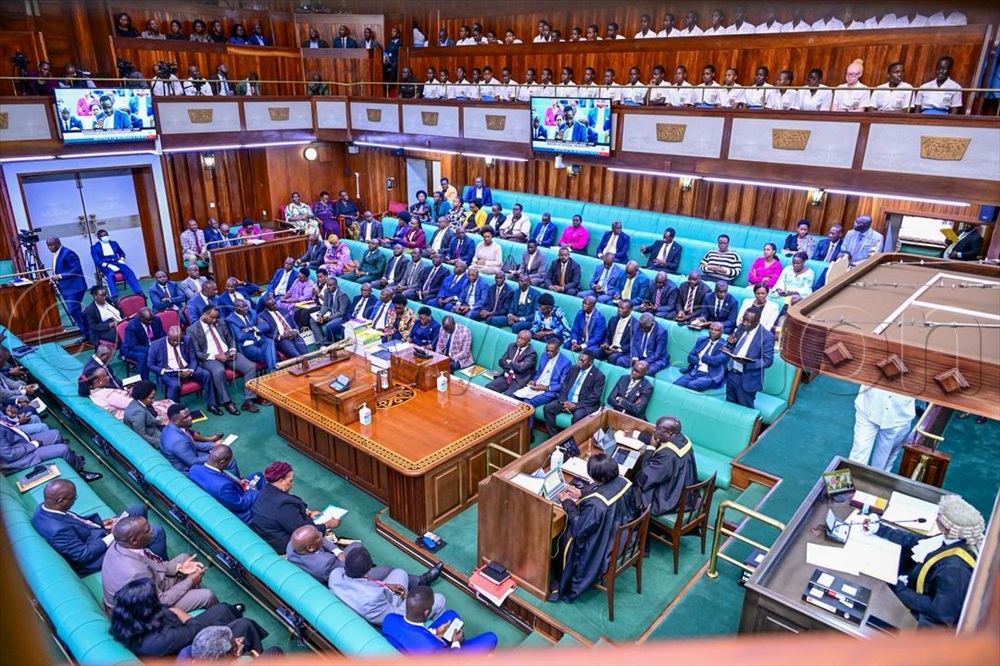
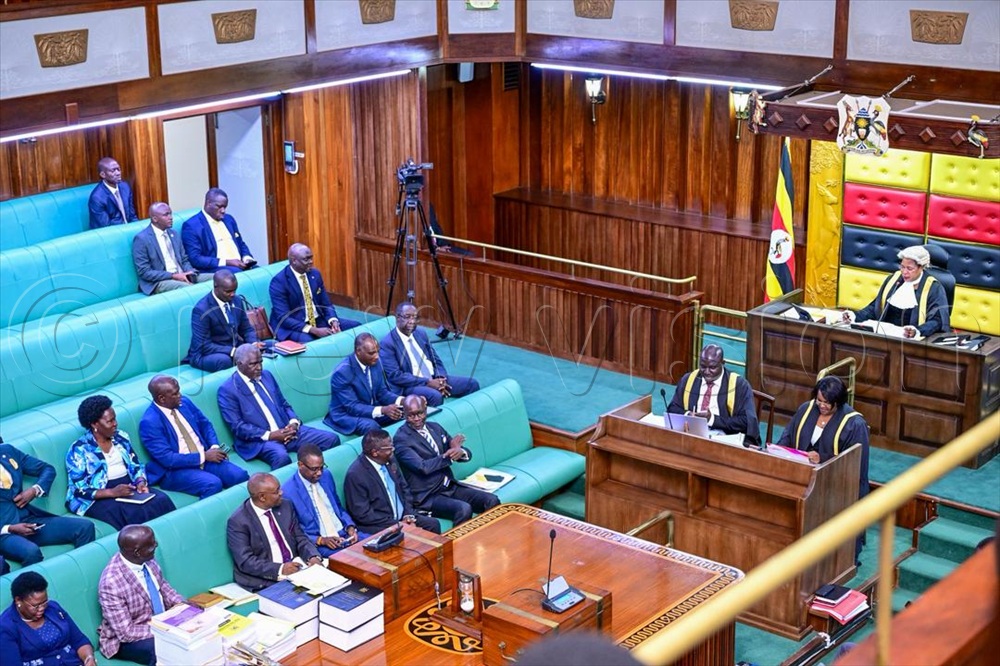
The session was chaired by Speaker Anita Annet Among, who referred the regulations to the sectoral committee of tourism, trade and industry chaired by Gomba district Woman MP Sylvia Nayebare. (Photos by Miriam Namutebi)
________________
After nearly two years of waiting, the Ugandan government has tabled regulations to operationalise the Competitions Act, 2024.
Cooperatives state minister Frederick Ngobi Gume presented the regulations during the parliamentary plenary on Thursday (March 12).
The session was chaired by Speaker Anita Annet Among, who referred the regulations to the sectoral committee of tourism, trade and industry chaired by Gomba district Woman MP Sylvia Nayebare.
The Speaker directed the committee to scrutinise the regulations to ensure they are consistent with the law.
When it was still the Competitions Bill 2022, the law was passed by Parliament in May 2023 and assented to by President Yoweri Museveni on February 2, 2024.
The law intends to create a level playing field for participants in Uganda’s free market economy, protect consumer interests and bring national laws into conformity with international legal instruments.
Article 21 of the Protocol on the Establishment of the East African Customs (EAC) Union provides for the requirement by partner states to prohibit any practice that adversely affects free trade.
This includes any agreement, undertaking or concerted practice which has, as its objective or effect, the prevention, restriction or distortion of competition within the bloc.
At the time, Omoro district Woman MP Christine Lamwaka, argued that the legal framework was largely absent in Uganda. Hence, the need for an all-encompassing law.
Lamwaka was the mover of the bill.
Mergers
One of the areas the Competitions Act 2024 seeks to cure touches on the regulation of joint ventures, acquisitions and mergers, which in Uganda’s case are usually vertical and horizontal in nature.
Vertical mergers occur when two independent firms from different parts of the supply chain form a new legal entity under the banner of one corporate name.
With horizontal mergers, dominant companies or firms with a stable supply of resources amalgamate with competitors offering a similar service and serving the same customers under the guise of capturing the latter’s market share.
According to Section 15(1) of the bill, where enterprises seek to enter into any merger or joint venture, they shall be obliged to notify the ministry.
Then, within 120 days, the ministry will inquire into and determine whether the action is likely to cause an adverse effect on competition within the market.
Whoever fails to do so will be presumed to have committed an offence and, upon conviction, will be liable to a fine not exceeding ten percent (10%) of the annual turnover of the person.
Section 11(5) of the Act bars individuals from abusing a dominant market position through imposition of unfair purchase or selling prices, limiting production or engaging in practices that are aimed at denying others market access.
The penalty for offenders is a fine not exceeding one hundred currency points (two million shillings) or imprisonment not exceeding four years, or both.
Move welcomed
Speaking during debate on the bill in May 2023, Budadiri West MP Nathan Nandala Mafabi and his Hoima East counterpart Dr Patrick Mwesigwa Isingoma lauded the move, arguing it would help prevent competitors of multinational conglomerates from folding.
Citing the work of Prof. E.A Brett, a development studies don, Isingoma noted that it had been observed that where scale economies exist, market competition does not constantly reproduce an existing structure of small competitive units.
Instead, it leads to what he said was the process of creative destruction in which large firms capable of exploiting innovation and cheapening cost of production destroy the market position of small firms and constantly increase their span of control.
The legislator said they had been concerned that multitudes of firms in Uganda were being displaced in various sectors, which not only led to job losses but also had far-reaching consequences on the economy.
“I am a player in the fuel industry, Total Energies swallowed GAPCO, AGIP and ESO. Recently, RUBIS swallowed KOBIL, and earlier on, KOBIL had swallowed DELTA. Nile Energy swallowed GAZ, and some time back, VIVO swallowed my company called PRIME PETROLEUM,” said Isingoma at the time.
Mafabi weighed in: “Of course, you remember how CHEVRON swallowed CALTEX and shortly CALTEX was swallowed by TOTAL, and I can tell you there are many, mostly because of mergers.”
Deputy Speaker Thomas Tayebwa, who was steering the debate three years ago, shared his experience.
“Some time back, before I came here, I had a small business which was swallowed up by a giant overnight and over 300 people I was employing lost jobs. We slept when we had jobs, but by morning, someone had made a declaration that 'I no longer want to work with you,” he said.
“They gave my business to a company in Dubai.
"So you can see there is a way, especially in these sectors, where young people can easily be employed. You find they are on tension all the time; you can easily be swallowed up in the information, communication and technology (ICT) sector," said Tayebwa.