
FY 2025/26: Govt releases sh16.5 trillion for third quarter
Dr Ramathan Ggoobi, the Permanent Secretary and Secretary to the Treasury (PSST), announced the Quarter Three expenditure limits at a media briefing at the ministry headquarters on Friday, January 9, 2026.
Dr Ramathan Ggoobi, the Permanent Secretary and Secretary to the Treasury (PSST), addressing journalists during a media briefing. (Photo by John Ricks Kayizzi)
_________________
The Government has released sh16.537 trillion to finance expenditures for the third quarter of the 2025/2026 financial year, covering the expenses of ministries, agencies, and other government entities for January, February, and March.
Officials from the Ministry of Finance, Planning, and Economic Development stated that the allocation is firmly based on fiscal consolidation, macroeconomic stability, and disciplined public spending.
Dr Ramathan Ggoobi, the Permanent Secretary and Secretary to the Treasury (PSST), announced the Quarter Three expenditure limits at a media briefing at the ministry headquarters on Friday, January 9, 2026.
He noted that the releases were deliberately structured to support Government priorities while safeguarding economic stability.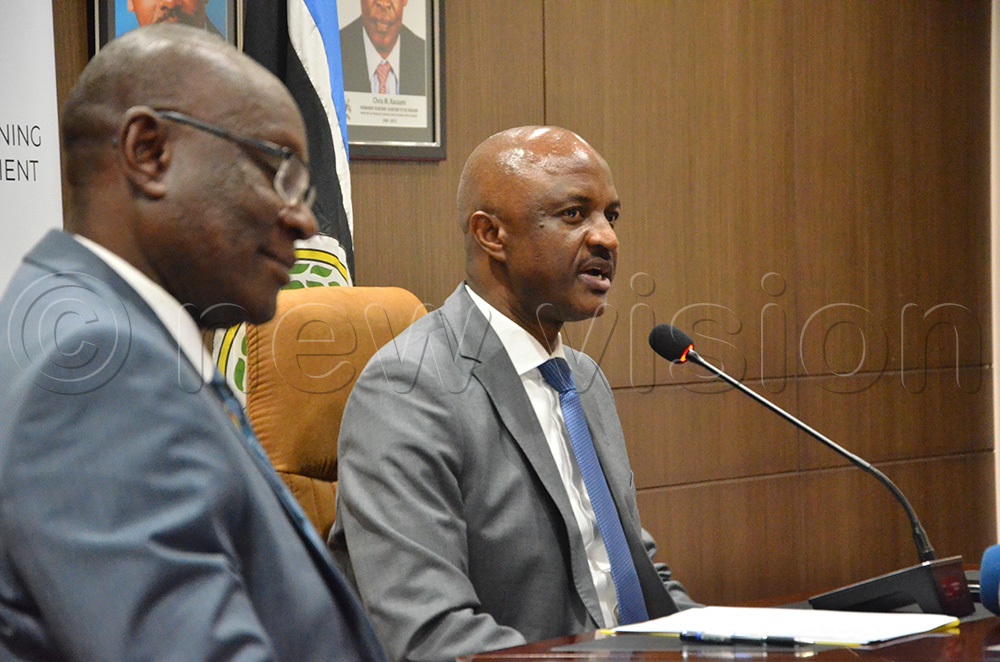
Dr Ramathan Ggoobi, the Permanent Secretary and Secretary to the Treasury (PSST), addressing journalists during a media briefing. (Photo by John Ricks Kayizzi)
“The Quarter Three expenditure limits have been informed by our fiscal consolidation agenda that prioritises implementation of the Government’s objective of sustaining macroeconomic stability and maintaining fiscal discipline,” Ggoobi said.
He added that they are very deliberate that every shilling released must contribute to stabilising the economy, protecting service delivery and driving growth.
According to the breakdown, the total sh16.537 trillion comprises sh2.175 trillion for wages, sh2.898 trillion for non-wage recurrent expenditure, sh514b for GoU development, sh3.277 trillion in external financing, and sh7.591 trillion for debt and other treasury operations.
The third-quarter releases also include sh318.24b for pensions and gratuity, sh91.65b for Parliament, sh28.27b for the Judiciary, and sh18.351b for the Office of the Auditor General.
Ggoobi noted that statutory obligations continue to take a significant share of the releases, reflecting the Government’s commitment to meeting unavoidable and legally mandated expenditures.
“We have provided Shs7.59 trillion for debt and treasury operations, because honouring our debt obligations is critical for maintaining confidence in the economy,” he said.
He further noted that sh2.175 trillion has been released to cater for wages and salaries across Government, ensuring that public servants are paid on time.”
Ggoobi stressed that these allocations are essential for the smooth functioning of the State. “These institutions play a constitutional role, and we must ensure they are adequately facilitated to deliver on their mandates,” he said.
ATMs boost
A key feature of the Quarter Three releases is continued financing of the ATMs strategy—Agro-industrialisation, Tourism development, Mineral-based industrial development, including oil and gas, and Science, Technology and Innovation—which the Government views as the engine for achieving tenfold economic growth.
Under agro-industrialisation, sh167b has been provided for research, innovations and critical programme interventions, including fast-tracking the rollout of the anti-tick vaccine. “Agriculture remains central to our transformation agenda,” Ggoobi said, adding that “investing in science-led solutions like the anti-tick vaccine will directly improve productivity and farmer incomes.”
Tourism development has received sh32.8b to support promotion initiatives such as the “Explore Uganda” campaign and development of the Uganda Martyrs Shrine at Namugongo.
Mineral-based industrial development, including oil and gas, takes sh469.69b to accelerate interventions aimed at achieving first oil. Science, technology and innovation, including ICT and the creative industry, have been allocated sh166.15b to expand internet connectivity and deepen digitisation of the economy.
Security, as a key enabler of ATMS, has also been prioritised. The Ministry of Defence and Veteran Affairs received sh270.05b, Uganda Police Force sh42.12b, State House sh17.92b, Uganda Prisons Service sh73.04b, Office of the President sh45.68b, Internal Security Organisation sh42.92b and External Security Organisation sh18.39b.
Ggoobi said these allocations are meant to “preserve peace and stability, which are prerequisites for economic growth.”
“In infrastructure, the Ministry of Works and Transport has been allocated sh1.34 trillion, largely from external financing, to support Uganda Airlines, Uganda Railways, Kalangala Infrastructure Services and the Standard Gauge Railway,” he said.
The Ministry of Energy and Mineral Development received sh468.48b for rural electrification, transmission lines and power generation projects, while Kampala Capital City Authority and the Ministry of Kampala Capital City and Metropolitan Affairs together received over Shs394 billion for roads, drainage, sanitation and urban services.
Human capital development features prominently, with sh344.67b released to the Ministry of Health and sh245.52b to National Medical Stores for essential drugs, including addressing gaps caused by the withdrawal of USAID support.
“Protecting the health of our people is non-negotiable,” Ggoobi said. “We have ensured that medicines, specialised services and referral hospitals are funded.”
Local governments received sh519.866b billion to support service delivery and capital development, while revenue-generating agencies such as the Uganda Revenue Authority, Immigration, UNBS and others have also been funded to strengthen domestic revenue mobilisation.
Ggoobi further noted that the third-quarter releases reflect the Government’s balancing act.
“We are consolidating fiscally, meeting our obligations, and at the same time investing strategically in growth drivers. That balance is what will keep Uganda on a stable and sustainable economic path,” he said.