
Eid shoppers hit by soaring sheep prices in Ivory Coast
Prices have shot up this year and animals are harder to come by as Ivory Coast's usual supply from neighbouring Sahel countries has been hit by export bans and conflict.
In Ivory Coast, herders off load sheep from a truck at the Anyama Livestock Park, on May 21, 2026 where livestock are sold ahead of Eid al-Adha, the Muslim Feast of Sacrifice. (AFP)
ABIDJAN - Buyers trudged through a muddy market in Abidjan, looking for the best-priced sheep to be sacrificed for Eid al-Adha, with traders driving hard bargains in the run-up to the Muslim festival.
Prices have shot up this year and animals are harder to come by as Ivory Coast's usual supply from neighbouring Sahel countries has been hit by export bans and conflict.
Ivory Coast depends heavily on imports to meet demand. Around 75 percent of the sheep and cattle needed for Tabaski, the name for Eid in west Africa, come from countries such as Burkina Faso and Mali. That amounts to about 350,000 animals.
But Burkina Faso halted livestock exports earlier this month to protect its domestic market, following a similar move by Niger in March.
In Mali, roads have been blocked by jihadists linked to Al-Qaeda, making transport routes dangerous.
Some trucks manage to slip across borders illegally, but tighter checks on the Burkinabe side are keeping numbers low.
So, supply is tight, and in the mud-soaked pens of the Adjame livestock market, prices are on the rise.
"I have 300 head of cattle at the Burkina border. It's impossible to bring them into Ivory Coast," said Assimi Barry, who has been selling at the market for 40 years.
Another trader, Ibrahim Sow, said he had "150 animals blocked in Koutiala, in Mali, all paid for, just waiting to be delivered here".
"My boss used to send me up to 200 animals from Burkina Faso for Tabaski. This year, only part of them made it into Ivory Coast. The rest are across the border," he added.
Both men say supplies are particularly tight this year -- about half of last year's levels, according to Sow.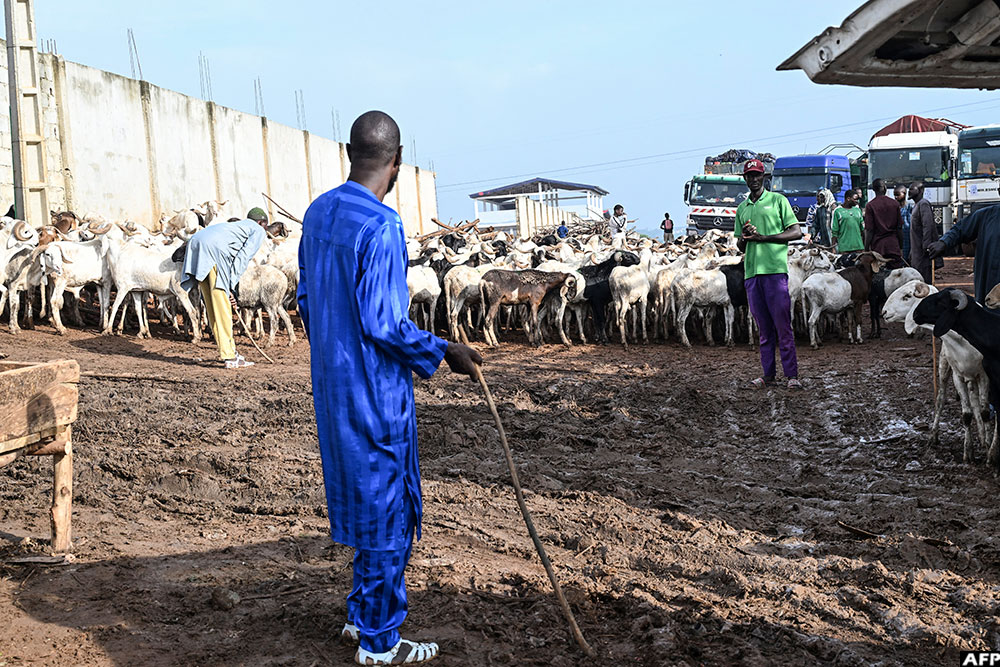
Herders stand next to sheep at the Anyama Livestock Park, on May 21, 2026 where livestock are sold ahead of Eid al-Adha.
High prices
With fewer sheep available for sacrifice at the family feast this year, haggling was in full swing across the market.
"I'm offering 250,000 CFA francs ($440). Otherwise, I'll look elsewhere," said Lagazane Ouattara, speaking from inside his car to avoid the mud.
The seller refused to budge, blaming the shortage.
"This one's worth 500,000 CFA francs," he said, patting the ram.
After lengthy bargaining, Ouattara walked away with a large ram from another trader for 320,000 CFA francs but complained of the higher prices this year.
"Last year, 200,000 CFA francs would get you a good ram. This year, you're looking at at least 250,000," Barry said.
For many, this is out of reach in a country where the monthly minimum wage is 75,000 CFA francs ($131).
Buyer Kassoum Ouattara told AFP he was struggling to find an animal within his usual budget of 150,000 CFA francs.
A week before the holiday, Trade Minister Ibrahim Kalil Konate said nearly 165,000 sheep -- 47 percent of national demand -- were already on the market, with prices "for all budgets".
Authorities said this month they aimed to boost local production, which currently covers between 25 and 45 percent of demand, according to official figures.
But convincing buyers to switch might not be easy.
Locally bred sheep are known to be smaller than those from neighbouring Sahelian countries -- a key factor for families catering for a major religious celebration.