
Youth embark on restoration of native tree species in Uganda
The native trees that are being targeted for replanting include Prunus africana (Entaseesa), Warbugia ugandensis (Mukuzannume), Khaya anthotheca (Mahogany), and Milicia excelsa (Muvule).
Youth from Namirembe Diocese holding trees they are going to plant at St Peters Church Kakiri. (photo by Jovita Mirembe)
_______________
In a bid to restore the native tree species threatened in Uganda, youth have embarked on a drive to replant them.
The native trees that are being targeted for replanting include Prunus africana (Entaseesa), Warbugia ugandensis (Mukuzannume), Khaya anthotheca (Mahogany), and Milicia excelsa (Muvule).
The youth are focusing on replanting these trees because they are becoming endangered, often being used as firewood for cooking.
Climate YES, a global ecumenical movement of young activists from around the world, is partnering with the Namirembe Diocese youth ministry, Reformed Presbyterian Church Africa, Pure Earth, and the All Africa Conference of Churches to promote climate justice.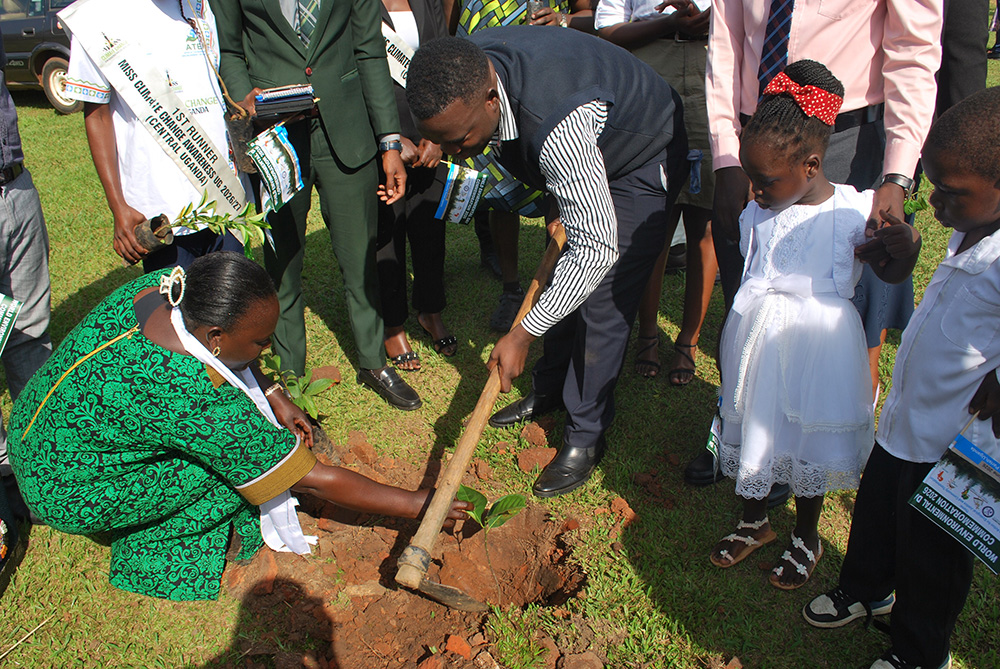
Betty Mutunda and Tefero Lule launching the tree planting project at St Peters Church of Uganda, Kakiri. (Photo by Jovita Mirembe)
As the Earth overheats amid the emission of greenhouse gases, this undermines weather patterns and results in severe ecological disturbances across the world. He said this is worsened by deforestation and environmental pollution.
‘In the olden days, Uganda used to have rainy and sunny seasons, which helped farmers to plant their crops in seasons, but all this has failed today because of environmental pollution and deforestation. Today, when it rains, it rains so hard, resulting in floods that destroy gardens, and when it shines, it shines so much that it causes a dry spell. This means that in the next 20 years, we will be living in a worse environment if afforestation is not done,” Kagga said.
Kagga made the observations during the launch of a campaign to plant native trees at St. Peter's Church of Uganda, Kakiri in Wakiso district, as part of the events to mark World Environment Day last week. The day was marked under the theme "Faith in Action for Ecological Justice and community transformation.”
The United Nations General Assembly designated June 5 as World Environment Day to encourage nations, civil society, and the private sector to intensify efforts to protect and sustainably manage the environment.
Tefero Lule, the secretary of Namirembe Diocese Youth Ministry, said 500 native trees would be planted on a four-acre plot of land, which is part of St. Peter's Church of Uganda land in Kakiri.
Quoting the Uganda Bureau of Statistics, Lule noted that roughly 94% of Uganda’s population relies on biofuels (firewood and charcoal) for cooking.
The report further says that heavy reliance on traditional fuels drives severe environmental consequences across the country, where 73% of households primarily use wood, mainly in rural areas, 21% households rely on charcoal use mainly in urban areas, and less than 6% of the population has transitioned to electricity, solar, or gas due to its high cost.
Lule said native tree species are cut down mostly because they provide hardwood compared to the exotic trees, hence causing their drastic reduction in numbers.
He said their collaboration with Climate YES has already seen them plant 500 native trees in Masulita within Wakiso, as well as 300 fruit trees in Mwererwe parish in 2023.
The move, he noted, is aimed at conserving the environment and encouraging more youth and the church countrywide to join the drive.
Betty Mutunda, the national women’s leader of the Reformed Presbyterian Church of Africa in Uganda, commended the existing proactive efforts undertaken by Namirembe Diocese and Climate YES, and called for more efforts to mobilise all religious denominations in Uganda to plant trees and save the environment.