
Uganda planning zero export of unprocessed coffee—Minister Kyakulaga
Agriculture state minister Fred Bwino Kyakulaga says the policy aims to address persistently low prices earned from raw coffee exports by promoting local processing.
Participants pose for a group photo at the Lakeside Protea Hotel Entebbe during an international workshop on food security. (Courtesy photo)
____________________
Uganda is planning to introduce restrictions that could make it difficult for unprocessed coffee to be exported, as the Government moves to strengthen value addition in the sector.
Agriculture state minister Fred Bwino Kyakulaga says the policy aims to address persistently low prices earned from raw coffee exports by promoting local processing.
“We have started with the mineral sector,” he said, noting that Uganda has already halted exports of unprocessed minerals.
“We are working on adding coffee. We are facing resistance from some people, but we shall overcome.”
Kyakulaga was speaking on February 25, 2026, during an international workshop on food security at the Lakeside Protea Hotel Entebbe in Wakiso district where he presided over the opening ceremony.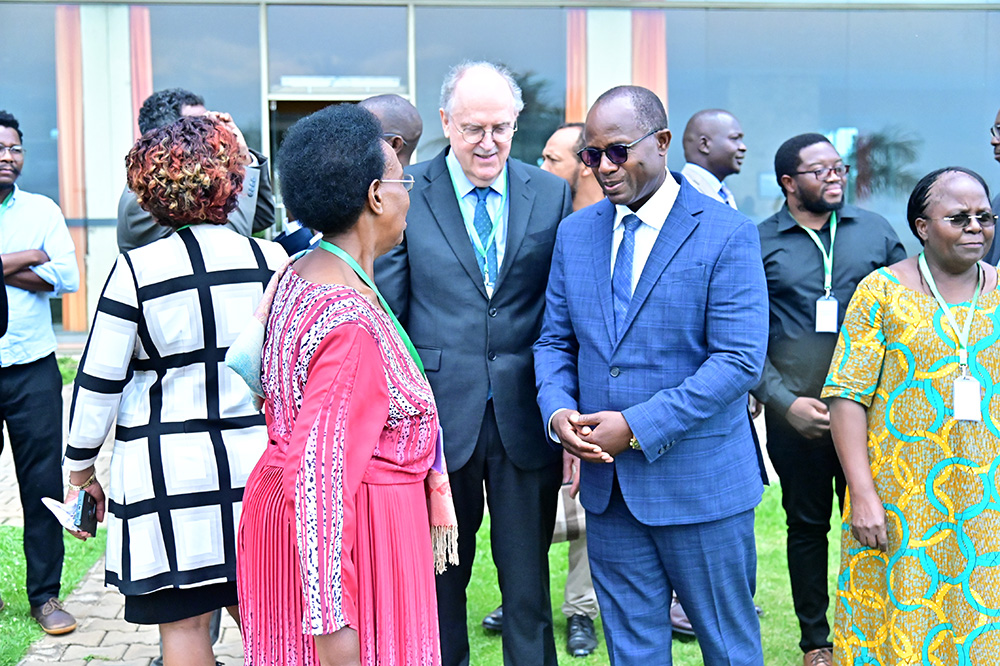
State Minister for Agriculture Maj Fred Bwino Kyakulaga (second right, in a blue suit) with Joachim von Braun of the Center for Development Research at the University of Bonn on the sidelines of an international food security workshop. (Courtesy photo)
The two-day event is being held under the theme: True Cost of Food: Policies for Sustainable Production of Coffee and Other Export-Oriented Crops in East Africa.
It is examining how to address hidden costs and externalities in the food value chain, particularly in coffee and other export crops, and to propose policy responses.
The workshop is organised through a partnership between the University of Bonn, Makerere University, and the Office of the President.
Kyakulaga praised the organisers for focusing on coffee, now Uganda’s leading export commodity and described global coffee trade as structurally skewed against producing countries.
He illustrated this disparity by noting that one kilogramme of coffee can produce about 140 cups of espresso. With each cup retailing at between $1 and $5 in major European capitals, he argued that Uganda captures only a fraction of the final value.
“It means we sell only one cup out of the 140 cups and the other 139 cups are given away for free. Where is the equity?” he said, adding that even the small share Uganda earns is further divided among farmers, exporters and other value-chain actors.
Participants also highlighted the social and environmental challenges associated with coffee production.
While much attention is given to trade and employment opportunities in the food value chain, speakers said less focus is placed on negative impacts such as child labour and environmental degradation.
“We need multi-stakeholder involvement that ensures trade works not only for markets but also for people,” said Goretti Nabanoga, Principal of the College of Agricultural and Environmental Sciences at Makerere University and one of the keynote speakers.
Concerns were also raised about pesticide regulation. Although Uganda periodically publishes lists of approved pesticides, some of those chemicals are banned in key export markets, including the European Union.
Speakers further linked sustainability concerns to social challenges such as child labour in coffee-growing areas.
Unequal global trade
Kyakulaga said Africa contributes about 12 per cent of global coffee trade volume, estimated at roughly $460 billion, but earns only about $3.2 billion — less than one percent of total value.
“Africa contributes a lot but earns little. The reason is simple — the price offered does not factor in the real cost of production, including environmental impact,” he said.
In his presentation, Joachim von Braun of the Centre for Development Research at the University of Bonn commended the minister’s remarks, describing them as substantive and focused on the sector’s key challenges.
He noted that coffee supports the livelihoods of about 12 million people in Uganda, a number that could increase significantly with better investment.
Developed countries, he said, capture more value because of heavy investment in research and development, unlike many African economies.
“Africa has a lot of land but needs to manage it better,” he said.
Market access challenges
Former agriculture minister Victoria Sekitoleko called for cheaper credit and policy reforms to strengthen Uganda’s agricultural sector.
“In Uganda, there are few people who can export because policies make it difficult. We are like orphans — you suffer alone,” she said, urging increased financing.
Uganda currently operates the Agricultural Credit Facility, which offers loans to farmers at a capped interest rate of 12 percent, but speakers said access remains limited.
Sekitoleko also raised concerns about foreign dominance in export markets, saying many Ugandan exporters struggle to compete with international firms that access credit at rates as low as two percent, compared to domestic rates that can reach 20 percent.
Participants further pointed to infrastructure gaps, particularly in road networks, that raise costs not reflected in international prices.
Responding to concerns about high borrowing costs, Braun said international lenders often view African markets as high-risk, contributing to elevated interest rates.
Meanwhile, Vincent Tumusiime Bamugaya, commissioner in charge of socio-economic monitoring and research at the Office of the President, said Africa often has little bargaining power in global markets.
To address this, some countries are boosting domestic consumption. He cited Ethiopia, where roughly half of coffee production is consumed locally, unlike Uganda, where more than 90 percent is exported.
Light at end of tunnel
Despite the challenges, Braun said Uganda could benefit from shifting global trade dynamics driven by rising protectionism.
“The world trading system has changed, with more focus on national systems,” he said, noting that countries are increasingly forming strategic alliances rather than relying solely on multilateral institutions such as the World Trade Organisation.
“New deals are becoming more favourable to Africa because power imbalances are shifting, and Uganda can take advantage,” he said.