
Turyahebwa’s dairy farm birthed other enterprises
Turyahebwa began with 10 friesian cows, later expanding to 35. Over time, she phased out older animals and today, she has 25.
Turyahebwa started with 400 broilers and has since doubled stock due to high demand in Kenya. (Photos by Moses Nampala)
________________
For the tenth year running, Vision Group, together with the Embassy of the Netherlands, KLM Airlines, dfcu Bank and Koudijs Animal Nutrition, is running the Best Farmers Competition.
The 2025 competition runs from April to November, with the awards in December. Every week, Vision Group platforms are publishing profiles of the farmers. Winners will walk away with sh150m and a fully paid-for trip to the Netherlands.
Before 2015, Tororo residents were spending more than sh21m on 5,000 litres of milk daily and 500 bunches of matooke trucked in from outside the district. For Nelly Turyahebwa, that was not just a statistic; it was an opportunity.
Armed with research and determination, in 2015, she quit her job at National Water and Sewerage Corporation to venture into farming. Today, she has built a multi-enterprise farm in Akapa village, Rubongi sub-county.
Dairy enterprise
Turyahebwa began with 10 friesian cows, later expanding to 35. Over time, she phased out older animals and today, she has 25. Of these, 17 are lactating, with each producing 25 litres daily, yielding a total of 400 litres on average. Although she owns equipment to make yoghurt and cheese, she has not yet ventured into value addition.
“Demand for milk is high, yet I cannot satisfy it. I have plans to expand,” she says.
To boost production, she recently paid for 10 super dairy cows in Kenya and these will be delivered within a month. This strategy is expected to double the output to 800 litres, creating a surplus needed in the manufacture of yoghurt and cheese.
Animal care
Her cows are given fodder, which includes Napier, elephant grass and calliandra, which she grows on 10 acres. Each cow, weighing 500– 600kg, consumes 100–120kg of feed daily. In addition to fodder, the cows are fed on maize bran, soya, sunflower cake and concentrates.
She stresses hygiene, clean water and vaccination schedules.
“When basics are observed, disease outbreaks are rare. Our monthly veterinary drugs bill is less than sh200,000,” she notes.
The farm has six permanent workers, each earning sh200,000. Casual labourers are hired during peak periods, with each paid a daily wage.
Markets
Since 2018, she has built a strong market for milk. Her clients include Tororo Cement, with its large workforce and Busitema University. The farm-gate price for milk is sh2,500 per litre.
Growing bananas
In 2018, Turyahebwa planted 670 suckers on 1.5 acres after consulting agronomists. She chose Mpologoma, Kisansa, and Kibuzi varieties. Her plantation has since expanded to cover five acres.
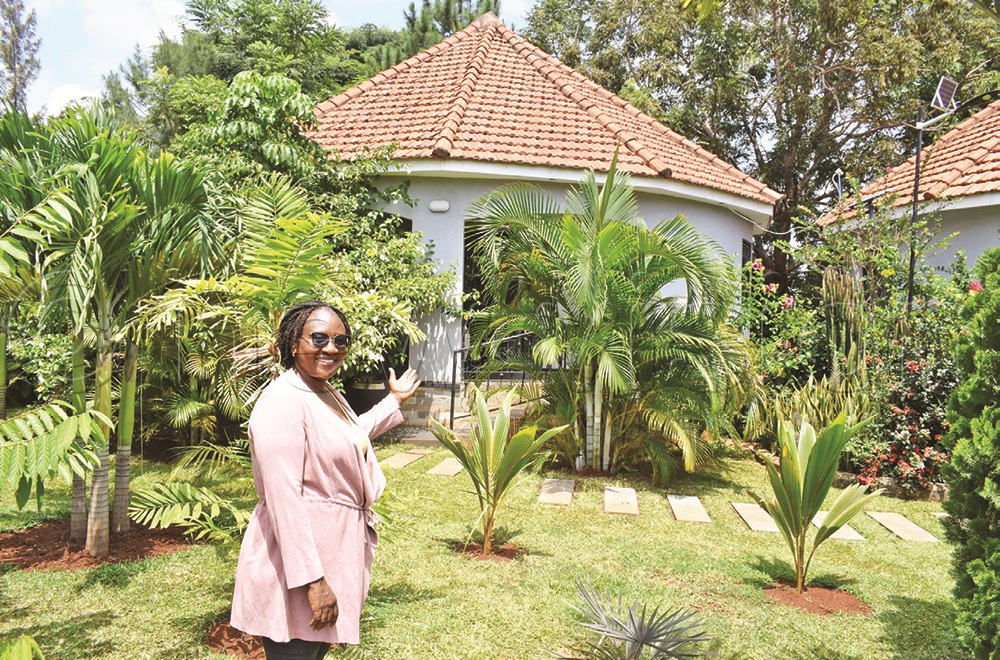
Turyahebwa established a cottage hotel from the proceeds of her farm.
She harvests about 200 bunches monthly, with each sold at sh25,000, which translates to a total of sh5m. Buyers harvest and transport the bananas themselves, saving her such operational costs.
Keeping poultry
With profits from dairy and bananas, in 2022, she to invested part of her savings in poultry, starting with 4,000 broilers. The demand was high, especially across the border in Kenya, prompting her to double the stock.
Best practices
She has involved family members in her business, an attribute that has yielded immeasurable attention and care, strengthening a sense of ownership among the labour force.
To assess its productivity, each enterprise is audited regularly and where it is falling short, the necessary adjustments are made.
“Each of the enterprises has books of accounts which I carefully audit. Each enterprise fetches a modest profi t margin,” she notes.
Some of the visitors who come to her farm include technical officers who advise on the best agronomic practices.
Turyahebwa also ensures that the livestock live in hygienic conditions as well as adhering to the right protocol regarding diet, which reduces the risks of disease outbreak, hence saving the farm from unnecessary expenditures.
Achievements
Proceeds from her enterprises have enabled her to:
- Establish a cottage hotel that attracts high-profile guests.
- Purchase 20 acres of land, which she could utilise to expand her income-generating enterprises.
- Employ about 30 people on a permanent basis and during peak seasons, especially when pasture is cut and processed, she hires over 50 casual labourers.
- Inspire 30 neighbouring households to start banana plantations. At the inception of the farm, women from households in the vicinity, who now consider her a role model, exclusively relied on their spouses for everything in terms of household basics such as salt, sauce.
In some instances over dependence on spouses had degenerated into episodes of domestic violence. However, today, many who have adopted the banana enterprise can afford to harvest a bunch from their backyard garden and sell it, and use the proceeds to buy basics in their respective homesteads.
- Providena training ground for Busitema University students and farmer groups from Tororo and beyond. Her farm also serves as a study site, regularly hosting tours and benchmarking visits. The farm registers not less than 30 people in month.
Challenges
Despite her success, she has to contend with a number of challenges. Prolonged dry spells affect yields, while pests and diseases increase costs. Bad roads make transporting produce difficult. Weather vagaries affect her farm, too.
“Tororo is geographically disadvantaged. During the dry spell, it becomes too humid for animals that thrive in cooler high-altitude conditions. We have planted many trees around the farm to contain the humidity,” she says.
The lack of knowledgeable extension workers is another challenge. The market is saturated with fake agro-inputs that, in the past, have cost her farm, reducing her profit margins significantly.
To mitigate this, she sources veterinary supplies only from accredited dealers in Kampala or agro stores in Kenya.
She has also suffered theft of matooke bunches, but has since hired watchmen, which has curbed the problem. Limited access to affordable credit is another challenge.
“The Government has created many platforms, but I have not accessed low-interest loans under programmes like GROW,” she says.
Looking ahead
She plans to venture into value addition, that is, making yoghurt and cheese when her milk production increases. Related to dairy farming, her long-term vision is to build a herd of 60 dairy animals, ensuring greater production and sustainability.
She is also investing in artificial insemination to improve breeds, using semen from superior bulls with high yield genetics.
Turyahebwa also plans to scale up poultry and bananas, creating a fully integrated agribusiness.
Mistakes
She has had to suspend services of veterinary entities that fleeced her of money, particularly when it came to artificial insemination services.
“Animals would be served several times, but not conceive, yet every session was costly,” she recalls.
Background
Born in 1982 to Polly and Angelica Bangirana in Ibanda, Mbarara district, she is the eldest of nine children.
She studied at Nyahora Primary School in Ibanda, Kiruhura Girls’ for secondary, and later joined Makerere Business School.
She holds a bachelor’s degree in business administration and a master’s in management.
She is also a mother of four. Growing up in the cattle corridor, she is familiar with livestock and inherited her parents’ entrepreneurial spirit.
“I admired their hard work and versatility. I wanted to emulate their business aggressiveness, and today, I don’t regret it,” she says.
While her parents kept local breeds, she rears hybrids.
“But the foundation of livestock farming originates from what I learnt from my parents. It’s the animals from which my parents raised school fees that educated us, among other needs, and that is how I’ve grown to appreciate livestock as an enterprise,” she notes.