
Tick control gets boost as Kitgum dip facility returns to service
Local farmers have welcomed the development. Julius Omony Palukok from Ogwapoke village said the dip will help address persistent tick infestations that have already cost him three animals this year.
A cow coming out of the rehabilitated dip facility located in KelPolo village in Pubech parish. (Credit: Christopher Nyeko)
_______________
KITGUM — Livestock farmers in Kitgum district are beginning to see renewed hope following the rehabilitation of a long-abandoned livestock dip facility in Mucwini East subcounty.
Rehabilitated by the Jimmy Akena Foundation, the dip facility located in KelPolo village in Pubech parish, had remained non-functional since the collapse of Milton Obote’s last government.
Its restoration now provides farmers with an effective method of controlling ticks and other external parasites through full-body immersion of livestock in an acaricide.
Plunge dips, commonly referred to as dip tanks, play a vital role in livestock health management. By immersing animals such as cattle, goats and sheep, they ensure thorough coverage against parasites like ticks, lice, flies and mites, including areas that are difficult to reach through conventional spraying.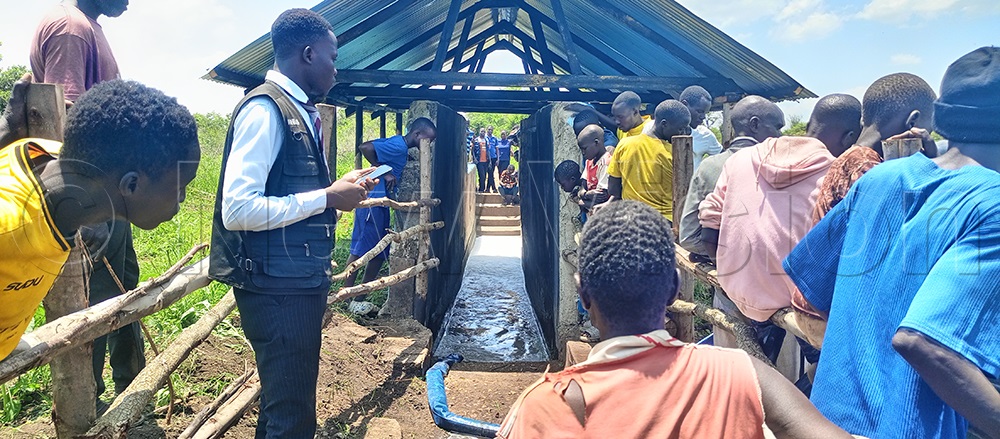
The rehabilitated dip facility located in KelPolo village in Pubech parish. (Credit: Christopher Nyeko)
The refurbished facility has an 800-litre acaricide capacity and has undergone significant upgrades, including desilting, installation of a protective roof, construction of wooden guide rails to manage animal movement, and repainting.
Local farmers have welcomed the development. Julius Omony Palukok from Ogwapoke village said the dip will help address persistent tick infestations that have already cost him three animals this year.
He explained that delays in acquiring acaricides and the lack of proper spraying equipment have long hindered effective disease control. Palukok also noted that he typically spends about sh150,000 annually on acaricides, a cost he sometimes struggles to meet.
Similarly, Geoffrey Kilama from Likol A village highlighted the inefficiencies of spraying, saying he spends roughly sh30,000 monthly on tick control. For him, livestock farming is essential, supporting his family’s education and housing needs.
The LCIII chairperson of Mucwini East, Herbert Richard Odongo, confirmed that a management committee will be established to oversee the facility’s operations. He emphasised its importance in tackling the area’s ongoing tick challenges.
Kitgum district communications officer Allan Carrick Oola observed that farmers in the region have faced decades of difficulty managing livestock parasites. He noted that previous district-led spraying programmes have had limited success.
Until now, the district had only three dip facilities, one inactive in Kitgum Municipality, one privately owned in Namokora, and this newly restored unit.
At the official handover, Jimmy Akena, founder of the foundation and son of Obote, announced plans to rehabilitate all government-built dip facilities that have fallen into disrepair.
The initiative aims to strengthen Uganda’s livestock sector and improve its capacity to meet export standards free of tick-borne diseases.
Akena revealed that the foundation is currently funding the restorations but may seek external support if government funding delays persist. The broader goal is to restore more than 200 dip facilities nationwide.
This marks the second rehabilitation effort in 2026, following an earlier project in Akokoro, Apac district.
Tick infestations continue to pose a major threat to Uganda’s livestock industry, causing estimated annual losses of sh3.9 trillion due to animal deaths and reduced productivity. Farmers often spend over 60% of their disease management budgets on tick control alone.
Efforts to find long-term solutions have included research by the National Agricultural Research Organisation, which developed the anti-tick vaccine NAROVAC. However, funding challenges have slowed its rollout. A proposed sh60 billion supplementary budget for mass production in 2025 was not approved, and earlier allocations of about sh10 billion faced delays in implementation.
Animal health funding remains under the Ministry of Agriculture, Animal Industry and Fisheries, but resource constraints continue to limit the effectiveness of disease control programmes. For instance, vaccination efforts for diseases like Foot and Mouth Disease have historically reached only a small portion of at-risk livestock.
The restoration of the Mucwini dip facility is therefore seen as a timely and practical intervention, one that could significantly ease the burden on farmers while improving livestock health and productivity in the region.