
Agric. & Environment
Refugee women spared long treks as Adjumani water project cuts GBV risk
The project was constructed by Action Against Hunger with funding from the German Federal Foreign Office and was officially handed over to the Northern Umbrella for Water and Sanitation for operation and maintenance on March 31, 2026.
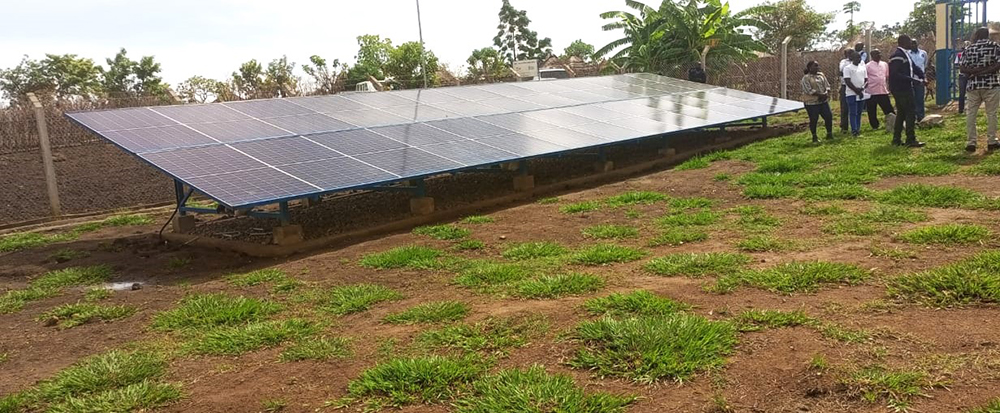
The leaders inspecting the solar-powered water at Ayillo II refugee Settlement in Adjumani district. (Courtey)
By: Robert Adiga and Doreen Tasia, Journalists @New Vision
________________
A solar-powered water project worth sh478 million, constructed in Ayilo II refugee settlement in Pakelle subcounty, Adjumani district, has been credited with helping to reduce cases of gender-based violence, offering a positive shift in community safety and wellbeing.
The nightmare of water inadequacy
Nanyok Bapal Kat, a 52-year-old South Sudanese refugee, is one person who has fallen victim to gender-based violence due to water scarcity.
Nanyok, now a beneficiary of the multi-million water project, says they no longer have to travel long distances in search of water for household chores such as cooking, which was often a cause of gender-based violence.
“Personally I was bitten by my husband over claims that I delay in the water source to look for other husbands and this cause misunderstanding between us,” said Nanyok adding "Women and girls would cover more than 2 kms to get water, when they delay men beat them up, sometimes they are even sexually abused especially in late hours as they return home."
She says that, with water now readily available, their livelihoods are expected to improve as more time will be spent on productive activities.
The project was constructed by Action Against Hunger with funding from the German Federal Foreign Office and was officially handed over to the Northern Umbrella for Water and Sanitation for operation and maintenance on March 31, 2026.
Stanley Regards Akuku, the Refugee Welfare Council I chairperson for Ayilo refugee settlement, said the introduction of solar-powered piped water closer to households has significantly reduced the risk of violence against women and girls.
“Personally I was bitten by my husband over claims that I delay in the water source to look for other husbands and this cause misunderstanding between us,” said Nanyok adding "Women and girls would cover more than 2 kms to get water, when they delay men beat them up, sometimes they are even sexually abused especially in late hours as they return home."
She says that, with water now readily available, their livelihoods are expected to improve as more time will be spent on productive activities.
The project was constructed by Action Against Hunger with funding from the German Federal Foreign Office and was officially handed over to the Northern Umbrella for Water and Sanitation for operation and maintenance on March 31, 2026.
The solar panels installed for the water supply in Ayillo II refugee Settlement in Adjumani district. (Courtesy)
Stanley Regards Akuku, the Refugee Welfare Council I chairperson for Ayilo refugee settlement, said the introduction of solar-powered piped water closer to households has significantly reduced the risk of violence against women and girls.
"This water system has helped the community a lot. The community used to depend on only two boreholes; women would stay the whole day waiting for water, and in the end, they are beaten for not cooking on time,” Akuku said.
District officials applaud timely intervention
Richard Izakare, the district water officer for Adjumani, appreciated Action Against Hunger for the project, noting that it has increased water coverage in the area, although more still needs to be done.
"In Adjumani, the water coverage is 75%, meaning 25 % are still grappling to access clean and safe water, while in Pakelle subcounty, the coverage is at 68%, leaving a gap of 32%,” Izakare explained.

Edema Richard, the principal assistant chief administrative officer of Adjumani, commended partners for working collaboratively with the government to address refugee challenges in the district.
"We have been getting a lot of challenges regarding the management of refugee affairs; people used to fight for water at points. Thanks to Action Against Hunger for bringing water for peace,” Edema remarked.
Assurance on affordable safe water
Engineer Ronald Olara of the Northern Umbrella for Water and Sanitation said the water costs only sh17 per jerrycan, encouraging the community to comply with proper maintenance of the system.
"We request the community to comply because what you are paying is not for water, but the services involved, such as treatment and the guards, emphasised Eng. Olara.
Guard against vandalism
Polyne Abino, the refugee desk officer at the Office of the Prime Minister in Adjumani, pledged continued advocacy to ensure the extension of clean water services across refugee settlements.
Abino also urged local leaders to support the protection of the water system to prevent damage and theft.
“We must all guard against vandalising the facilities if we are to continue consuming clean and safe water in the area as we continue to advocate for more water facilities in these refugee settlements of the district amidst the meagre resources,” Abino pleaded
Alarming GBV statistics
Research conducted in Adjumani district in 2025 found that up to 54% of female refugees aged 15 and above have experienced gender-based violence.
Project impact
The water system now delivers an additional 130,000 litres of treated water daily, significantly improving coverage and reliability. This has led to reduced diarrhoeal infections, improved child nutrition, better school attendance, and reduced gender-related burdens, particularly for women and girls.
Ayilo refugee settlement is home to over 15,000 refugees from South Sudan who have long struggled with limited access to clean and safe water.
Previously, women and girls were often forced to walk long distances in search of water, exposing them to risks of gender-based violence.
Sustainable management
The Northern Umbrella for Water and Sanitation (NUWS), a government utility agency under the Ministry of Water and Environment, will oversee the long-term operation and management of the Ayilo II solar-powered water system.
NUWS is mandated to provide safely managed rural water services, ensuring that refugees and host communities benefit from reliable, affordable, and high-quality water through operation and maintenance, tariff collection, infrastructure oversight, community engagement, and integration into the national system.
District officials applaud timely intervention
Richard Izakare, the district water officer for Adjumani, appreciated Action Against Hunger for the project, noting that it has increased water coverage in the area, although more still needs to be done.
"In Adjumani, the water coverage is 75%, meaning 25 % are still grappling to access clean and safe water, while in Pakelle subcounty, the coverage is at 68%, leaving a gap of 32%,” Izakare explained.
The pump station where the solar powered water is generated from in Adjumani district. (Courtesy)
Edema Richard, the principal assistant chief administrative officer of Adjumani, commended partners for working collaboratively with the government to address refugee challenges in the district.
"We have been getting a lot of challenges regarding the management of refugee affairs; people used to fight for water at points. Thanks to Action Against Hunger for bringing water for peace,” Edema remarked.
Assurance on affordable safe water
Engineer Ronald Olara of the Northern Umbrella for Water and Sanitation said the water costs only sh17 per jerrycan, encouraging the community to comply with proper maintenance of the system.
"We request the community to comply because what you are paying is not for water, but the services involved, such as treatment and the guards, emphasised Eng. Olara.
Guard against vandalism
Polyne Abino, the refugee desk officer at the Office of the Prime Minister in Adjumani, pledged continued advocacy to ensure the extension of clean water services across refugee settlements.
Abino also urged local leaders to support the protection of the water system to prevent damage and theft.
“We must all guard against vandalising the facilities if we are to continue consuming clean and safe water in the area as we continue to advocate for more water facilities in these refugee settlements of the district amidst the meagre resources,” Abino pleaded
Alarming GBV statistics
Research conducted in Adjumani district in 2025 found that up to 54% of female refugees aged 15 and above have experienced gender-based violence.
Project impact
The water system now delivers an additional 130,000 litres of treated water daily, significantly improving coverage and reliability. This has led to reduced diarrhoeal infections, improved child nutrition, better school attendance, and reduced gender-related burdens, particularly for women and girls.
Ayilo refugee settlement is home to over 15,000 refugees from South Sudan who have long struggled with limited access to clean and safe water.
Previously, women and girls were often forced to walk long distances in search of water, exposing them to risks of gender-based violence.
Sustainable management
The Northern Umbrella for Water and Sanitation (NUWS), a government utility agency under the Ministry of Water and Environment, will oversee the long-term operation and management of the Ayilo II solar-powered water system.
NUWS is mandated to provide safely managed rural water services, ensuring that refugees and host communities benefit from reliable, affordable, and high-quality water through operation and maintenance, tariff collection, infrastructure oversight, community engagement, and integration into the national system.