
Refugee women in Terego appeal for more irrigation kits
Various farmers in Uganda use a pre-packaged, do-it-yourself watering system that delivers water directly to plant roots, drop by drop or via micro-sprays.
Kitchen gardens remain a key income-generating activity in refugee settlements, but prolonged drought continues to threaten their sustainability. (Credit: Prossy Nandudu)
__________________
As Uganda joins the rest of the world to celebrate World Refugee Day, 30-year-old Sarah Utua, who was forced to come to settle in IMVEPI Refugee Settlement in Terego district, has been thriving on farming both in the settlement and in private gardens hired from host communities.
She has been growing maize and beans in addition to passion fruit and vegetables. From the food items harvested, she can feed her family and sell surplus to fellow refugees and the host community.
Earnings are supplemented with a token she is given by the refugee organisations to provide for her family with other essential items. But with the drought ravaging her settlement, the entire Terego district is worried that the next harvest will not even be enough for her family. According to Utua, they have been experiencing prolonged heat from the month of April, which has affected the growth of the food that had been planted.
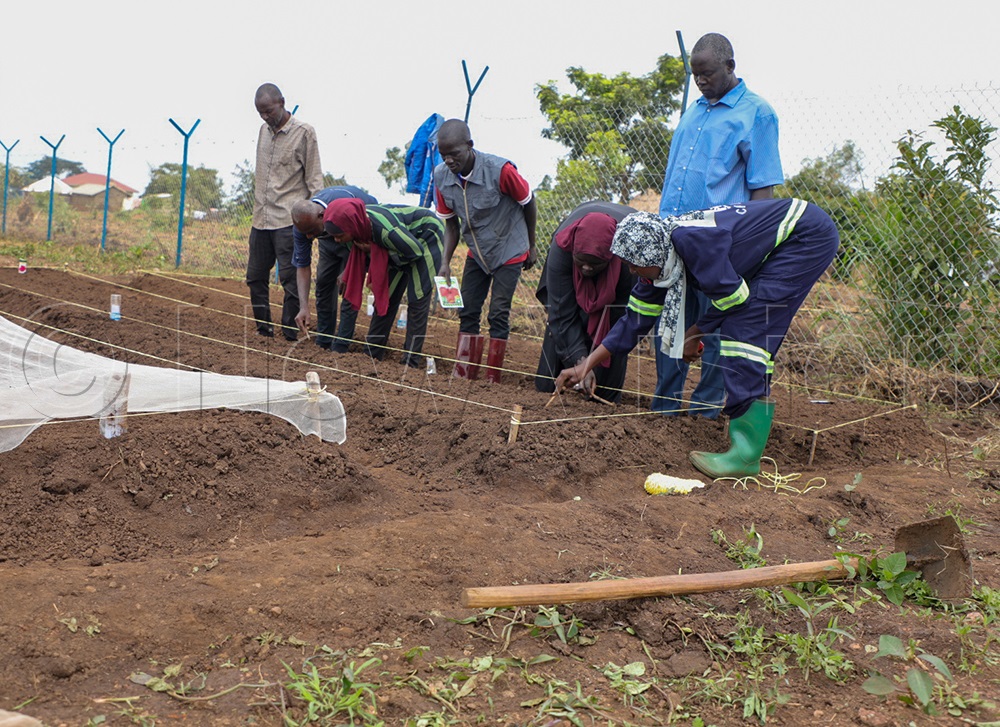
Farm training sessions underway to empower communities with sustainable agricultural skills. (Credit: Prossy Nandudu)
“The main activity that takes place in the refugee settlement is farming; that is what we depend on. From April, May till now, we haven’t seen any rain; we had planted maize, passion, vegetables and beans, but now asking myself, what are we going to eat,” wondered Utua.
Her challenges were also shared by women refugees from Kiryandongo refugee settlements, who also faced similar challenges. According to environmentalists, prolonged dry spells in refugee settlements have been attributed to the continuous cutting down of trees by refugees for settlement and cooking, which has, in the long run, affected rainfall patterns.
Utua is now appealing for support with irrigation packages for women farmers in refugee settlements to increase food production for both home use and for the market.
Various farmers in Uganda use a pre-packaged, do-it-yourself watering system that delivers water directly to plant roots, drop by drop or via micro-sprays. These kits contain all the necessary, compatible components to set up an automated or semi-automated system without requiring specialised plumbing tools or expertise
LEAD Project empowers refugees and host communities in Uganda through local development and sustainable livelihoods. Under this project, individuals are equipped with skills and resources to thrive independently. This is done through targeted education and vocational training. The conference is part of the celebrations to mark World Refugee Day, which is celebrated on June 20, every year.
“Women in the refugee settlement are stuck. They don't know what to do. It has never rained since April, and things are drying off. It is my appeal that you give us irrigation kits,” Utua added. She also wants the irrigation kits to be solar-powered for a continuous water supply given the changing weather patterns.
Her appeal comes a few weeks after the Ministry of Water and Environment, through the meteorology department, announced that the country would experience a dry spell for the next three months, from June, July, and August, with isolated cases of rain.
Following the announcement, some parts of the country, including the central region, are already experiencing water scarcity.