
Rainmaker no more?: Learners, teachers decry Rwenzori mountains' receding glaciers
Students and educators from schools at the foot of the mountains say melting glaciers are also disrupting education, health and livelihoods. They fear that the mountains, if conditions do not change, will cease being a rainmaker.
About 60 learners from various schools display their certificates after being trained as climate ambassadors. (Credit: Samuel Amanyire)
Learners kick off the tree planting activity in a bid to participate in restoring snow on the Rwenzori mountains. (Credit: Samuel Amanyire)
The Rwenzori Mountains consist of six distinct mountains, Stanley, Speke, Baker, Emin, Gessi and Savioa. Mt Stanley’s 5,109m Margherita Peak is the third-highest point in Africa after Kilimanjaro and Mount Kenya, and the highest in Uganda, famous for its glaciers, unique afro-alpine flora, and challenging treks.
The explorer Henry Stanley placed the Rwenzori on the modern map on May 24, 1888. He labelled it ‘Ruwenzori’, a local name that he recorded as meaning “rainmaker” or “cloud-king.”
However, the mountain's peak, once crowned with snow, is facing an inherent threat: Climate change, which is directly affecting downhill areas by altering water supply (less meltwater long-term, more initial floods), changing terrain (increased landslides/rockfalls as ice disappears), and threatening biodiversity, according to students and teachers in Kasese district.
The development is also creating hazards for communities and disrupting local ecosystems reliant on glacial melt for rivers like the Semliki.
Students and educators from schools at the foot of the mountains say melting glaciers are also disrupting education, health and livelihoods. They fear that the mountains, if conditions do not change, will cease being a rainmaker.
At a recent event in Kasese district, pupils and teachers described the events triggered by rising temperatures, a problem they also attribute to unchecked industrial emissions and deforestation.
At St Matia Mulumba Primary School in Ibanda-Kyanya, learners and educators detailed how the receding snows have turned their classrooms into battlegrounds against heat, floods, and disease. Ten-year-old Anthony Ndobya said, “When glaciers melt, landslides and floods destroy property and force us to miss school. People, especially children, die.”
Kyanya SDA Primary School's Joan Balubasa in P6 added that afternoon classes are now unbearable: “The heat makes us drowsy. We can’t concentrate.”
Charity Musoki from Ruboni Primary School said extreme heat compounds menstrual discomfort.
“Girls suffer from severe headaches and excessive bleeding during periods.”
Teachers, too, are sounding the alarm, including St Matia Mulumba headteacher Damian Muthwanda, who said rising temperatures have created ideal conditions for malaria-carrying mosquitoes, forcing students to miss school. Muthwanda added that floods also destroy crops, leaving families unable to afford school fees.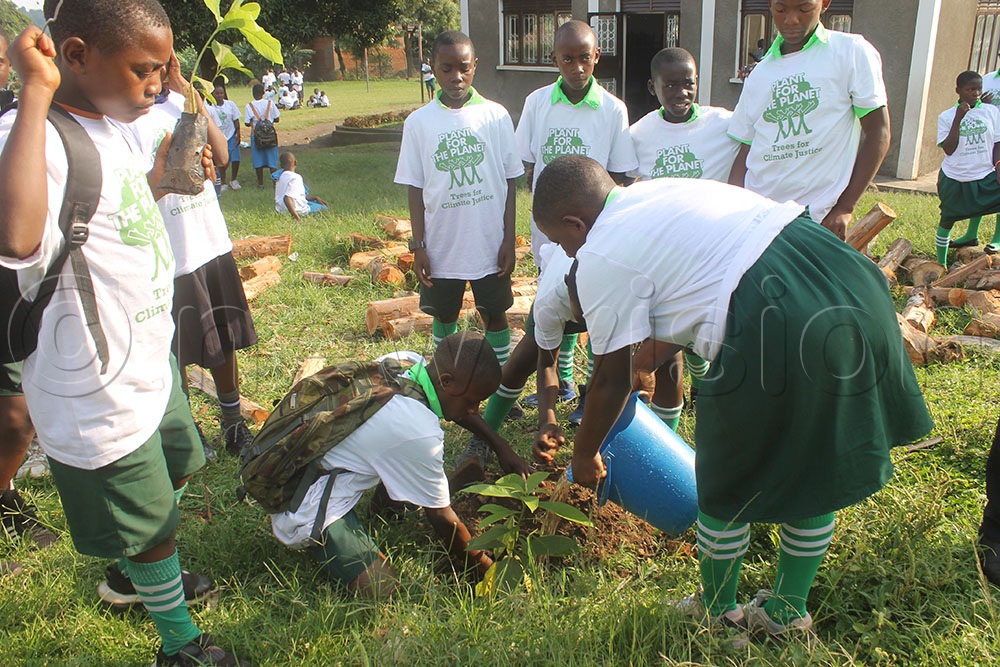
A disappearing icon
Plant-for-the-Planet initiative co-ordinator Isaac Sinamakosa said glacial cover on the mountain's peak has shrunk from 15 square kilometres in 1900 to just 1.5 square kilometres in 2021. Between 2020 and 2024 alone, the Stanley Plateau glacier shrank by 30%.”
Experts warn that without urgent action, the glaciers could vanish entirely within decades.
Community response
To combat the crisis, students and activists are mobilising. The Plant-for-the-Planet academy, launched at the event, brings together 60 pupils from three schools to plant trees and restore ecosystems. Sinamakosa urged the youth to act now.
"The future belongs to them, that's why they have to act now." He said.
Cultural and economic stakes are equally high as information state minister Godfrey Kabbyanga Baluku warned that losing the snows would erase part of Uganda’s tourist attractions, as thousands of hikers come to see the snow, and strip local communities of spiritual identity.
"Socially, some natives, especially in Kasese believe that their God dwells on the glaciers. Therefore, if they disappear, they will not find luck," Kabbyanga said.
To preserve the mountain’s legacy, according to Kabbyanga, Kasese will host the annual Theluji Festival, where thousands plant trees to revive the snows.
As the glaciers retreat, students like Ndoby and Balubasa are catalysts for change as their plea to policymakers and global leaders is urgent.
“The snows are our lifeline,” Kabbyanga said. “Without them, we lose more than mountains—we lose our world.”
Climate on the Rwenzoris
The climate on the Rwenzori Mountains, according to the Uganda Wildlife Authority, is cold and extremely wet; Rainfall is heaviest (sometimes reaching 300mm/month) during March-May and August-December, though even in the drier months, some daily rain is common. Though daytime temperatures average 100 °C, after dark they drop below freezing. It is common for Visibility to be obscured by mist and (on the peaks) snow.
It is, therefore, advisable to visit the Rwenzori during the drier months of January and June-July.