
Minister Cheptoris warns complex messaging is failing environmental fight
Uganda, Cheptoris cautioned, is “walking into a slow suicide” if environmental degradation and pollution continue unchecked.
Dr Alfred Okot Okidi, PS at the Ministry of Water and Environment, joins 560km awareness campaign walkers from Karamoja to Kampala for a group photo at the 9th Water and Environment Week closing in Luzira. ( Photos by Leonard Mukooli)
________________
Water and environment minister Sam Cheptoris has challenged both policymakers and citizens to rethink how environmental messages are communicated and acted upon, warning that technical discussions held in conference halls often fail to reach the communities most responsible for environmental destruction.
“We are not here to impress ourselves,” Cheptoris told attendees said during the close of the 9th Uganda Water and Environment Week at the ministry headquarters in Luzira. “The real audience is the ordinary Ugandan out there. Drop the complex language; speak in ways that change behaviour.”
The week-long event, held at the ministry headquarters in Luzira, brought together government officials, development partners, civil society actors, and private sector players to reflect on progress, challenges, and opportunities in the water and environment sector, alongside the commemoration.
Uganda, Cheptoris cautioned, is “walking into a slow suicide” if environmental degradation and pollution continue unchecked.
Wetland destruction and pollution
Cheptoris expressed concern over the increasing degradation of wetlands, describing it as one of the most visible and dangerous trends undermining Uganda’s environmental stability.
“It is disturbing to see wetlands being filled with soil just to pave way for buildings,” he said. “We know their value, yet we are destroying them at an alarming rate.”
He warned that such actions are not isolated incidents but part of a broader pattern of environmental neglect that threatens water systems, biodiversity, and public health.
Drawing from personal experience, the minister linked environmental degradation directly to health risks, noting that pollution has compromised the quality of food and air in the country.
Permanent Secretary at the Ministry of Water and Environment, Dr Alfred Okot Okidi, officiated the launch of Climate Resilient Action Plans and reports during the closing ceremony of the Water and Environment Week.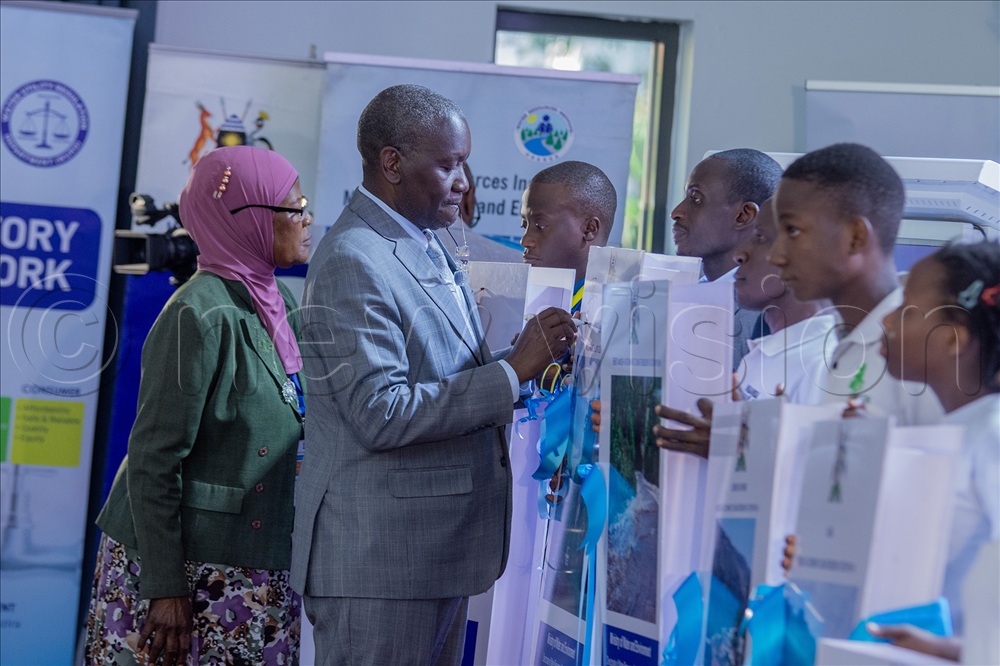
“I was advised abroad to rely on organic food for my health,” he said. “But with the level of pollution we are facing from vehicle emissions to industrial activity, you begin to question the safety of what we consume.”
‘Driving ourselves to death’
In one of his most striking remarks, Cheptoris turned attention to air pollution, particularly from ageing vehicles and the growing number of motorcycles.
“We are slowly poisoning ourselves,” he said. “You find someone driving an old vehicle that emits dangerous fumes, yet we all breathe the same air.”
He dismissed the notion that environmental protection is a Western luxury, arguing instead that developed countries have achieved progress precisely because of strict environmental safeguards.
“In many European cities, forests are preserved within urban spaces, and environmental laws are enforced without compromise,” he said. “Here, we are doing the opposite.”
Cheptoris suggested bold measures, including restricting old vehicles and promoting alternative transport.
“If it were within my mandate, I would phase out old cars entirely,” he remarked. “Those who cannot maintain cleaner vehicles should consider alternatives like cycling.”
He also criticised the environmental impact of boda-bodas, likening their emissions to harmful indoor smoke.
“The fumes from these motorcycles are just as dangerous as the smoke people inhale in poorly ventilated kitchens,” he said. “We are exposing ourselves to long-term health risks.”
Economic stakes
Finance minister Matia Kasaija framed environmental protection as central to Uganda’s long-term economic ambitions.
He noted that this year’s theme, Water and Environment for a Prosperous Uganda, reflects a strategic direction rather than a ceremonial slogan.
“Our economic future is inseparable from the health of our natural resources,” Kasaija said. “Environmental degradation is already imposing significant costs on the economy.”
He outlined Uganda’s ambition to expand its economy tenfold from $50 billion in 2025 to $500 billion by 2040 under a development framework anchored on agro-industrialisation, tourism, mineral development, and science and technology.
However, he cautioned that these pillars depend heavily on sustainable water and environmental systems.
“You cannot talk about agro-industrialisation without reliable water for irrigation,” he said. “Tourism thrives on intact ecosystems: our forests, lakes, and wildlife. Even mineral development requires substantial water resources.”
Kasaija stressed that without deliberate conservation efforts, the country risks undermining its own growth trajectory.
“It is impossible to achieve this transformation without protecting the very resources that sustain it,” he added.
Investment and inclusion
Kasaija called for increased investment in water infrastructure, particularly in storage and distribution systems, to address persistent gaps in access.
“Water is a basic human right,” he said. “We must ensure equitable access, especially for rural communities, women, and the youth.”
He also emphasised the need to protect wetlands, forests, and catchment areas, describing such investments as essential rather than optional.
“These ecosystems are the backbone of agriculture, energy, and tourism,” he said. “Protecting them is an investment in our economic resilience.”
The minister further urged the government and private sector to harness youth innovation, particularly digital solutions for environmental monitoring and management.
“Technology offers us an opportunity to leapfrog traditional challenges,” he said. “We must empower young people to drive this transformation.”
Water, gender, and inequality
At the World Water Day commemoration, Dr Eng. Frank Kweronda highlighted the intersection between water access and gender inequality.
“Water is not just a resource; it is a matter of dignity and justice,” he said.
Kweronda noted that women and girls disproportionately bear the burden of water collection, often sacrificing education and economic opportunities.
“In many communities, the responsibility of fetching water falls on women and girls,” he said. “This limits their potential and exposes them to risks.”
He called for policies that prioritise gender inclusion, linking improved water access to broader development goals, including education, health, and economic empowerment.
Climate warning signs
Meanwhile, Dr Bob Alex Ogwang of the Department of Meteorological Services warned that Uganda is already experiencing the effects of climate change.
“Temperatures are rising across all regions, and rainfall patterns are becoming increasingly unpredictable,” he said.
He pointed to a growing frequency of extreme weather events, floods, droughts, and landslides, which are causing widespread damage to lives and infrastructure.
“These events are no longer rare,” Ogwang said. “They are increasingly becoming the norm.”
He underscored the role of ecosystems such as wetlands and forests in regulating climate systems, warning that their destruction disrupts rainfall patterns.
“Protecting these ecosystems is not just about conservation; it is about survival,” he said.
Ogwang also called for stronger early warning systems, including expanded weather monitoring networks and improved public communication.
Global perspective
Ian King emphasised the importance of inclusive and sustainable water governance, particularly for women and girls.
“Water is central to resilience, human development, and public health,” he said. “Yet those most affected by water scarcity are often excluded from decision-making.”
King warned that the continued degradation of forests and wetlands threatens not only biodiversity but also economic stability.
“Restoring these ecosystems offers significant returns,” he said. “It is both an environmental and economic imperative.”
Cultural dimension
Mariam Nkalubo Mayanja, the minister of community self-help, environment, water, and gender in the Buganda kingdom, spoke about the cultural importance of natural resources.
“Water is deeply embedded in our identity and traditions,” she said.
She noted that indigenous practices, such as the protection of sacred sites and totems, have historically played a role in conservation.
“These traditions remain relevant,” she said. “They can complement modern approaches to environmental management.”
Call for collective action
The permanent secretary at the Ministry of Water and Environment, Alfred Okot Okidi, emphasised that environmental protection is a shared responsibility.
“Our development depends on natural resources,” he said. “But mismanagement and climate pressures are putting this foundation at risk.”
Okidi urged stakeholders to translate discussions from the Water and Environment Week into concrete action.
“This is not just a government agenda,” he said. “Every Ugandan has a role to play.”
He added that effective environmental management is critical to job creation and wealth generation.
“We must move from dialogue to implementation,” he said. “That is how we secure sustainable growth.”