
Makerere, NARO say developed new high-value soybean variety
The Maksoy variety 6-Nodumax, which was developed in partnership with Technology for African Agricultural Transformation (TAAT) and the International Institute of Tropical Agriculture (IITA), matures in 93-96 days.
A researcher and farming technology expert, Dr. Omikunle Oluwaseun from Nigeria (2nd-Right) highlighting the difference between comparative performance of Nodumax, and Makerere’s Rhizobia, soybeans during a field tour at IITA’s Namulonge farm on Monday, December 1, 2025 (Photo by Stuart Yiga)
_________________
Crop scientists at Makerere University and the National Agricultural Research Organisation (NARO) say they have developed a new fast-maturing soybean variety, which is expected to boost farmers’ incomes across Uganda.
The Maksoy variety 6-Nodumax, which was developed in partnership with Technology for African Agricultural Transformation (TAAT) and the International Institute of Tropical Agriculture (IITA), matures in 93-96 days.
Becky Nakabugo, the IITA soybean focal person, told New Vision Online that samples are being grown in Lira district and that more varieties are in the offing, while others like 1N, 2N, 3N, 4N and 5N had been introduced earlier on.
“The MAK 7N is being developed by the same Makerere team and will be released after clearance from the relevant authorities,” she says.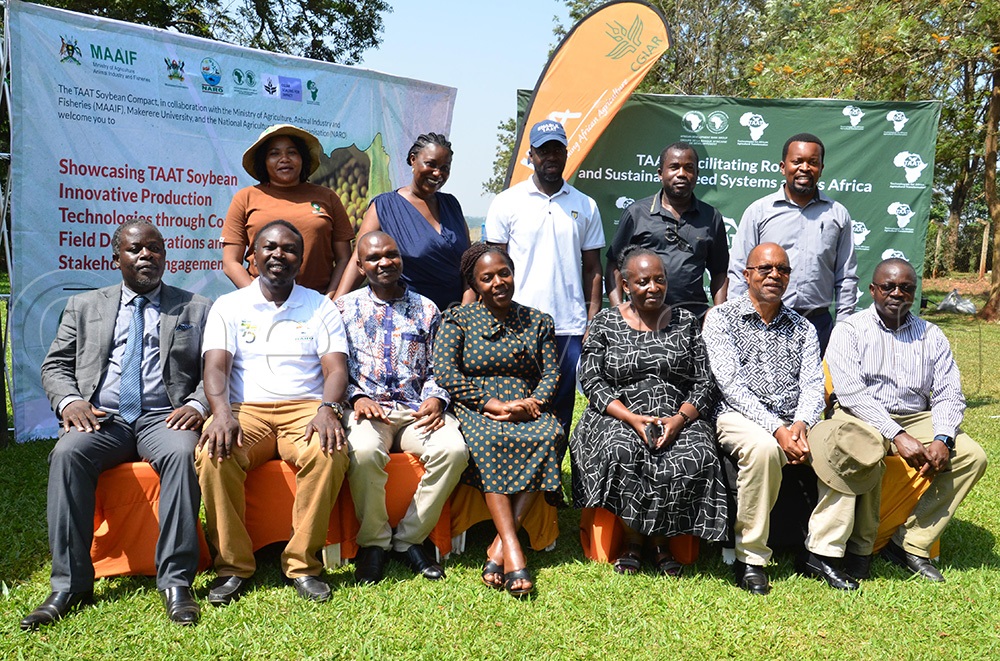
Some of the experts who facilitated the soybean field tour and training at Namulonge, on Monday, December 1st, 2025, posing for a group photo (Photo by Stuart Yiga)
Nakabugo adds that the Maksoy variety is early‑maturing, bears big seeds and matures in less than 96 days.
“It offers solid resistance to soybean rust and moderate drought tolerance,” she says.
Prof. Ivan Mukisa, the head of the food technology and nutrition department at Makerere University, said both Maksoy 3N and Maksoy 6N are high‑quality soybeans.
She said 3N contains 36 % protein and 22 % oil, while 6N has 41 % protein and 20 % oil.
“Both varieties also have high grain quality and are tolerant to drought. They are capable of fixing nitrogen to restore soil fertility,” he said, adding that the varieties were developed specifically targeting youth and women farmers.
Prof. Phineas Tukamuhabwa, a scientist from Makerere University, urged the youth and women to grow soy.
“Soybean remains a strategic commodity in Uganda’s agricultural transformation agenda due to its high nutritional value for people and livestock,” said Tukamuhabwa.
IITA country director Dr George Mahuku said they have trained over 40 youth in agri-entrepreneurship, where they covered critical components of the soy value chain.
“Participants acquired comprehensive skills in areas of input utilisation, selection and pre-processing of high-quality soybeans, processing and product development, production of nine soy-based products including soymilk, tofu, soy yoghurt, soy flour, soy coffee, and soy-enriched baked products like bread, mandazi,” he said.
This was during the showcasing of the TAAT soybean innovative production technologies through comparative field demonstrations and national stakeholders engagement at the International Institute of Tropical Agriculture's national station (IITA) campus, Namulonge in Wakiso district on December 1, 2025.
Dr Eunice Kesiime, who represented Dr Pamela Paparu, the head legumes department at NARO, commended fellow experts from IITA, Makerere University, NARO, and the Ministry of Agriculture, Animal Husbandry and Fisheries (MAAIF) for coming up with such initiatives that help the youth and women.
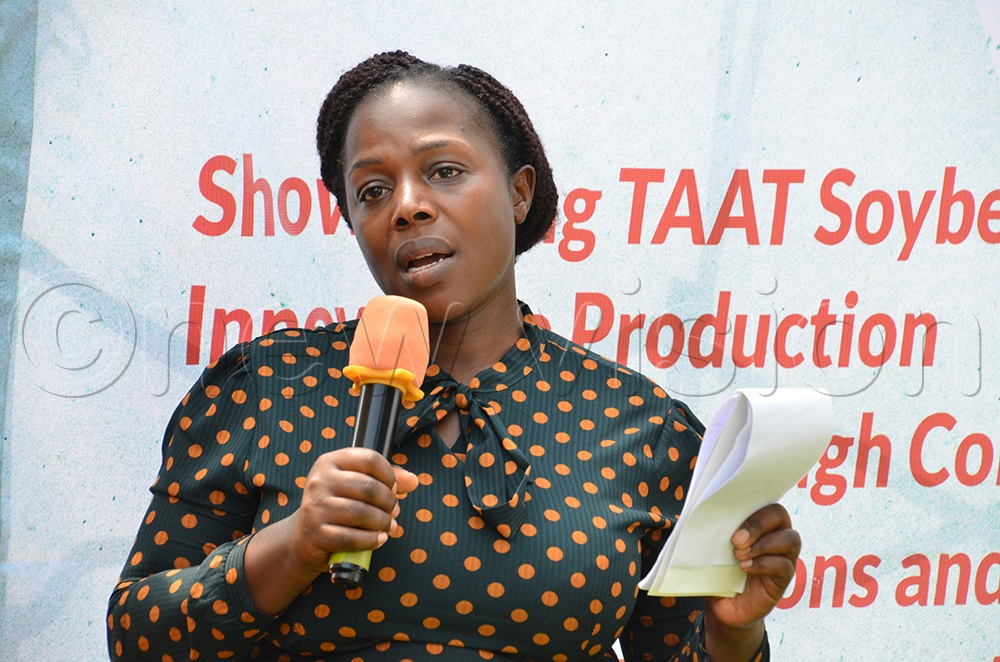
Dr Eunice Kesiime, who represented Dr Pamela Paparu, the head legumes department at NARO. (Photo by Stuart Yiga)
Dr Omikunle Oluwaseun, a researcher and farmer from Nigeria, said value addition and product development remain critical components in enhancing agribusiness competitiveness and sustainability.
“Such initiatives will help promote the use of improved inputs and evidence-based technologies for increased productivity and profitability,” he said.
Joweria Namubiru, a soybean farmer from Mayirikiti, Luwero district, said they often faced challenges in accessing quality foundation seeds and effective biological inoculants that enhance nitrogen fixation and yield performance.
“The training has helped us observe and understand crop performance, the role of biological inoculants and certified seed in improving soybean yields and soil health,” she said.