
Kabale University, NFA sign pact to boost forestry research
The research will also involve assessing the socio-economic impacts of protected areas on surrounding communities. Researchers will study how conservation policies affect livelihoods and explore ways to balance environmental protection with community development.
Kabale University and National Forestry Authority officials posing for a group photo after the Memorandum of Understanding was signed on Friday during a ceremony held in Echuya Forest at Rwaburindi Village in Ikamiro Parish, Muko subcounty in Rubanda District. (Credit: Nelson Ahimbisibwe)
____________
Kabale University has signed a Memorandum of Understanding with the National Forestry Authority to establish a Field Research Station in Echuya Central Forest Reserve in Rubanda District.
The project aims at strengthening forestry research, improving environmental conservation, and expanding practical training opportunities for students.
The initiative is expected to address the growing need for scientific research and practical solutions to environmental challenges such as deforestation, biodiversity loss, and the effects of climate change in the Kigezi region. The research station will also provide a platform for students and researchers to conduct field-based studies while promoting sustainable management of forest ecosystems.
The Memorandum of Understanding was signed on Friday during a ceremony held in Echuya Forest at Rwaburindi Village in Ikamiro Parish, Muko subcounty in Rubanda District.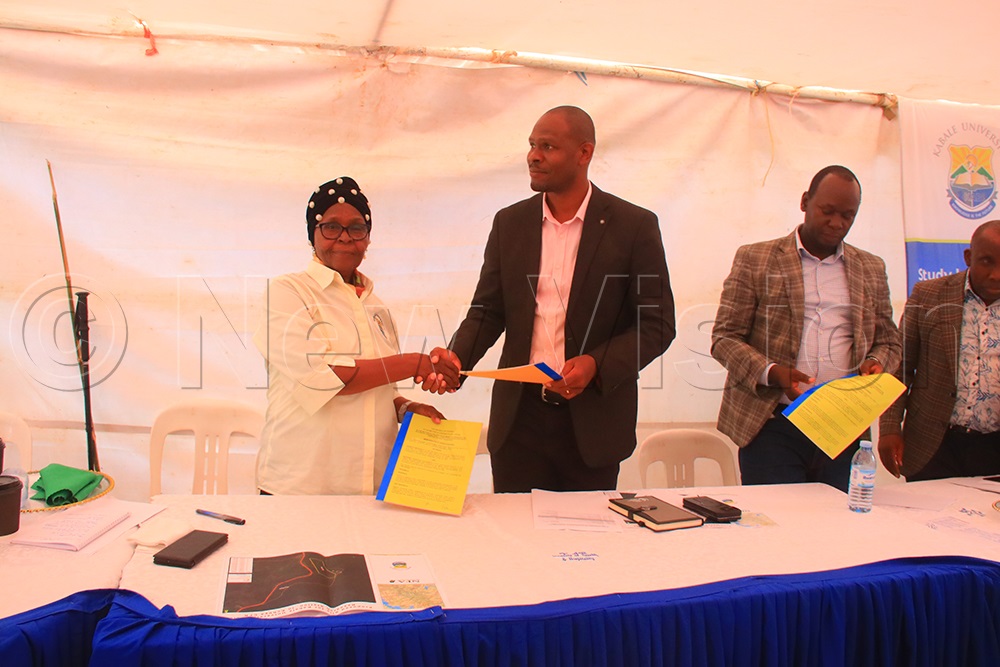
Kabale University Vice Chancellor Prof. Joy Kwesiga (Left) shaking hands with National Forestry Authority led by Executive Director Stuart Maniraguha after signing the MoU. (Credit: Nelson Ahimbisibwe)
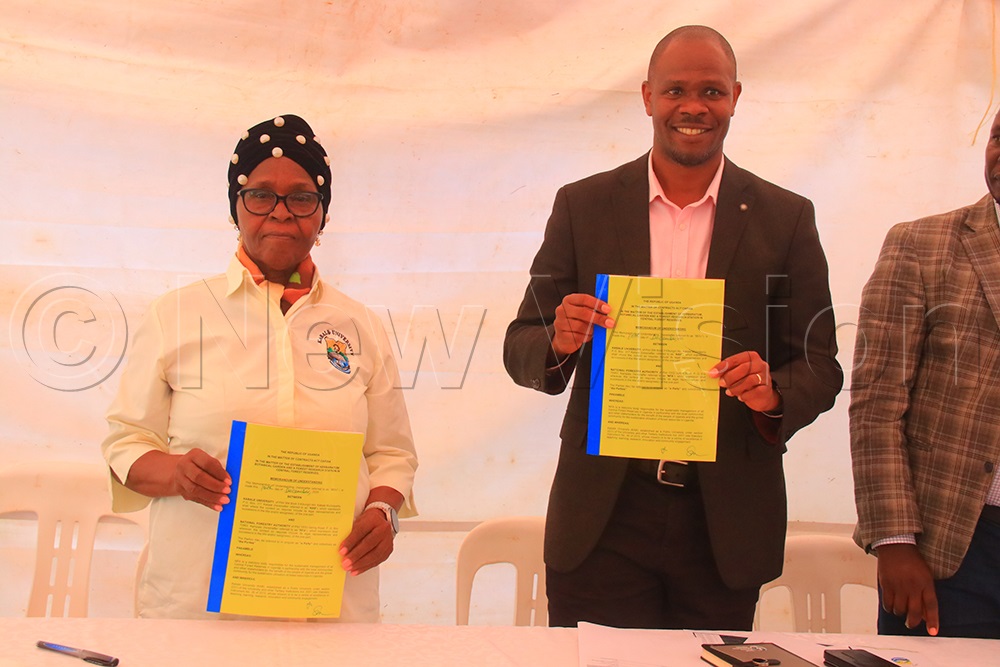
Kabale University Vice Chancellor Prof. Joy Kwesiga (Left) with National Forestry Authority led by Executive Director Stuart Maniraguha after signing the MoU. (Credit: Nelson Ahimbisibwe)
Kabale University, led by the Vice Chancellor Prof. Joy Kwesiga, representatives from the National Forestry Authority led by Executive Director Stuart Maniraguha, district leaders from Rubanda District led by Vice Chairperson Prossy Akampurira Kesafari, and residents from surrounding communities attended the events.
Under the agreement, the National Forestry Authority has allocated 2.1 hectares of land within Echuya Central Forest Reserve to Kabale University to facilitate the construction and establishment of the field research station. The facility will serve as a centre for research, learning, and conservation activities involving students, academic staff, and environmental experts.
The research station is expected to address the gap between theoretical learning and practical experience by enabling students to engage directly with natural ecosystems. It will support studies in forestry, biodiversity conservation, environmental management, tourism planning, and the socio-economic impact of protected areas.
The establishment of the research station is also expected to promote long-term ecological monitoring within the forest reserve while supporting conservation efforts aimed at protecting rare, threatened, and endangered species of plants and animals. Through the station, researchers will be able to document ecological changes, assess the health of forest ecosystems, and develop strategies for sustainable forest management.
Academic programs at Kabale University are expected to benefit significantly from the facility, particularly in the Faculty of Agriculture and Environmental Sciences. Research activities at the station will focus on key areas including forest ecology, watershed management, tourism management and planning, ecosystem changes, and the conservation of endangered species.
The research station will also facilitate the study of medicinal plants found within Echuya Forest Reserve. Many of these plants have potential scientific and socio-economic value, and researchers are expected to document their properties and explore their possible contribution to modern medicine and community livelihoods.
The research will also involve assessing the socio-economic impacts of protected areas on surrounding communities. Researchers will study how conservation policies affect livelihoods and explore ways to balance environmental protection with community development.
The collaboration between Kabale University and the National Forestry Authority began in 2024 when the university approached the authority seeking formal cooperation and land to establish a field research station and botanical garden. Following this request, a joint technical team from both institutions conducted a field assessment within Echuya Forest Reserve to determine the availability and suitability of land for the project.
The assessment confirmed the presence of an appropriate site, leading to further consultations and the eventual approval of the proposal by the Board of Trustees of the National Forestry Authority. This approval paved the way for the signing of the Memorandum of Understanding that formally establishes the partnership between the two institutions.
Following the signing of the agreement, several activities have been planned to ensure the successful establishment of the research facility. These include the development of a detailed site layout plan, preparation and approval of architectural designs, and the conducting of an Environmental and Social Impact Assessment to ensure that the project aligns with environmental protection standards.
Construction of the research station will then follow, after which research programs and training activities will be launched. The institutions also plan to disseminate research findings to policymakers, conservation organisations, academic institutions, and communities to promote informed decision-making on environmental management.
The National Forestry Authority, working together with the Ministry of Water and Environment, will continue to provide technical guidance and oversight throughout the implementation of the project to ensure that it aligns with national forestry policies and conservation goals.
The project is expected to contribute to the protection of Echuya Forest Reserve while promoting environmental education, sustainable tourism, and community engagement.
Once completed, the field research station is expected to become a key centre for environmental research and training in southwestern Uganda, supporting scientific studies, conservation initiatives, and sustainable development efforts within the region.