
Initiative restores over 100,000 hectares of degraded Karinzu, Kasyoha–Kitomi forest reserves cover
This achievement is a result of the Collaborative Forest Management (CFM) initiative, which aims to engage local communities in forest conservation and management in an effort to enhance biodiversity and friendly eco-system.
Members of Ndangara and Nyakiyanja parishes Tutungukye Group in their apiary that they secured from IFPA-World Bank funding. (Photo by Isaac Nuwagaba)
__________________
A conservation initiative has successfully restored 100,000 hectares of degraded forest cover in Karinzu and Kasyoha–Kitomi forest reserves through a collaborative effort between the Forest Sector Support Department under the environment ministry and local communities, New Vision Online has heard.
This achievement is a result of the Collaborative Forest Management (CFM) initiative, which aims to engage local communities in forest conservation and management in an effort to enhance biodiversity and friendly eco-system.
Charles Sabiti, the range manager for Kalinzu Central Forest Reserve, on May 11, 2026, told journalists during a ministry fact-finding visit of forests and protected areas for climate-smart development (IFPA-CD) projects in the 11 districts of southwestern Uganda, “Under the IFPA-CD, we realised that it is more useful to co-operate with local community groups. When we engage with them in profitable activities on the land around the forest, we prevent them from going into the forest to cut wood illegally,” said Sabiti.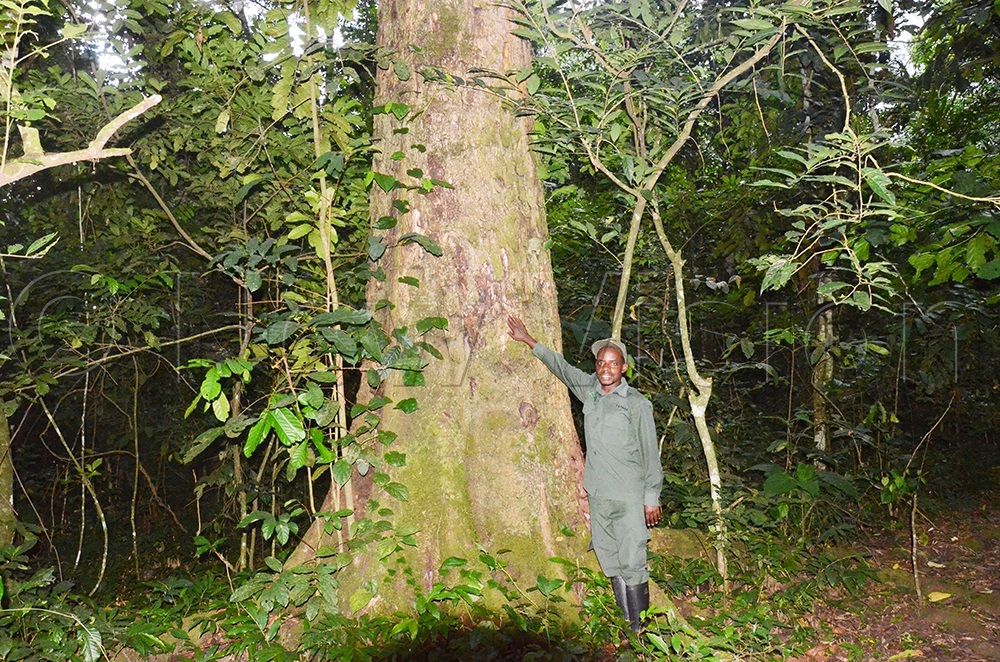
Pathias Katururwa, the nature site guide, showing the trunk of Plunas Africana, one of the indigenous species which were planted in Karinzu Central Forest Reserve. (Photo by Isaac Nuwagaba)
Funded by the World Bank, IFPA project empowered enrichment planting of the indigenous trees with the aim of restoring over 200 tree species that were degraded by encroachers who were burning charcoal through illegal felling.
“With the nine motorcycles given, we were able to do night and day patrols to guard against illegal encroachers on government land. We planted the indigenous Prunus Africana, Fagala Voet tree species, Warburgia Ugandensis species, Mahogany tree species to restore the reserve,” Sabiti added.
Located near Queen Elizabeth National Park in Kasese district, Kalinzu forest in Bushenyi and Rubirizi districts offer eco-tourism, primate tracking of the chimpanzees with over 4oo tree species and over 3oo bird species.
“Under know your boundaries, we opened boundaries and planted one-metre-high demarcation pillars in Ihimbo and Isaasi community surrounding areas to continue enriching the forest,” he said.
With this initiative, two families of chimpanzees were habituated to attract more tourists with the newly maintained 9 kilometres of roads in Kasyoha – Kitomi Forest Reserve in Bunyaruguru.
“During the peak season, we receive over 40 tourists per day which made us earn over sh2b last year,” Sabiti observed.
Over 615 hectares were given out to communities in Ndangara and Nyakiyanja parishes in Ryeru sub-county, Bunyaruguru county in Rubirizi to plant more trees, Sabiti noted.
700 beehives changing lives of adjacent communities
The Nyakiyanja-Ndangara Community Group, one of the beneficiaries of the project, reported increased income from sustainable forest products, including timber, vegetables, and beekeeping.
Under IFPA-CD project, the World Bank provided 700 beehives to communities adjacent to protected to promote sustainable management of forests and protected areas.
Zinori Bikorwomuhangi, a resident of Kabukwiri village in Ndangara parish, Ryeru sub-county in Rubirizi district, said that they engaged in beekeeping, candle making and handicrafts, which he said has reduced human-wildlife conflict.
“The IFPA-CD project has supported the establishment of community tree nurseries, fuel-efficient stoves, and ecotourism initiatives, benefiting over 6,000 locals,” Bikorwomuhangi said.
The project's focus on community engagement and participation has empowered local communities to take charge of their natural resources, he observed.
Benefits of restoration
Deus Byaruhanga, hailing from Kanyara cell, Butoha parish, Magambo sub-county in Rubirizi district, says that the restored forest cover has helped to regulate water flow, reduce the risk of floods and steady supply of clean water.
Uganda has set ambitious targets to restore its forest cover, with the National Strategy on Integrated Forest Landscape Restoration (IFLR) aiming to restore 2.5 million hectares of degraded landscapes by 2030. Uganda's forest cover has been declining due to charcoal burning, agricultural expansion, and illegal logging. However, community-led restoration efforts, supported by non-governmental organisations and government programs, are helping to reverse this trend.