
How Mubende model home is reversing child malnutrition-induced deaths
Through these initiatives, Nakibuule’s home was later turned into a training centre and also an immunisation centre, which has made it easier for her and the medical teams from Madudu Health Centre III to attend to children.
Nakibuule Aisha explains the feeding steps using the hut model while showing the Iron and zinc-rich beans fed to babies. (Courtesy)
_______________
Malnutrition is one of the many causes of death among children under five years old. However, its impact is usually underestimated because many people don’t report deaths associated with nutritional deficiencies.
That was the case in Lutete Village, Kabulamuliro parish in Mubende district for two years. According to Aisha Nakibuule, a Village Health Team member, in a month, they used to refer between eight and 10 children to Madudu Health Centre III with sicknesses associated with malnutrition.
Unfortunately, of these 70% would succumb to the condition. Nakibule, who would discover children during her village visits, was later identified by Sasakawa for training on how to promote proper feeding and nutrition in communities.
"Because I was interested in saving these children and helping their parents, I enrolled for the training in how to combat malnutrition using food under the Sasakawa association training programmes," Nakibuule shared her story with journalists on December 8, 2025, who are part of the Sasakawa Uganda team assessing the impact of their interventions in selected communities they serve.
She said she and other members were introduced to training sessions on how to mix different food items to generate a balanced diet that can be fed to children, whether malnourished or not.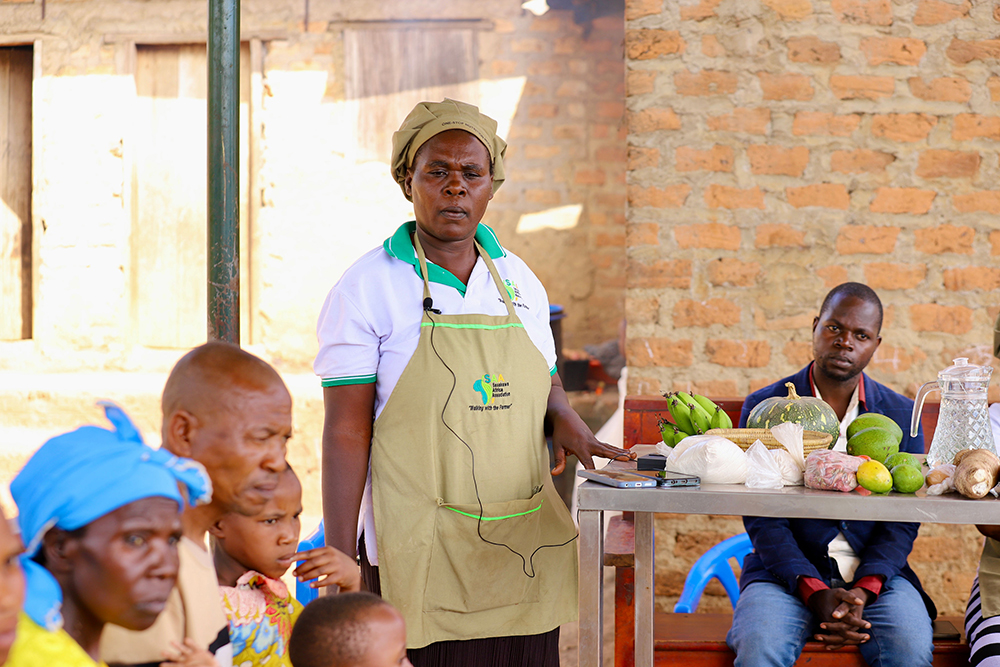
Nakibuule displaying the different food items that should be fed to malnourished children. (Courtesy)
“Trainers used a picture of a hut with different layers. Each layer has a type of food to choose from. Some of the food items in the layers include energy-giving foods, protein-giving foods, vitamins, iron and zinc-rich foods, fruits and also drinks that are suitable for children,” she explained.
To make sure that what community leaders were being trained on would attain the intended objective, and is sustainable enough, she said a team from SASAKAWA trained them to establish kitchen gardens so as to have a constant source of nutritious foods, and also encouraged them to keep local poultry to get organic eggs for the children. For food items like iron-rich beans, maize, soybeans and groundnuts, the community was encouraged to grow them as both sources of food and income.
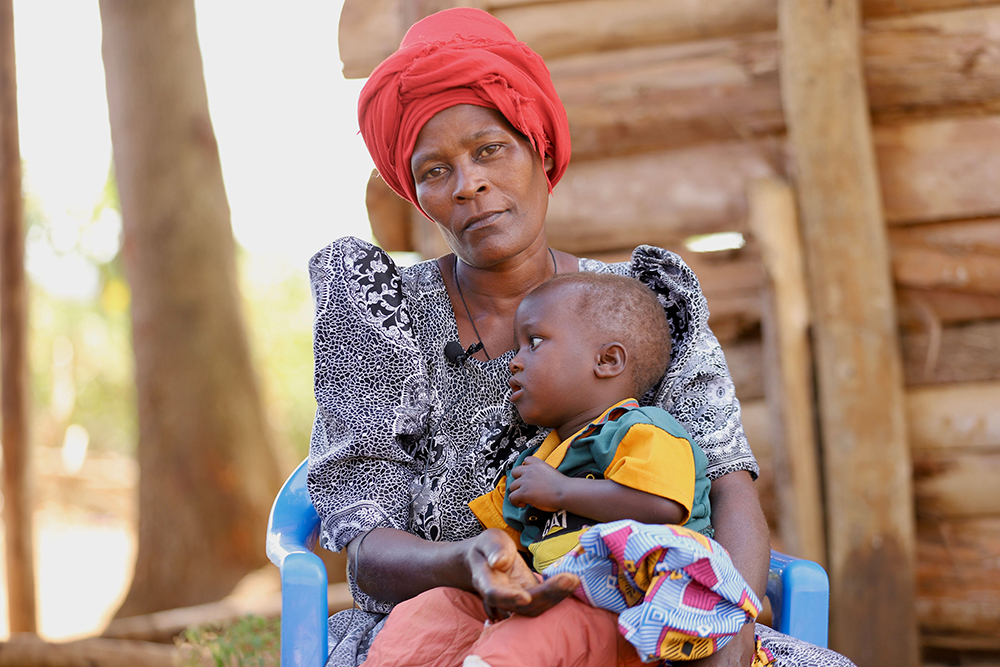
Nantale and her recovering grand son. (Courtesy)
Through these initiatives, Nakibuule’s home was later turned into a training centre and also an immunisation centre, which has made it easier for her and the medical teams from Madudu Health Centre III to attend to children.
Two years down the road, Nakibuule says the number of referrals has reduced to two referrals in a space of three months, and that more parents have embraced the malnutrition classes to learn how best to care for their children.
An example of the beneficiaries is Nantale Ether, who has benefited from the training sessions and improved the livelihoods of her children.
Nantale, who is late 50s, is the caretaker of two of her grandchildren, who were abandoned by their mother at three months, and another wasn’t being fed well by his mentally ill mother.
“When they first brought for me the girl, she was two years old, but couldn’t do anything for herself; she used to not be able to ask for a potty, or food or even move an inch away from a dirty place,” Nantale said.
She added that it's the same time that the initiatives were introduced in their village, with the help of another VHT, Nantale and her grandchild were introduced to Nakibuule’s home, where she enrolled in nutrition feeding classes, an initiative which has seen her grandchild grow.
For the second baby, who is now eight months, Nantale said through the porridge mixture, he too is improving and becoming active as a child compared to the time when he was with his mentally ill mother.
Nantale is one of the many examples of women from 11 parishes in Madudu whose feeding habits for children are improving the lives of children in this region, through her the Nutrition Model.
Nakibuule’s transformation and impact on the community was later supported by the Sasakawa Africa Association (SAA), through training sessions, in nutrition, agronomy, and regenerative agriculture.
Equipped with knowledge, tools, and confidence, Aisha has become a leader in promoting healthy diets, climate-smart farming, and community resilience. Her story demonstrates how empowering one woman can uplift an entire village.