
How Dutch partnerships are transforming Uganda’s smallholder farming
Bouwe-Jan Smeding, the Deputy Ambassador of the Kingdom of the Netherlands, reiterated that Uganda has the potential to become a true regional food basket — but only through collaboration.
A farmer displaying a vegetable variety she had planted. (Photos by Francis Emukule)
________________
From Kamuli, Elgon, to Kigezi, a network of partnerships is showing that Uganda’s journey toward commercial agriculture begins with collaboration, knowledge sharing, and farmer empowerment.
As Uganda moves towards full-scale commercial farming, it is important to acknowledge that before reaching that stage, the country must take small, deliberate steps. The reality remains that most farmers in Uganda are smallholders operating on a subsistence level, with little or no exposure to value addition, mechanisation, or sustainable food security.
To change this, someone; or a group of like-minded people, must set the pace and guide farmers in the right direction. And as experience has shown, progress cannot happen without the power of collaboration.
Bouwe-Jan Smeding, the Deputy Ambassador of the Kingdom of the Netherlands holds a conversation with one of the facilitators.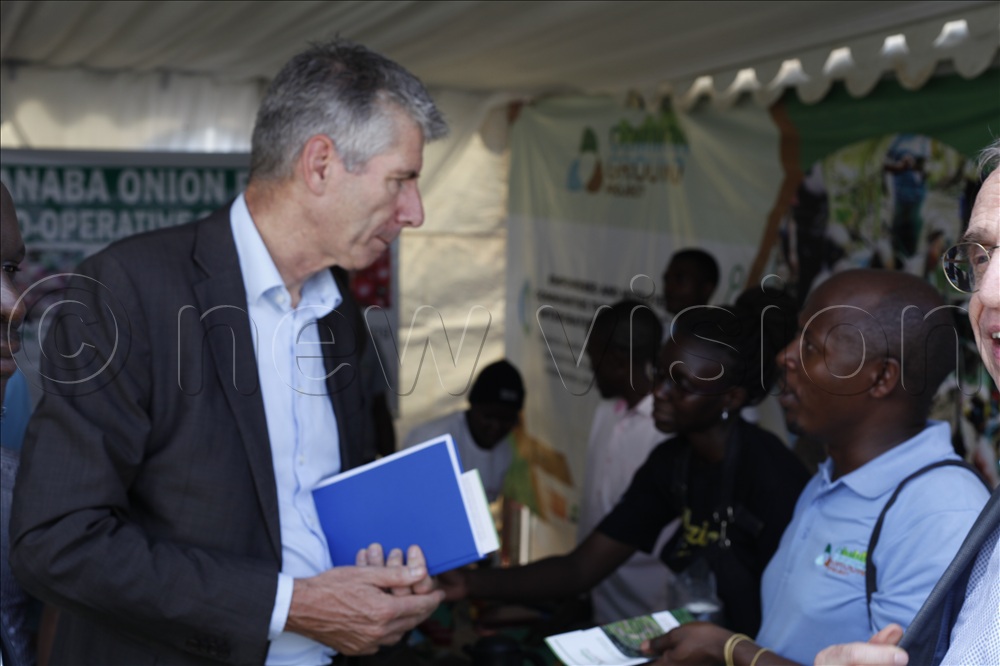
Until I witnessed it, I had never seen how far collaboration could go. Recently, the Embassy of the Kingdom of the Netherlands, in partnership with organisations including; SNV, IFDC, Cordaid, InspireGOAL, AgriTerra, ISSD Uganda, and PCP, held a Food and Nutrition Security Marketplace in Butansi Sub-county, Kamuli District. The event showcased how partnership can strengthen resilience among farming households, boost yields, improve productivity, and secure incomes — all while enhancing access to land, markets, and financial systems.
All the partners operate under one principle: Participatory Integrated Planning (PIP) — a concept that empowers farmers to take part in household decision-making, look beyond immediate challenges, and envision the future they want for their families.
Under this model, each partner focuses on solving a specific problem identified through collaboration.
Recognising that food insecurity and poverty still affect smallholder farmers, AgriTerra has worked through village farmers’ organisations to broker financial, market, and production services for smallholders.
Lynet Awat, Communications Officer at Inspire GOAL, explained: “The PIP approach allows farmers to become the first agents of change. Through workshops and training, we help them identify their challenges and equip them with the knowledge to find their own solutions.”
This approach has enabled farmers to improve their livelihoods by increasing yields, managing soil and water resources better, and realising the full potential of their land.
The process is holistic — problems are first identified through farmer training, solutions are co-created, and yields are improved with support from private sector players who buy the produce, supply fertilisers, and offer financial access through cooperatives.
Elizabeth Kyazike, a regional agronomist with Holland GreenTech Uganda, explained that her organisation, in conjunction with Inspire GOAL, helps farmers with pest and disease identification and soil testing.
Through INCLUDE (Inclusive Livestock Development for Smallholder Farmers) being implemented by SNV, smallholders in Busoga, Rwenzori, Greater Ankole, and Kigezi regions are increasing their household incomes through modernised livestock farming — with a target of reaching 75,000 farmers.
Dr Moses Kayira, Senior Research Officer at NARO’s Buginyanya ZARDI explained that without collaboration, research findings will never reach farmers.
Unlike the conventional approach of handing out inputs and money, PIP depends on intrinsic motivation. As Moses Bogere, Regional Livestock Advisor at INCLUDE, put it:
“The approach is based on intrinsic motivation, which has not been common in project implementation. Many farmers used to ask what they would receive before engaging, but we start by identifying what a farmer already has and then empower them to achieve their dreams.”
For Annet Wabaire, a farmer from Kamuli District, the change has been life-altering.
“Before INCLUDE introduced us to the PIP approach, my husband and I farmed separately. Now we work together as a family, plan our finances jointly, and my harvests have multiplied,” she said.
Village farmer groups have also linked members to SACCOs for savings and credit, producer cooperatives for inputs and market services, and umbrella organisations to advocate for a better policy environment for smallholders. The initiative targets 60 SACCOs, 60 cooperatives, and 180 farmer groups across 27 districts.
To enhance financial access and transparency, partners such as Uganda National Financial Cooperatives are digitising SACCO operations.
“We give farmers loans and digitise their SACCOs to make data collection and tracking easier. So far, we’ve digitised 200 SACCOs nationwide,” said Allen Twinedembe, the Regional Manager at Uganda National Financial Cooperatives.
Extension workers, too, play a critical role in sustaining productivity. Beatrice Luzobe, the founder of the Uganda Forum for Agricultural Advisory Services, explained:
“We build the capacity of extension workers to deliver better services, focusing on communication and publicity so that they can effectively share information with farmers from planting to harvesting.”
Bunawona Cooperative Society Limited, for instance, offers savings and loan services to farmers, particularly those in horticulture.
“Our loans range from sh100,000 to sh2 million. So far, over 265 farmers have borrowed and successfully repaid,” said Rachael Kagoya, General Manager of the cooperative.
Private agro-suppliers are also playing their part. Daniel Byansi, a field technical assistant with Ken-Agro East Africa, said they work through cooperatives to train farmers and supply them with agro-chemicals.
“We supply agro-inputs through cooperative agro-shops and help create referral systems for product demand,” he said.
Positioning and formalisation have also been key achievements. Before becoming a cooperative, Bukallasi Women Coffee Farmers Cooperative Society in Bududa operated as an informal group.
“We were just a group of women dealing in coffee without realising we were already functioning like a cooperative. After mentorship from AgriTerra, we formalised, improved our quality, and found stable markets for our coffee,” said one of the members.
At the research level, collaboration remains just as critical. Dr Moses Kayira, Senior Research Officer at NARO’s Buginyanya ZARDI explained:
“Without collaboration, research findings will never reach farmers. The linkage between researchers and farmers ensures that innovations don’t remain on the shelves.”
Bouwe-Jan Smeding, the Deputy Ambassador of the Kingdom of the Netherlands, reiterated that Uganda has the potential to become a true regional food basket — but only through collaboration.
“To improve our situation, we must involve people in identifying their needs and finding solutions. Without collaboration, even with funding, impact will remain minimal,” he said.
Delivering a speech on behalf of Agriculture Minister Hon. Fred Bwino Kyakulaga, Julius Twinamasiko, Coordinator of Food and Nutrition Security at the Ministry of Agriculture, said collaboration has helped farmers meet key benchmarks in Uganda’s agricultural value chain strategy.
“While it’s encouraging that farmers are doing well, sustainability must remain a shared goal. Collaboration between the private sector and local government makes this much easier,” he noted.
In conclusion, the guest of honour summed up the event’s essence:
“Food insecurity and malnutrition are multi-sectorial and multi-stakeholder issues. No single entity can solve them alone — only through collaboration can we achieve lasting food security.”