
Govt asked to promote economic benefits of forests for their protection
The recommendation was made by Leonidas Hitimana, Forestry Programme Team Lead at the Food and Agriculture Organisation (FAO) Uganda, in a statement issued on March 21, 2026, marking the International Day of Forests.
Youth processing timber in a timber workshop. (Photo by Prossy Nandudu)
_________________
Experts in the forestry sector have appealed to the government to allocate dedicated funding towards restoring Uganda’s rapidly depleting forest cover.
They recommend that such investments be directed towards promoting agroforestry to increase the number of beneficial trees grown alongside food crops, supporting wood processing to create jobs for the youth, and providing sustainable energy alternatives to reduce reliance on fuel wood, among other interventions.
The recommendation was made by Leonidas Hitimana, Forestry Programme Team Lead at the Food and Agriculture Organisation (FAO) Uganda, in a statement issued on March 21, 2026, marking the International Day of Forests.
He explained that, if well harnessed, forests in Uganda can sustain rural communities by providing food, medicine, and income, while also offering practical solutions to youth unemployment.
Information from the Uganda Bureau of Statistics indicates that nearly half, about 48.8%, of young people aged between 18 and 30 are seeking work, and forestry offers scalable employment opportunities in areas such as tree nursery management, plantation management, and value addition activities like sawmilling.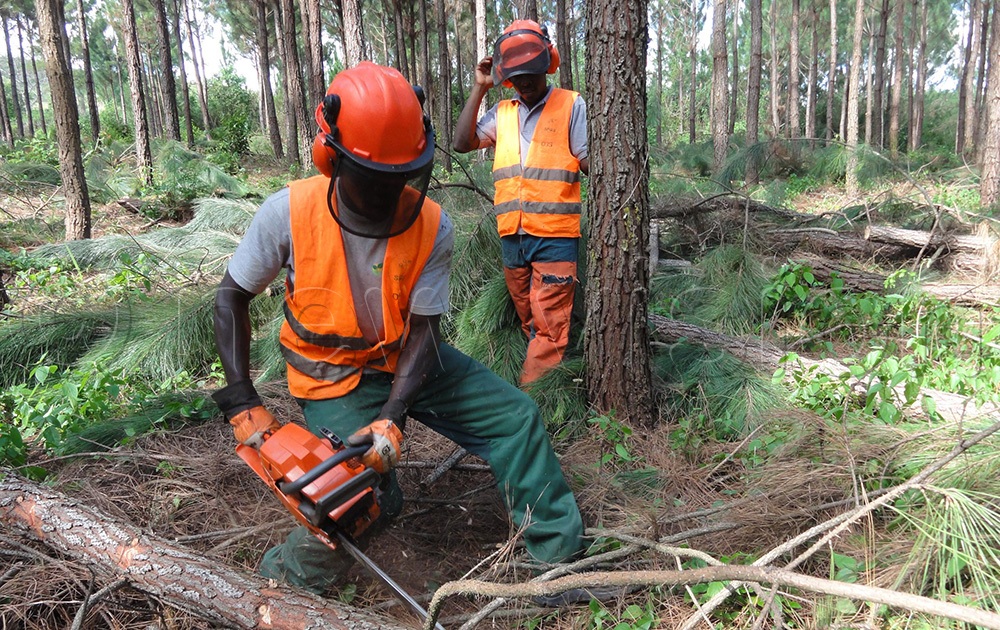
Forestry offers scalable employment opportunities in areas such as tree nursery management, plantation management, and value addition activities like sawmilling. (Photo by Prossy Nandudu)
However, for decades, the country’s natural forest cover has continued to shrink, with nearly a quarter lost between 1990 and 2005.
Hitimana added that although the government has undertaken policy and institutional reforms aimed at increasing forest cover and reversing deforestation through the promotion of plantation forests, Uganda continues to lose approximately 122,000 hectares of natural forest annually.
"This loss translates into soil degradation, increased flooding, reduced agricultural productivity, and heightened vulnerability to climate shocks, impacts that carry high economic costs," he said.
Hitimana further explained that plantation forests are a growing and significant part of Uganda’s forestry-based economy, with over $400 million invested, making forestry one of Uganda's most vibrant areas of private investment.
Through initiatives like the European Union-funded Sustainable Wood-Based Value Chains project, FAO is supporting Uganda to unlock this potential, driving investment, creating jobs, and positioning the country as a competitive player in regional and global timber markets, he explained.
With benefits of forests, including soil fertility enhancement through integrating trees with food crop growing, indigenous species have also become a source of foreign income. Globally, he said, the industry is currently valued at over $2.6 billion and growing.
“With the right investment and policy support, such resources could become as economically significant as traditional cash crops,” Hitimana added.
When it comes to the supply of fuel wood, he said forests remain central to Uganda’s energy mix. With millions relying on fuel wood and charcoal for cooking, the challenge is not simply to reduce demand, but to meet it sustainably.
“Establishing dedicated woodlots and promoting cleaner bio- energy fuels such as briquettes and pellets can meet domestic needs while unlocking export opportunities in emerging green markets.