
East Africa universities unite to transform farming systems
Dr Frank Chidawanyika, the project’s regional co-ordinator, said they are building evidence so governments can make informed decisions on which agricultural practices truly work.
Dr Frank Chidawanyika, the project’s regional co-ordinator, said they are building evidence so governments can make informed decisions on which agricultural practices truly work. (Courtesy photo)
__________________
Uganda has taken a major step toward transforming its struggling agricultural sector, with regional universities launching a collaborative effort to train experts in agroecology, a sustainable farming approach seen as key to future food security.
The initiative was unveiled on May 5, 2026, at Protea Hotel in Kampala during a stakeholder validation workshop organised by the Regional Multi-Actor Research Network in Agroecology in East Africa (RMRN-EA), in partnership with Makerere University’s College of Agricultural and Environmental Sciences.
Dr Frank Chidawanyika, the project’s regional co-ordinator, said they are building evidence so governments can make informed decisions on which agricultural practices truly work.
“We want to transform food systems through agroecology,” he said.
The project, funded by the European Union and led by the International Centre of Insect Physiology and Ecology (ICIPE), brings together Makerere University, the University of Nairobi (Kenya), and Sokoine University of Agriculture (Tanzania).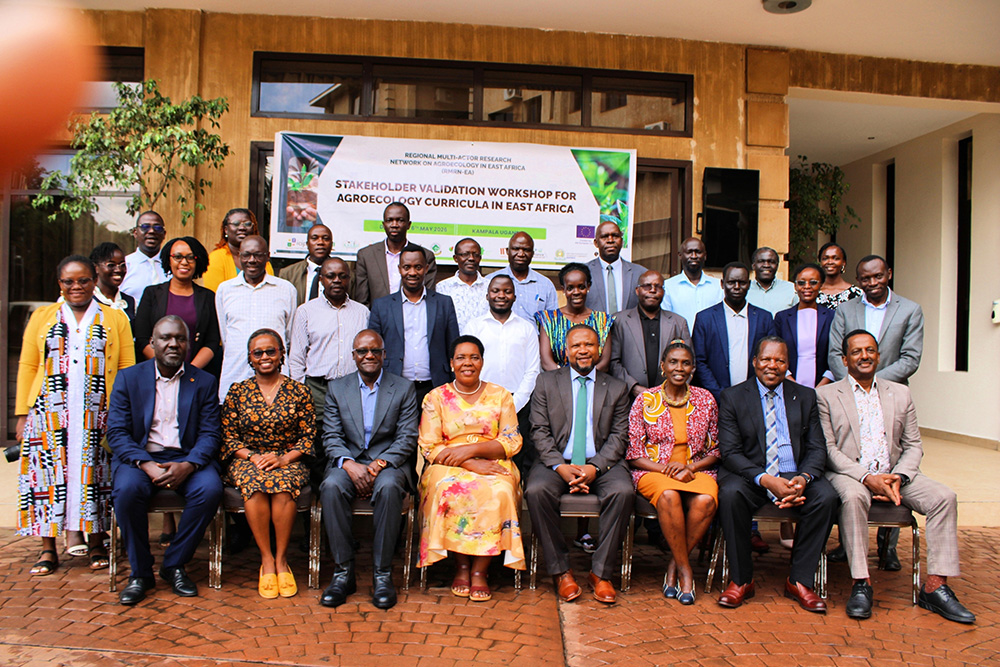
The project, funded by the European Union and led by the International Centre of Insect Physiology and Ecology (ICIPE), brings together Makerere University, the University of Nairobi (Kenya), and Sokoine University of Agriculture (Tanzania). (Courtesy photo)
The aim is to train a new generation of agroecology experts while testing practical solutions directly with farmers.
Unlike conventional agriculture, agroecology focuses on working with nature, recycling nutrients, improving biodiversity, and reducing reliance on chemicals.
Chidawanyika emphasised that many claim they practice sustainable agriculture, but without scientific validation, governments cannot confidently invest in those methods because skills and evidence is needed.
The initiative is structured around four key components: developing agroecology curricula in universities, strengthening research capacity, co-creating farmer-led innovations, and establishing a regional policy working group to translate research into actionable policy.
However, experts warn the sector is under mounting pressure from soil degradation, climate variability, loss of biodiversity, and rising input costs, threatening the survival of smallholder farmers.
One of the central goals is the introduction of a PhD program in agroecology at Makerere University, expected to begin enrolling students by 2028 after regulatory approvals, designed to equip scientists with skills to tackle real-world farming challenges.
Move aligns with national priorities
Prof. John Baptist Tumuhairwe, the dean at Makerere University, said agroecology offers a way to rebuild resilience by working with nature rather than against it.
“Agriculture remains the backbone of our economy, yet our soils are increasingly degraded,” said.
Prof. Anthony Egeru of Makerere stressed that the programme must go beyond academic output to deliver real economic value.
“Innovation must create value,” he said.
“This is about linking knowledge to productivity, income, and national development goals.”
Egeru added: “This is about survival and sustainability and we must increase productivity while protecting ecosystems.”
Prof Richard Onwonga from the University of Nairobi said the practice is not entirely new, and it is about refining traditional systems with science and scaling what works.”
Meanwhile, Prof Japhet Kashaigili from Tanzania noted that while training programs are expanding, the job market for agroecology specialists remains unclear.
“We need governments to recognise and invest in agroecology,” he noted. “Otherwise, we train people who have nowhere to go.”
Impact on smallholder farmers, youth
For farmers and youths, the impact could be significant.
Onwonga showed that graduates from the university will become extension workers who can guide farmers at grassroots levels toward sustainable practices.
“Right now, most extension services still promote chemical-based agriculture.”
The shift could also open new opportunities for young people.
Agroecology is closely linked to the circular economy turning farm waste into compost, creating new agribusiness ventures, and building value chains.
“Youth can plug in at every stage, from production to processing to innovation.”
As Uganda pushes toward economic transformation, stakeholders say the success of agroecology will depend on strong policy support, investment, and the ability to translate research into practice.