
Building smallholder farmer and environmental resilience in Uganda's highlands
Thanks to the CommonGround Project, the Nyambigha community and many others are transforming to thriving communities that take control over their own lives.
Majority of the households within the communities have been trained on nutrition and setting up a kitchen garden. (Credit: CommonGround Project)
________________________
COMMUNITY EMPOWERMENT
When the CommonGround Project first arrived in the Nyambigha community in Karugutu subcounty, Ntoroko district in Uganda's Rwenzori region in 2023, it found the community isolated and weary. The only path that led to this community was a narrow, bushy trail that was impassable to vehicles and treacherous in the rain.
Farming was practised in a rudimentary way, which made the harvests meagre, barely enough to feed the families and to supply the markets. Sanitation was a problem, due to lack of latrines and clean water, which forced women and children to walk for kilometres to collect from dirty water sources.
According to Joseph Busesi, a local leader, children would spend hours searching for water, which made them delay or absent themselves from schools, and the women too delayed at the water sources, something that made their husbands suspect that they were with other men, leading to violence against women.
The community was unorganized and expected government to solve its problems. 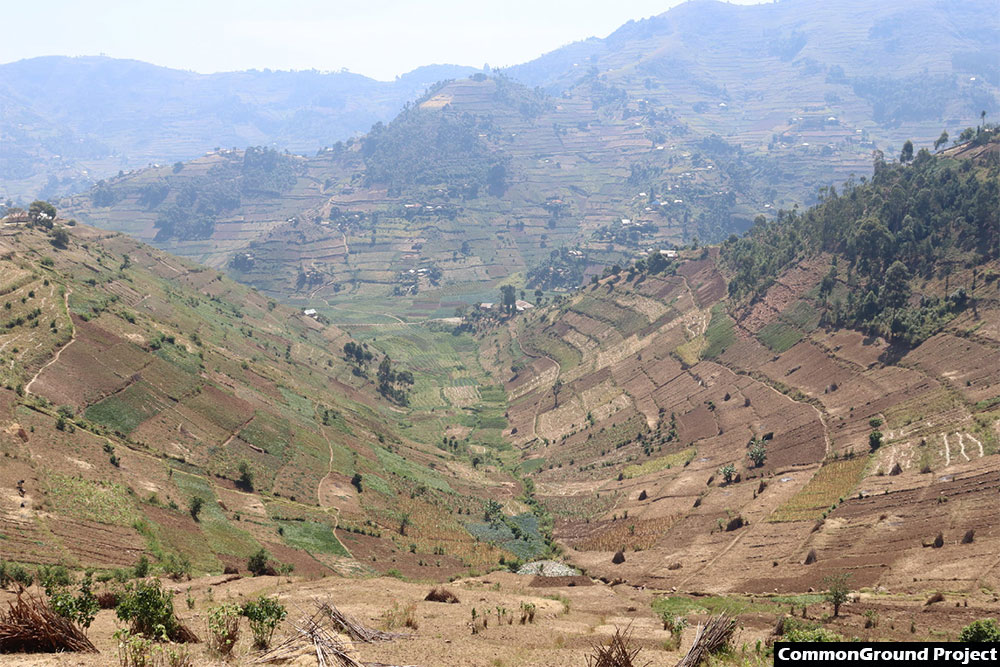
Before the arrival of the CommonGround Project, highlands underwent massive degradation
Taking ownership
With the arrival of the CommonGround Project, the community began to realize that they needed to take control of their own lives, which gave them hope.
This four-year project (2022-2026), funded by the Embassy of the Kingdom of the Netherlands in Uganda, is led by Wageningen University & Research and implemented by Integrated Seed and Sector Development Uganda (ISSD Uganda) in close collaboration with other partners in the highlands in Rwenzori, Kigezi and Elgon regions.
The project aims to enhance the resilience of 150,000 smallholder farmer households and healthy agroecosystems in the highlands of Uganda through sustainable farming systems, restored watersheds, and improved marketing opportunities remained firmly within reach.
The project started with mobilizing communities for awareness-raising meetings aimed at understanding the social, environmental, and economic problems that hindered their development.
These meetings also made communities aware of having to solve their own problems. This was done using the PIP approach, which supports farmer households and communities to transition from a present to a future situation by imagining a realistic future, developing action plans, and beginning to implement activities, driving locally-rooted and sustainable change.
So far, the project has supported to create PIPs (a vision and action plan drawn by each family and community), trained 15,178 PIP trainers and 702 integrated farm trainers (IFTs) in various PIP trainings.
The project supported the creation of 117 community action plans based on community visions. These processes inspire ownership, encourage collaboration around common goals and foster a proactive mindset, enabling communities to shape their own future. The priorities that emerge from these plans feed into tailored support from the project and related partners.
To ensure that PIP is initiated to 83,369 households and the young generation, the project has capacitated 59 schools on environmental education using a PIP curriculum.
The Nyambigha community realized that the major problems that were hindering development included lack of access roads, lack of clean water, poor farming systems, erosion, poor markets, and, above all, lack of collaboration within the community and households.
Opening roads to access markets
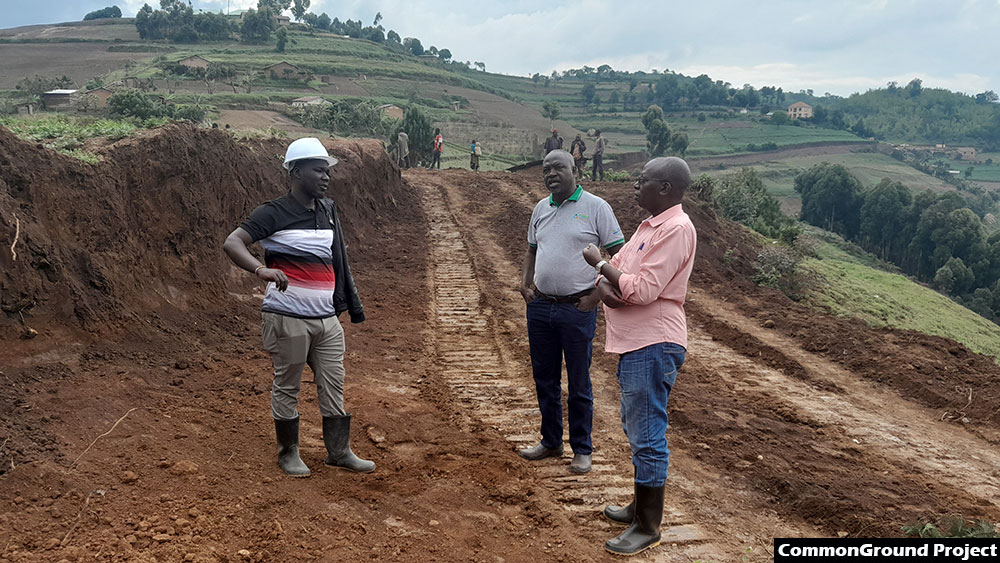
The project has supported the construction of community access roads to connect them to the markets
Once they realized their key problems, the Nyambigha community got together to take collaborative action. They started with the opening of the main road.
Eva Masika, a resident, said that after realizing that if they collaborated, they could solve the community problems, the community decided to mobilize local tools such as hoes, pickaxes and spades, and they started opening the community road. This 2km road now connects Nyambigha to Bundibugyo-Fort Portal Road and is now the shortcut for most traders.
“We allocated every Thursday for community work. Indeed, working together helped us to open our community to the rest of the world," she said.
Afswa Kengonzi, the parish chief of Nyambigha Karugutu Parish, said the road connects two parishes that have a population of over 1,000 people who use the road.
“People now access that community to buy cocoa, beans, and coffee easily. Because of the road, the community was able to have a visitor who opened a clinic, and now people no longer ply long distances in search of medication,” she said.
So far, over 97 kilometres of roads have been constructed from the 140 kilometres prioritized by the project, revolutionizing transport and market access for at least 14,000 community members across the three regions. For some areas, heavy machinery was required, which was arranged by the project with key stakeholders.
Apart from improved access to markets, the transport costs have also reduced. In the Kyatwa community located in Bunyangabu district, a newly constructed three-kilometre road has become a lifeline for farmers, facilitating the transport of produce to nearby markets.
Patrick Ishoza, a banana farmer, vividly recalls the struggles before the road improvements.
“Transport costs used to soar to 20,000 Ugandan shillings per trip during the rainy season due to the muddy conditions. Now, with the new road, costs have halved to 10,000 Ugandan shillings, and vehicles can easily access our community,” he says.
Improving farming systems
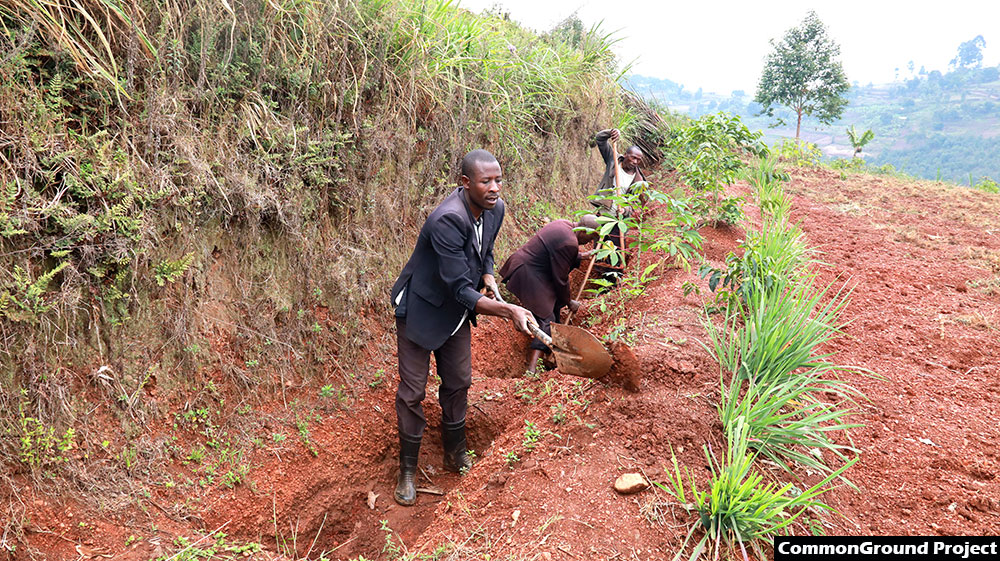
Sustainable land management practices are helping control erosion on the highlands
Matayo Kighuliro, the agricultural officer for Karugutu sub-county in which the community resides, says the farming systems were very poor. There were issues of erosion that had swept all the soil to the valleys; hence, the soil in the hilly areas had remained unproductive.
He says that as extension workers, they were not reaching the communities because they lacked facilitation in terms of transport, among others.
However, through CommonGround, Kighuliro says the farmers have now been trained in good agronomic practices such as cutting down old coffee so it rejuvenates, digging trenches in the gardens to control erosion, desuckering bananas and on the use of compost manure.
“The training sessions have improved production. Erosion has now been controlled, and the soils are regaining fertility” says Kighuliro.
The project has supported 83,369 households to establish Integrated Plot Plans (IPPs) that are aimed at helping farmers optimize the productivity of their land in a sustainable way.
To support farmers in adopting sustainable farming practices, ensuring that at least 80% of households trained in PIP (PIP households) are established and implementing sustainable farming practices on their IPPs and restoration sites, the CommonGround Project has capacitated 702 integrated farm trainers (IFTs), assigning roughly six trainers per community.
To reduce malnutrition, the project encouraged households in Nyambigha to have a kitchen garden. The community was trained, and now majority of te households have a vegetable garden where they get vegetables for nutrition, whilst the excess is sold to earn households an income.
Majority of the households within the communities have been trained on nutrition and setting up a kitchen garden. Of the 83,369 households reach so far, 60% of the households have kitchen gardens.
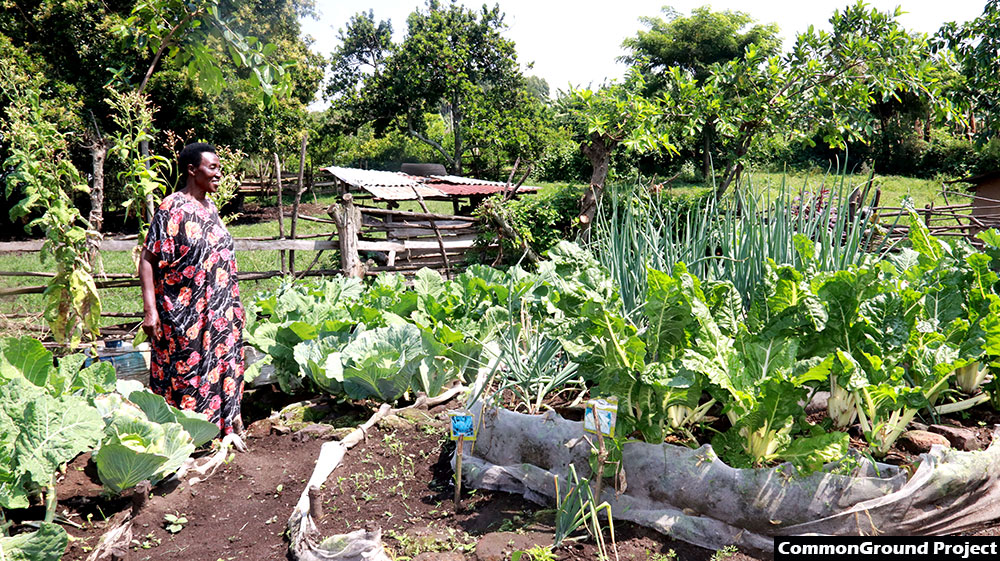
Kitchen gardens are established at households and are aimed at improving nutrition
Addressing deforestation
Herbert Kamuhanda, the district environment officer of Ntoroko, says the district was grappling with environmental challenges such as landslides, floods, erosion, and, above all, access to tree seedlings of indigenous tree species. He said this was caused by mass deforestation in the district.
“The district has lost millions of trees, but they are not replaced. This has made the hills remain bare, hence increasing the rate of erosion and landslides. However, the introduction of community tree nursery beds is to change everything."
Kamuhanda notes that the communities are managing the nursery beds with support from the CommonGround Project, and from the nurseries, they have planted trees both in their gardens and on the restoration sites. These have been because of the continuous awareness raised and over 522 restoration sites have been established by the project. He believes if this continues, forest cover will be restored.
"In Ntoroko, there are 11 nursery beds, and we have so far planted 38, 000 trees in the district," he says.
The project has established 98 tree nursery beds of indigenous trees species which have propagated over 1,145,201 seedlings. The nursery beds have led to the planting of nearly half a million seedlings on both restoration sites and in gardens. To strengthen the management of the beds, the project provided tools, seedlings, and grass species.
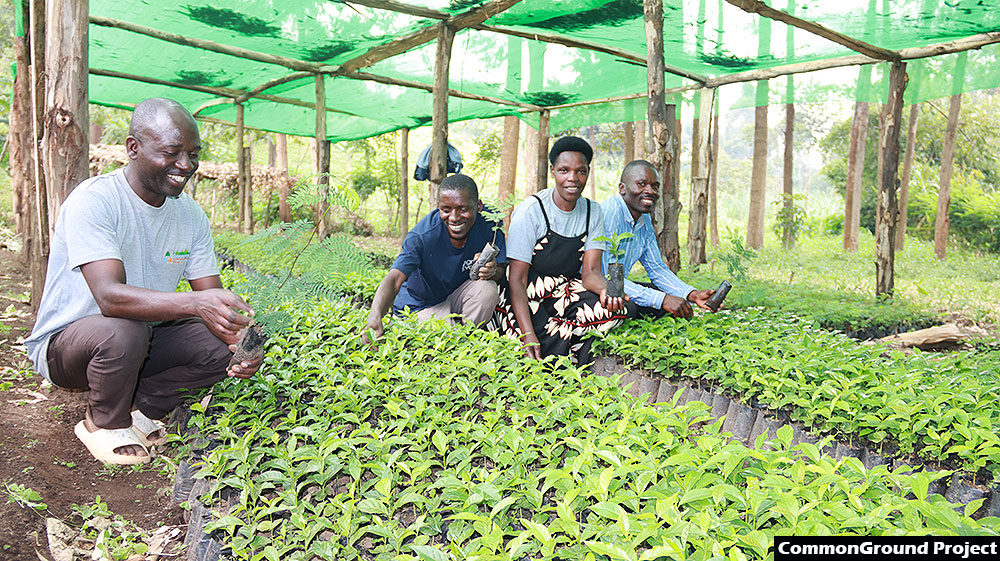
Community tree nursery beds have been established to ease access to tree seedlings
Restoring degraded land
Another issue that communities want to address, as indicated in their community PIPs/visions and plans is restoring the degraded highlands. At the forefront of this initiative is the Bukalasi restoration site located in Bukasali sub-county in Bududa district, where the community is restoring the degraded sites.
Fred Namukowa, a passionate resident, reveals that they have planted over 6,112 tree species, including Calliandra, Makamia, Musizi, Cordia, and Ficus. The trees are thriving, promising a greener future for the community.
“In the coming years, we hope to eliminate landslides in our community. The trenches we have established on the restoration site are already doing their job, controlling erosion effectively,” he says.
Namukowa adds that the grasses planted alongside these trenches not only stabilize the soil but also serve as fodder for their animals. This proactive approach reflects a deep-rooted commitment to environmental stewardship, showcasing how community-driven efforts can yield significant results. The same occurs in Nyambigha community, where, according to Kamuhanda, the grasses are also used for mulching.
Meanwhile, in the Nyakitokori community of the Ryakarimira Town Council in Kabale district, residents are restoring Ryabinegu and Rwebinegu slopes.
The hills were once lush and fertile. However, severe degradation, with soil erosion and fertility loss had taken a toll on the land. Water runoff pathways, originating from neglected woodlots, created gullies that threatened the integrity of the hills. This forced farmers to abandon upper and mid-slope farmlands, leaving only the lower slopes for cultivation.
However, with support of the CommonGround Project, community members collaboratively restored the hills.
A remarkable 12 retention ditches have been constructed per runoff waterway, with a minimum of 60 ditches established on each hill. This significantly reduced water runoff, capturing between 960 and 2,160 cubic metres of water from Ryabinegu and Rwebinegu hill, thus replenishing the soil and supporting the ecosystem.
Over 11,249 tree seedlings have been transplanted from the community nursery beds onto the restoration sites.
In total, 528 restoration sites were selected by the project and landowners. The community received training to undertake coordinated restoration activities.
Some 22 sub-watershed committees have been established or revamped with concrete action plans and with organized leadership structures. These committees ensured 309 sites are brought under sustainable management and the rest are being worked on.
The restoration sites are being managed sustainably through planting a variety of indigenous tree species, grasses, establishing trenches and water retention ditches.
In total 7,725 hectares of land are now under conservation practices. An additional 3,090 hectares of steep slopes are being stabilized against erosion with different sustainable land management practices.
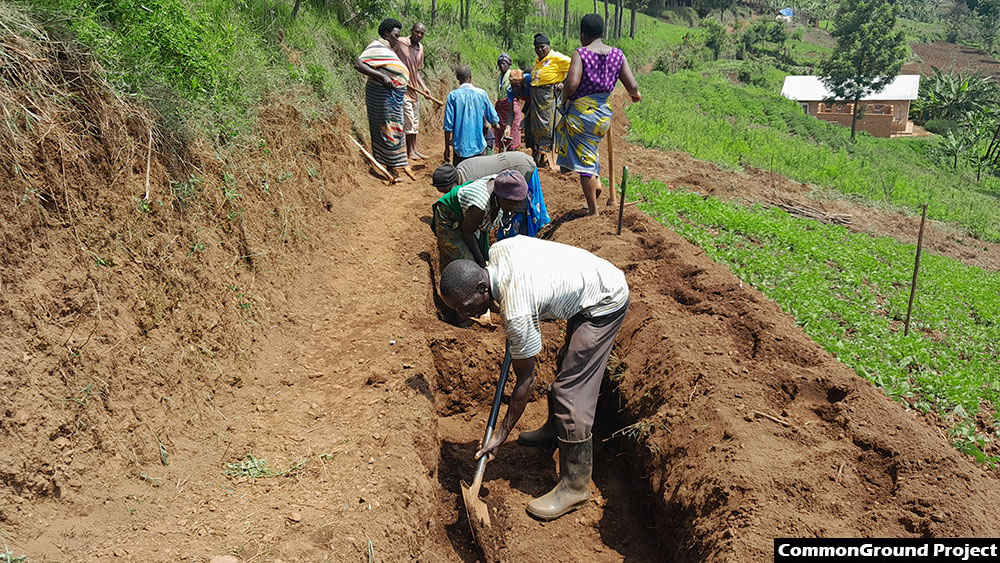
Community members digging trenches to prevent soil erosion in the hilly terrain
Better access to clean water has ripple effect
Another issue that Nyambigha community wanted to address is access to clean water.
"The project bought for the community three 10,000-litre water tanks that are now supplying clean water to over 110 households. Children now can go to school on time, and issues of violence in homes have also been controlled,” says Kamuhanda.
In total 360 investments have been made in the communities, including the provision of water tanks, but also the market structures amongst others, all based on the needs defined by the communities in their community PIPs/visions and plans.
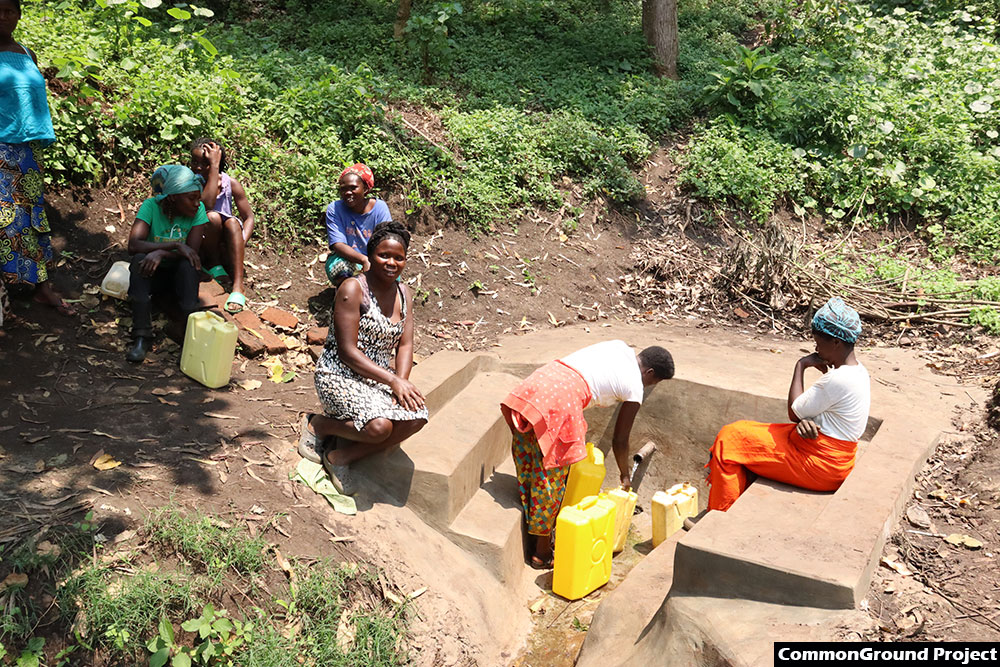
The project has supported the construction of water sources to control water borne diseases
Entrepreneurship, market linkages and finance
For many communities in the project, the major bottlenecks to market access include poor road infrastructure, a scarcity of markets, and limited access to finance.
To increase income in the communities, the project started providing holistic support to a broader range of farmer organizations to become sustainable, self-managed farmer economic organizations. These include;
▪️Village Savings and Loan Associations (VSLAs)
▪️ Entrepreneurial and Income-Generating Groups (IGPs)
▪️ Informal farmer groups that are transitioning toward formalization and commercialization
Nyambigha community has three farmer groups and each group has 15 members. Each group has received in kind support worth one million Ugandan shillings to buy animals and birds to boost the groups' incomes.
They were also supported to form VSLAs. There are three groups in the community, and they were also supported with complete VSLA kits. They also received training on governance, documentation practices, and internal accountability.
In general the group governance and organizational capacity of these farmer groups is being strengthened whilst entrepreneurship capacity is strengthened by supporting 150 farmer groups in developing comprehensive business plans, to make them more market-responsive and financially viable.
Targetted technical training has been delivered to 57 of these groups, focusing on production management, financial record-keeping, and the application of best indigenous practices. This holistic approach prepares them for active engagement in both input and output markets. The project supports linking farmer organizations to input and output market actors. These linkages address critical issues such as counterfeit inputs and inefficiencies in supply, transforming co-operatives into robust service hubs for their members.
Access to credit, another important bottleneck to accessing markets, is being addressed by the project farmer organizations and smallholder farmers, embedding practical knowledge and skills into local communities, and steering them towards professional, market-oriented operations. For this purpose, the project engages with financial institutions in strategic partnerships, through which 750 million Ugandan shillings has been mobilized.
This influx of working capital has empowered 159 smallholder farmers having access 189.6 million Ugandan shillings, averaging 1.19 million Ugandan shillings each for on-farm investments. But it also fortified the collective strength of co-operatives, enabling them to scale production and thrive in competitive markets.
With 278 VSLAs trained in savings and record-keeping, group management and financial discipline have been significantly strengthened. The provision of 100 full VSLA kits has further supported the consistent application of the VSLA methodology, ensuring the operational efficiency and sustainability of these savings groups.
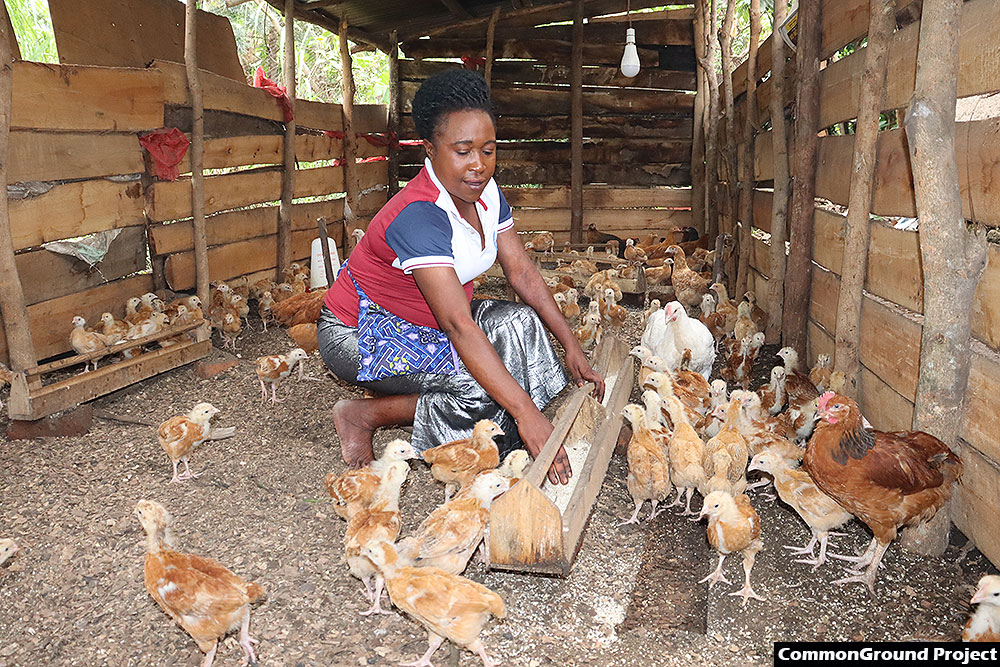
Households have been supported to start income-generating activities for income security
Success story
A success story of this transformative journey is the Abiniki Bomugusha Kwetungura Group in Kacerere ward, Nyakitokori community in Kabale district.
The group was formed in 2023nby 15 women who recognized the lucrative potential of fermented sorghum, which fetched 3,500 Ugandan shillings compared to 1,000 Ugandan shillings for ordinary sorghum.
The group decided to pool resources, each 100,000 Ugandan shillings raising1.5 million Ugandan shillings to kickstart their business, and investing in essential items like weighing scales, sacks, tarpaulin and the initial sorghum.
In June 2024, the CommonGround Project, in collaboration with the local council leadership, started training the group on business planning, visioning to help members assess their current situation, define a shared vision, and plan steps toward their desired future. They were supported to improve and align their record-keeping systems for better operational efficiency and they were also linked to financial institutions to explore options for financial support, including access to loans to scale up their business operations.
The Nyambigha community and many other communities are transforming to thriving communities that take control over their own lives by addressing the issues they face at household, community, environmental and market level.
This makes them resilient to better withstand shocks and stresses in the future.
_______________________