
2026 Best Farmers Competition starts
Ten regional winners will receive financial rewards and coveted study trips to the Netherlands
The overall winner of the 2025 Best Farmers Competition, Hood Kasirye Kiwana, at his farm
The 12th edition of the Best Farmers Competition will be unveiled today (Tuesday) at De Heus/Koudijs Animal Nutrition Plant in Njeru, Jinja district.
The deputy ambassador of the Embassy of the Kingdom of the Netherlands in Uganda, Bouwe-Jan Smeding, is scheduled to preside over the ceremony as the chief guest.
The New Vision Foundation Manager, John Eremu, yesterday indicated that this will be the first time the competition is being held under the newly established Vision Initiative for Sustainable Agriculture (VISA) framework.
The VISA programme comprises a consortium of carefully selected four partners: Vision Group (sponsor and implementing partner), ASIGMA Capital Advisory Services Limited, the Strategic Advisory and Research Consulting Limited (SARC) and EMSA Emerging Markets Africa, a Netherlands-based organisation.
The consortium will be coordinated by the New Vision Foundation, which is an independent charity and social enterprise arm of Vision Group.
“The competition signals a bold new chapter in Uganda’s journey from subsistence to commercial farming,” Eremu said in a statement.
The Embassy of the Kingdom of the Netherlands in Kampala, through a four-year grant totalling euro 1m (about sh4.148b), has been an outstanding sponsor of the initiative. The other sponsors of the programme include dfcu Bank, KLM Royal Dutch Airlines, De Heus/Koudijs Nutrition BV and Vision Group, Uganda’s leading media house.
Eremu said the 2026 competition will be under the theme: Farming as a Business; Growth, Commercialisation, and Cooperatives.
“It will see 13 most innovative farmers selected through a rigorous process by an independent jury and will win an all-expenses paid trip to the Netherlands and share prize money totalling sh150m,” he revealed.
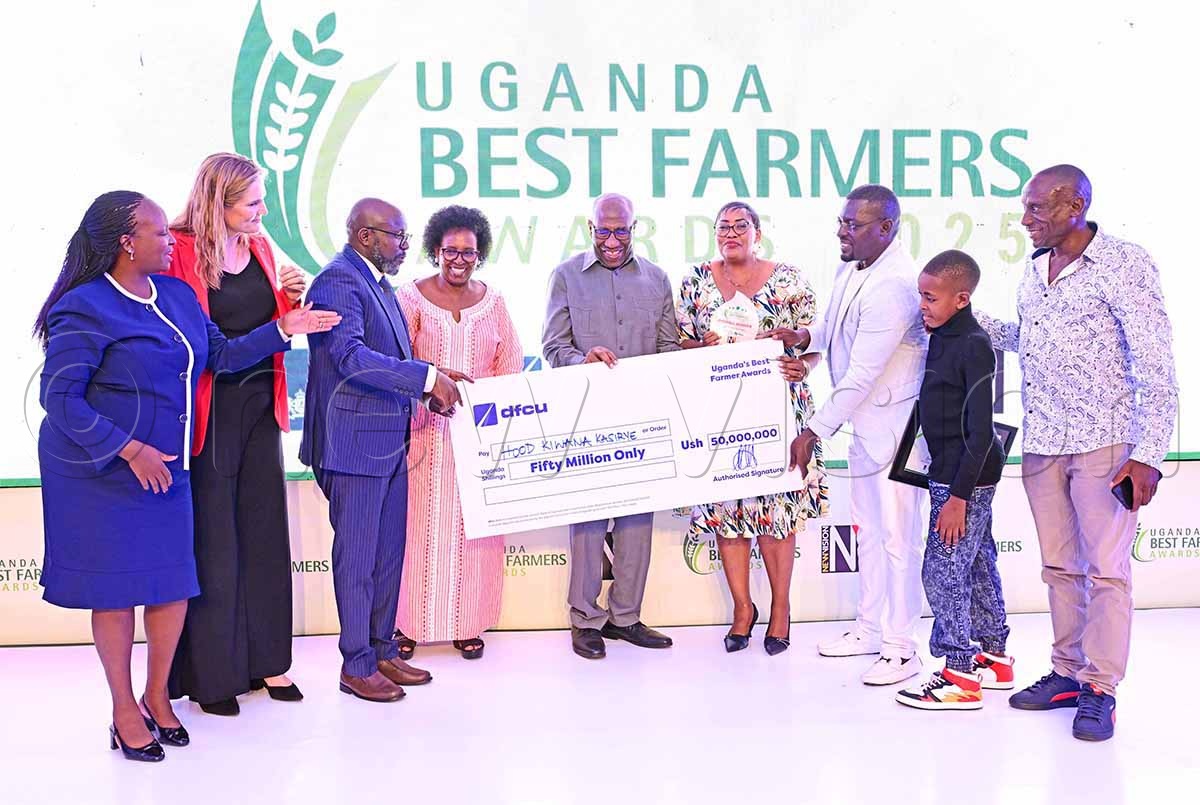
(L-R) dfcu Bank’s Annette Kiconco, former Netherlands Ambassador to Uganda Frederieke Quispel, Vision Group CEO Don Wanyama, Jocelyn Rugunda and husband ex-premier Dr Ruhakana Rugunda, hand over sh50m cheque to the overall winner of the 2025 Best Farmers Competition, Hood Kasirye Kiwana (3rd right) who was accompanied by family members during the award ceremony on December 10, 2025.
The Best Farmers Competition was initiated by Vision Group in 2014, and since its inception, it has become one of Uganda’s most respected initiatives for recognising excellence in agriculture.
Over the past 10 editions, missing only one year due to the COVID-19 pandemic lockdown in 2021, the competition has celebrated 124 winners across 10 sub-regions of the country.
“In 2026, the competition is going to be more ambitious than ever. A total of 13 winners will be selected: Ten regional winners will receive financial rewards and coveted study trips to the Netherlands. Three co-operatives will also earn the opportunity to travel to the Netherlands for a firsthand appreciation of world-class farming systems,” Eremu said.
One of the most significant developments in the 2026 edition, according to Eremu, is the expansion of the competition to include large-scale commercial farmers and agricultural cooperatives in addition to medium-scale and small-scale farmers, who have been the bedrock of the competition since its founding.
“The inclusion of large-scale farmers reflects the belief that exposing Uganda’s most capitalised farmers to global best practices, especially in the Netherlands, one of the world’s most productive agricultural nations, will yield transformative dividends for the sector at large,” Eremu said.
The eligibility criteria under this category include: Business being registered in Uganda, operated for at least five years, meeting all statutory and regulatory requirements, and certified organic farmers, where applicable.
Also, applicants must hold a Uganda National Bureau of Standards seal, must meet all good environmental/waste management practices, have no employment record of children in any of their production processes, and should have a robust anti-sexual harassment and exploitation policy.
The other qualification benchmarks are: if it is a coffee farmer, production must comply with European Union regulations and standards, must have a minimum investment of $272,000 (about sh1b), must be verified through financial records rather than declarations, and have a high level of mechanisation.
Those in poultry should be rearing over 50,000 chickens; dairy farmers should be producing at least 1,000 litres of milk per day; while piggery farmers should be able to breed at least 2,000 piglets a year.
The foundation stressed that medium and small-scale categories are the backbone of the competition for over a decade, adding that they remain central to the 2026 edition.
“These are established farmers with proven enterprises and the ambition to grow,” said Eremu.
Uganda is home to over 32,000 active agricultural cooperatives and associations, according to the agriculture ministry. “This category recognises their critical, yet underappreciated role in addressing the most stubborn challenges facing Ugandan smallholders,” Eremu stated.
The KLM country manager, Lukia Otema, said: “As an airline, we deeply recognise the indispensable role the farmers play. You feed our communities, support livelihoods, connect cultures through the products you grow and provide valuable cargo for our business.
We, therefore, remain committed to supporting initiatives that champion agricultural excellence and sustainability.”